Short term effects of temperature on risk of myocardial infarction in England and Wales: time series regression analysis of the Myocardial Ischaemia National Audit Project (MINAP) registry
- PMID: 20699305
- PMCID: PMC2919679
- DOI: 10.1136/bmj.c3823
Short term effects of temperature on risk of myocardial infarction in England and Wales: time series regression analysis of the Myocardial Ischaemia National Audit Project (MINAP) registry
Abstract
Objective: To examine the short term relation between ambient temperature and risk of myocardial infarction.
Design: Daily time series regression analysis.
Setting: 15 conurbations in England and Wales.
Participants: 84,010 hospital admissions for myocardial infarction recorded in the Myocardial Ischaemia National Audit Project during 2003-6 (median 57 events a day).
Main outcome measures: Change in risk of myocardial infarction associated with a 1 degrees C difference in temperature, including effects delayed by up to 28 days.
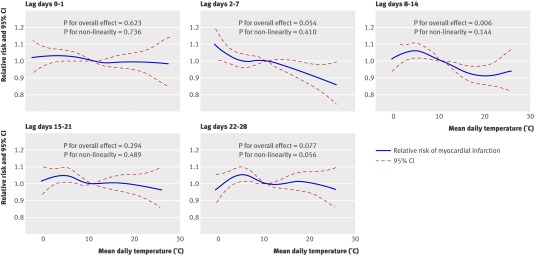
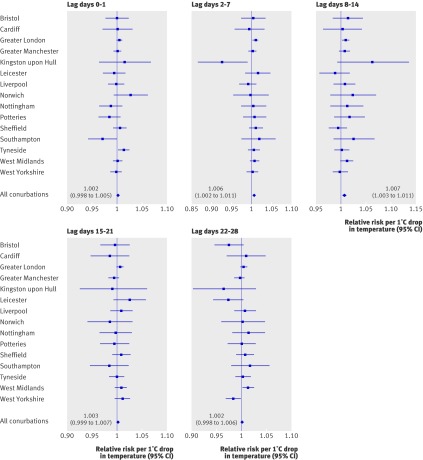
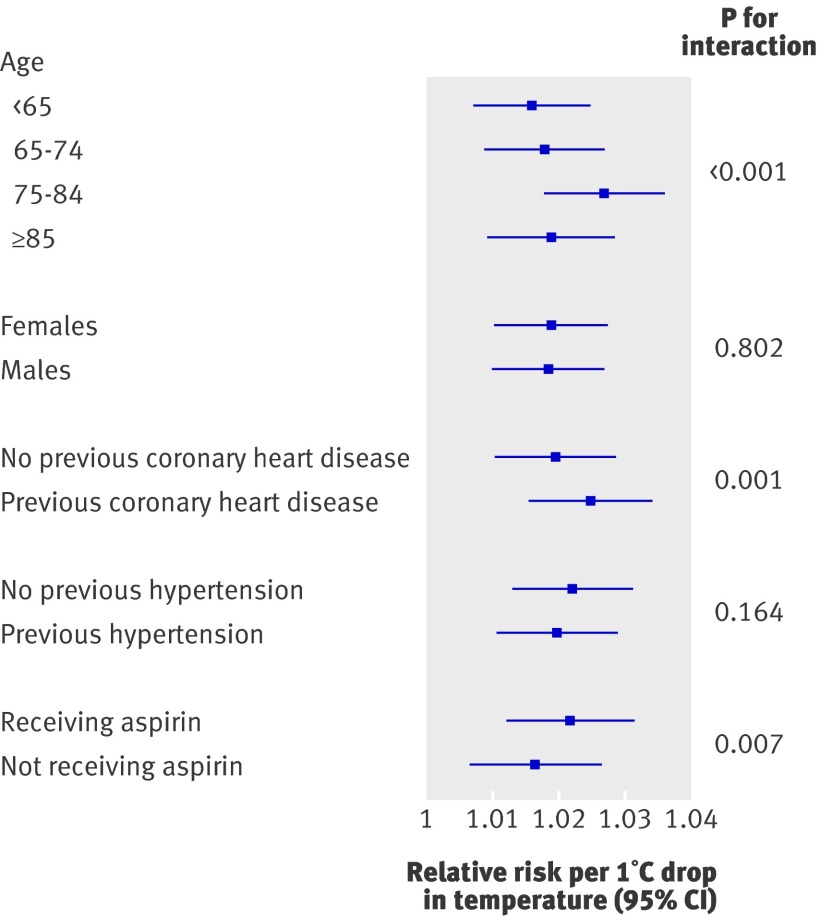
Results: Smoothed graphs revealed a broadly linear relation between temperature and myocardial infarction, which was well characterised by log-linear models without a temperature threshold: each 1 degrees C reduction in daily mean temperature was associated with a 2.0% (95% confidence interval 1.1% to 2.9%) cumulative increase in risk of myocardial infarction over the current and following 28 days, the strongest effects being estimated at intermediate lags of 2-7 and 8-14 days: increase per 1 degrees C reduction 0.6% (95% confidence interval 0.2% to 1.1%) and 0.7% (0.3% to 1.1%), respectively. Heat had no detrimental effect. Adults aged 75-84 and those with previous coronary heart disease seemed more vulnerable to the effects of cold than other age groups (P for interaction 0.001 or less in each case), whereas those taking aspirin were less vulnerable (P for interaction 0.007).
Conclusions: Increases in risk of myocardial infarction at colder ambient temperatures may be one driver of cold related increases in overall mortality, but an increased risk of myocardial infarction at higher temperatures was not detected. The risk of myocardial infarction in vulnerable people might be reduced by the provision of targeted advice or other interventions, triggered by forecasts of lower temperature.
Conflict of interest statement
Competing interests: All authors have completed the unified competing interest form at
Figures
Comment in
-
Temperature changes and the risk of cardiac events.BMJ. 2010 Aug 10;341:c3720. doi: 10.1136/bmj.c3720. BMJ. 2010. PMID: 20699304 No abstract available.
References
-
- Curriero FC, Heiner KS, Samet JM, Zeger SL, Strug L, Patz JA. Temperature and mortality in 11 cities of the eastern United States. Am J Epidemiol 2002;155:80-7. - PubMed
-
- Baccini M, Biggeri A, Accetta G, Kosatsky T, Katsouyanni K, Analitis A, et al. Heat effects on mortality in 15 European cities. Epidemiology 2008;19:711-9. - PubMed
-
- McMichael AJ, Wilkinson P, Kovats RS, Pattenden S, Hajat S, Armstrong B, et al. International study of temperature, heat and urban mortality: the ‘ISOTHURM’ project. Int J Epidemiol 2008;37:1121-31. - PubMed
-
- Analitis A, Katsouyanni K, Biggeri A, Baccini M, Forsberg B, Bisanti L, et al. Effects of cold weather on mortality: results from 15 European cities within the PHEWE project. Am J Epidemiol 2008;168:1397-408. - PubMed
Publication types
MeSH terms
Grants and funding
LinkOut - more resources
Full Text Sources
Medical