. 2010 Oct;154(2):810-9.
doi: 10.1104/pp.110.161109. Epub 2010 Aug 10.

Nitric oxide acts downstream of auxin to trigger root ferric-chelate reductase activity in response to iron deficiency in Arabidopsis

Affiliations

Nitric oxide acts downstream of auxin to trigger root ferric-chelate reductase activity in response to iron deficiency in Arabidopsis

Wei Wei Chen et al. Plant Physiol. 2010 Oct.

Abstract

In response to iron (Fe) deficiency, dicots employ a reduction-based mechanism by inducing ferric-chelate reductase (FCR) at the root plasma membrane to enhance Fe uptake. However, the signal pathway leading to FCR induction is still unclear. Here, we found that the Fe-deficiency-induced increase of auxin and nitric oxide (NO) levels in wild-type Arabidopsis (Arabidopsis thaliana) was accompanied by up-regulation of root FCR activity and the expression of the basic helix-loop-helix transcription factor (FIT) and the ferric reduction oxidase 2 (FRO2) genes. This was further stimulated by application of exogenous auxin (α-naphthaleneacetic acid) or NO donor (S-nitrosoglutathione [GSNO]), but suppressed by either polar auxin transport inhibition with 1-naphthylphthalamic acid or NO scavenging with 2-(4-carboxyphenyl)-4,4,5,5-tetramethylimidazoline-1-oxyl-3-oxide, tungstate, or N(ω)-nitro-L-arginine methyl ester hydrochloride. On the other hand, the root FCR activity, NO level, and gene expression of FIT and FRO2 were higher in auxin-overproducing mutant yucca under Fe deficiency, which were sharply restrained by 2-(4-carboxyphenyl)-4,4,5,5-tetramethylimidazoline-1-oxyl-3-oxide treatment. The opposite response was observed in a basipetal auxin transport impaired mutant aux1-7, which was slightly rescued by exogenous GSNO application. Furthermore, Fe deficiency or α-naphthaleneacetic acid application failed to induce Fe-deficiency responses in noa1 and nial nia2, two mutants with reduced NO synthesis, but root FCR activities in both mutants could be significantly elevated by GSNO. The inability to induce NO burst and FCR activity was further verified in a double mutant yucca noa1 with elevated auxin production and reduced NO accumulation. Therefore, we presented a novel signaling pathway where NO acts downstream of auxin to activate root FCR activity under Fe deficiency in Arabidopsis.


Figures
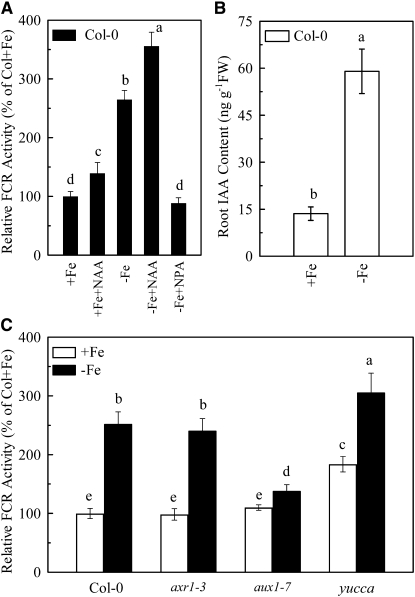
Figure 1.
Figure 1.
Effect of auxin availability on the induction of FCR activity and accumulation of IAA in −Fe roots. A, Relative FCR activity of +Fe or −Fe wild-type plants in the presence or absence of 0.08 μm NAA or 10 μm NPA. B, IAA content in −Fe roots of wild-type plants. FW, Fresh weight. C, Relative FCR activity of three auxin mutant lines in response to −Fe treatment. Means ± sd (n = 7 for FCR activity, n = 3 for auxin content) followed by different letters indicate a statistical difference at P < 0.05.
Figure 2.
Figure 2.
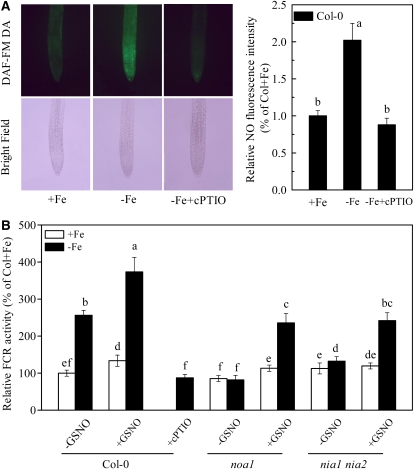
Effect of Fe-deficiency-induced NO on the induction of root FCR activity. A, NO production shown as green fluorescence and relative fluorescence intensity from DAF-FMDA in roots of wild-type plants under +Fe, −Fe, or −Fe + cPTIO treatment, respectively. B, Relative FCR activity in roots of wild-type and NO-related mutants (noa1 and nia1 nia2) in response to exogenous NO treatments. GSNO (50 μm) was added to both +Fe and −Fe plants, while cPTIO (0.5 mm) was only added to −Fe wild-type plants. Means ± sd (n = 10 for NO production, n = 7 for FCR activity) followed by different letters indicate a statistical difference at P < 0.05.
Figure 3.
Figure 3.
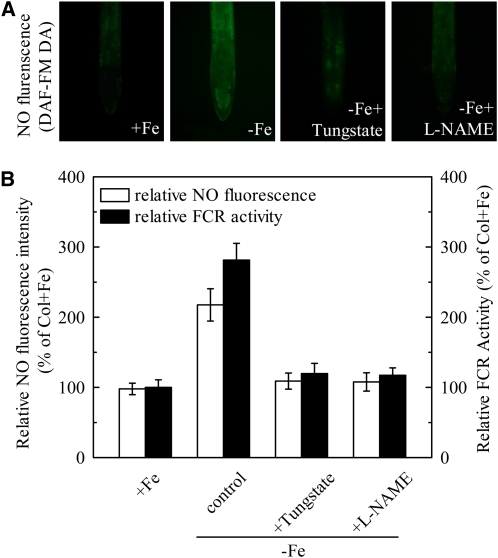
Involvement of NR and NO synthase-type enzyme (NOA1) in NO production and FCR induction during Fe deficiency. Wild-type Arabidopsis plants were grown in +Fe media for 6 weeks and then transferred to −Fe media in the presence of the NR inhibitor, tungstate (1 mm), and the NOA inhibitor, l-NAME (1 mm) or without any treatment (control). A, The NO production as DAF-FMDA fluorescence detected in roots of wild type. B, The corresponding fluorescence intensity of NO and FCR activity in roots under treatments as described. Data are expressed as means ± sd (n = 10 for NO production, n = 7 for FCR activity).
Figure 4.
Figure 4.
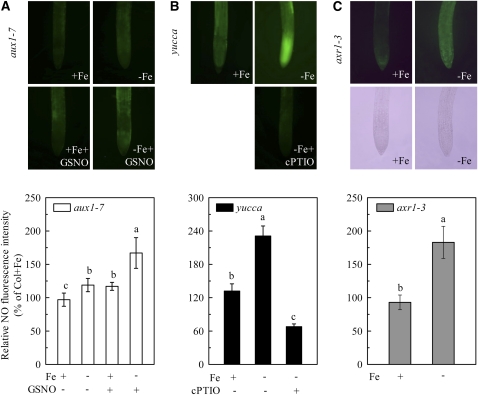
Effect of auxin on NO accumulation in roots of three auxin-related mutants during Fe deficiency. A, NO green fluorescence and the corresponding relative fluorescence intensity in +Fe and −Fe roots of aux1-7 plants treated with 50 μm GSNO. B, NO green fluorescence and the corresponding relative fluorescence intensity in roots of yucca plants under treatments of +Fe, −Fe, and −Fe + cPTIO (0.5 mm), respectively. C, NO green fluorescence and the corresponding relative fluorescence intensity in +Fe and −Fe roots of yucca plants. Means ± sd (n = 10) with different letters indicate significant differences at P < 0.05.
Figure 5.
Figure 5.
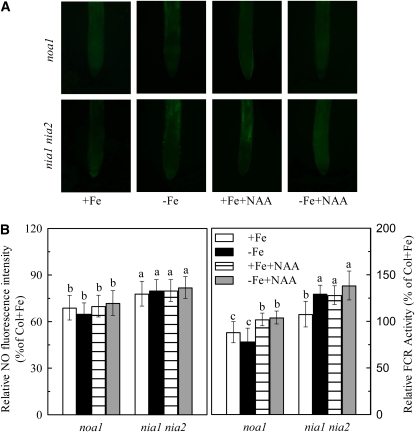
Effect of auxin on NO accumulation in roots of two NO-related mutants, noa1 and nia1nia2. A, NO green fluorescence, and the corresponding NO fluorescence intensity and relative FCR activity (B) in +Fe or −Fe roots of mutants noa1 and nia1nia2 in response to 0.08 μm NAA treatment. Data are expressed as means ± sd (n = 10 for NO production, n = 7 for FCR activity) with different letters indicating significant differences at P < 0.05.
Figure 6.
Figure 6.
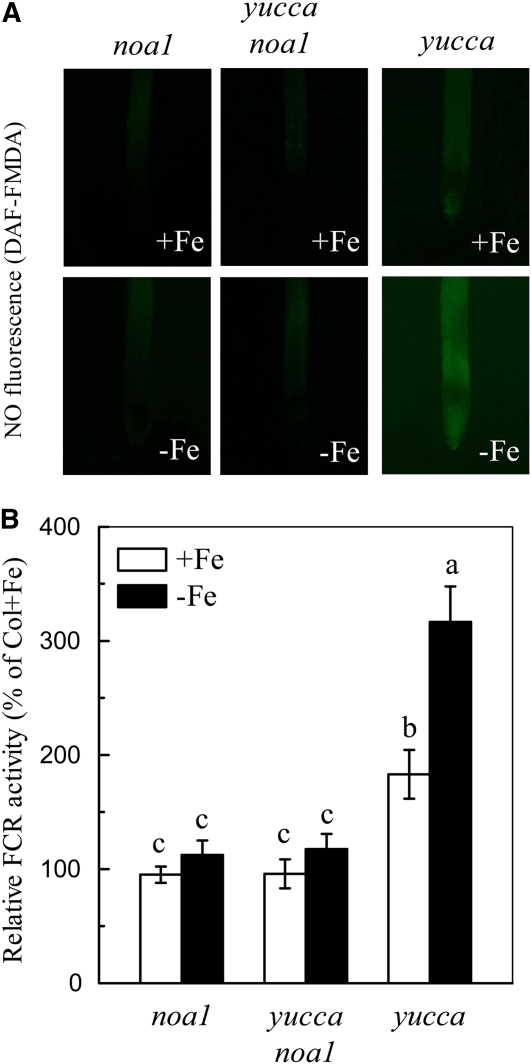
Physiological analysis of NO burst and FCR induction in yucca noa1 double mutant grown under Fe deficiency. A, NO green fluorescence, and the relative FCR activity (B) in roots of yucca noa1 double mutant after exposed to +Fe or −Fe media for 7 d. Means ± sd is shown (n = 9) with different letters suggesting a statistical difference (P < 0.05) between these two treatments.
Figure 7.
Figure 7.
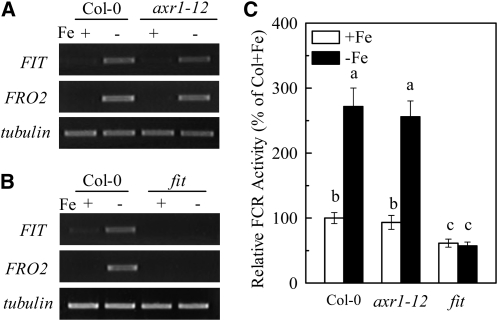
Role of Fe deficiency in regulating expression levels of FIT and FRO2 genes and FCR activation in roots of axr1-12 and fit mutant lines. Six-week-old plants were transferred to +Fe or −Fe media for a further 7 d, and then the expression of FIT and FRO2 genes (A and B) was analyzed. Total RNA extracted from roots and the transcript level was analyzed by RT-PCR with tubulin β-3 expression as a control. Relative FCR activity (C) was conducted as well. Means ± sd are shown (n = 7). Different letters indicate a significant difference (P < 0.05) among the treatments.
Figure 8.
Figure 8.
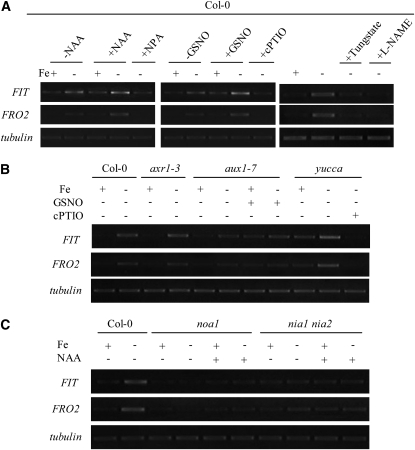
Role of auxin and NO in regulating expression levels of FIT and FRO2 in −Fe roots of wild-type seedlings and several auxin or NO-related mutant lines. Six-week-old Arabidopsis plants were transferred to −Fe conditions for different treatments. A, Expression of FIT and FRO2 genes in +Fe or −Fe roots of wild-type plants treated with exogenous auxin, NO, or NR/NOA1 inhibitors. B, Expression of FIT and FRO2 genes in +Fe or −Fe roots of three auxin-related mutants treated with exogenous NO. C, Expression of both genes in +Fe or −Fe roots of two NO-related mutants treated with NAA. Total RNA was extracted from roots and the mRNA level was analyzed by RT-PCR. tubulin β-3 expression was used as a control.
Figure 9.
Figure 9.
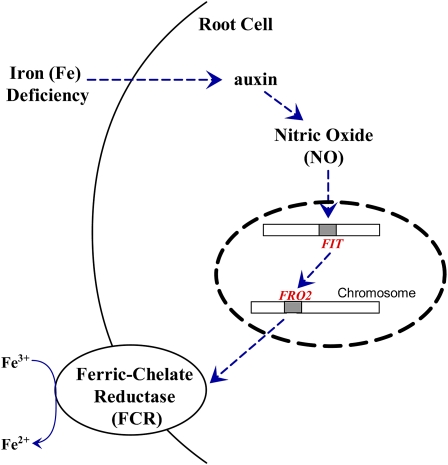
Schematic model of hoe NO operates downstream of auxin in the transduction of Fe-deficiency sensing to induce FCR activity in Arabidopsis roots. Fe deficiency could increase auxin levels in roots with the subsequent induction of NO accumulation. This enhanced NO signal then activates FCR activity via FIT-mediated transcriptional regulation of FRO2, which results in the increased accumulation of Fe in response to low plant Fe status. Dashed arrows denote regulatory pathways. [See online article for color version of this figure.]

References

    1. Besson-Bard A, Gravot A, Richaud P, Auroy P, Duc C, Gaymard F, Taconnat L, Renou JP, Pugin A, Wendehenne D. (2009) Nitric oxide contributes to cadmium toxicity in Arabidopsis by promoting cadmium accumulation in roots and by up-regulating genes related to iron uptake. Plant Physiol 149: 1302–1315 - PMC - PubMed
    1. Bright J, Desikan R, Hancock JT, Weir IS, Neill SJ. (2006) ABA induced NO generation and stomatal closure in Arabidopsis are dependent on H2O2 synthesis. Plant J 45: 113–122 - PubMed
    1. Chaney RL, Brown JC, Tiffin LO. (1972) Obligatory reduction of ferric chelates in iron uptake by soybeans. Plant Physiol 50: 208–213 - PMC - PubMed
    1. Connolly EL, Campbell NH, Grotz N, Prichard CL, Guerinot ML. (2003) Overexpression of the FRO2 ferric chelate reductase confers tolerance to growth on low iron and uncovers posttranscriptional control. Plant Physiol 133: 1102–1110 - PMC - PubMed
    1. Curie C, Briat JF. (2003) Iron transport and signaling in plants. Annu Rev Plant Biol 54: 183–206 - PubMed

Publication types

MeSH terms

LinkOut - more resources