. 2010 Sep-Oct;4(5):390-7.
doi: 10.4161/chan.4.5.13006. Epub 2010 Sep 1.

Random mutagenesis screening indicates the absence of a separate H(+)-sensor in the pH-sensitive Kir channels

Affiliations

Random mutagenesis screening indicates the absence of a separate H(+)-sensor in the pH-sensitive Kir channels

Jennifer J Paynter et al. Channels (Austin). 2010 Sep-Oct.

Abstract

Several inwardly-rectifying (Kir) potassium channels (Kir1.1, Kir4.1 and Kir4.2) are characterised by their sensitivity to inhibition by intracellular H(+) within the physiological range. The mechanism by which these channels are regulated by intracellular pH has been the subject of intense scrutiny for over a decade, yet the molecular identity of the titratable pH-sensor remains elusive. In this study we have taken advantage of the acidic intracellular environment of S. cerevisiae and used a K(+) -auxotrophic strain to screen for mutants of Kir1.1 with impaired pH-sensitivity. In addition to the previously identified K80M mutation, this unbiased screening approach identified a novel mutation (S172T) in the second transmembrane domain (TM2) that also produces a marked reduction in pH-sensitivity through destabilization of the closed-state. However, despite this extensive mutagenic approach, no mutations could be identified which removed channel pH-sensitivity or which were likely to act as a separate H(+) -sensor unique to the pH-sensitive Kir channels. In order to explain these results we propose a model in which the pH-sensing mechanism is part of an intrinsic gating mechanism common to all Kir channels, not just the pH-sensitive Kir channels. In this model, mutations which disrupt this pH-sensor would result in an increase, not reduction, in pH-sensitivity. This has major implications for any future studies of Kir channel pH-sensitivity and explains why formal identification of these pH-sensing residues still represents a major challenge.


Figures
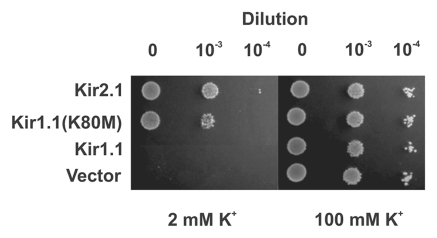
Figure 1
Figure 1
Growth complementation by pH-insensitive Kir channels. The pH-sensitive wild-type Kir1.1 channel does not complement the growth of K+-auxotrophic S. cerevisiae (SGY1528) on low [K+] media (2 mM KCl) presumably due to the low intracellular pH found in yeast. However, the pH-insensitive channel Kir2.1 and the mutant Kir1.1(K80M) channels both complement growth well. In all cases the strains can grow well on high 100 mM [K+] (right hand part). The control vector is the parental pYES-2m.
Figure 2
Figure 2
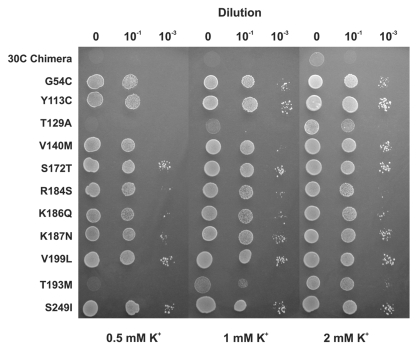
Random mutagenesis identifies activatory mutations. By screening a randomly mutated library of the 30C chimeric channel on low [K+] growth media, 11 unique activatory mutations were identified which complemented growth. All except the S249I mutation were located in the Kir1.1 section of the chimera.
Figure 3
Figure 3
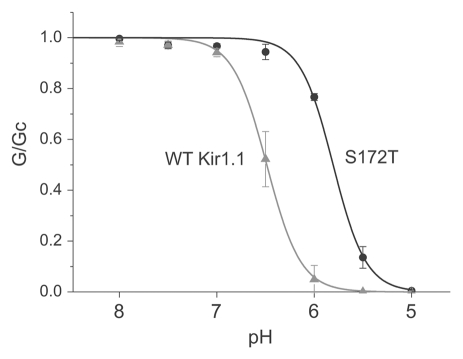
Reduced pH-sensitivity in the Kir1.1 S172T mutation. Measurement of the pH-sensitivity of the S172T mutation in giant excised patches from Xenopus oocytes. The S172T mutation markedly reduces channel pH-sensitivity (IC50 = 5.8 ± 0.1) compared to wild-type Kir1.1 (IC50 = 6.5 ± 0.1).
Figure 4
Figure 4
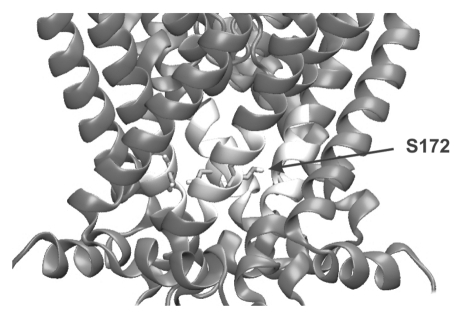
S172 Residue located close to the helix-bundle crossing. The S172 is located close to the bottom of TM2 and to the adjacent TM2 helix in the closed state homology model of Kir1.1., The TM2 segment containing the S172 residue is shown in white for clarity and the S172 residue is shown as a stick. Opening of the channel involves movement of the TM2 helices and the S172T mutation may reduce pH-sensitivity either by destabilizing the closed state or forming additional interactions in the open state.
Figure 5
Figure 5
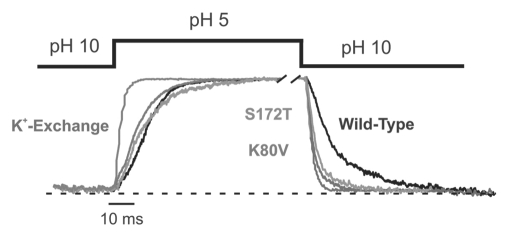
Destabilization of the closed state by S172T mutation. Time course of pH gating for wild-type and mutant Kir1.1 channels induced by changes in the intracellular pH. Solution exchange was done using a fast piezo-driven application system. Currents for the different channels were equalized for better comparison. The time course of wild-type Kir1.1 currents upon K+ exchange (replacement with Na+ measured at +40 mV) are shown in gray and superimposed on the pH gating time course obtained in the same patch. This demonstrates the maximal temporal resolution of the application system. The pH-inhibition of wild-type Kir1.1 is shown in black, Kir1.1-K80V in red, and the S172T in green. Both the K80V and S172T mutant channels show a faster rate of recovery from inhibition, i.e., faster off rate which reflects a destabilization of the closed state. The values for on and off rates are shown in Table 2. The dotted line represents the zero current level. For color, see online publication.
Figure 6
Figure 6
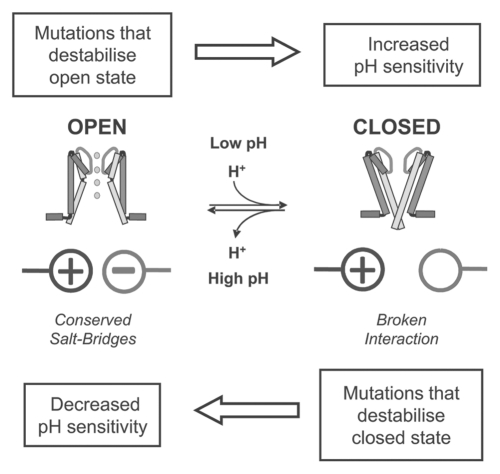
A putative model for Kir channel pH-sensitivity. The model proposes that all Kir channels possess a low intrinsic pH-sensitivity and that this pH-sensitivity is due to titration of one or more salt-bridges in the intracellular domains that stabilize the channel in the open-state. Low pH probably involves titration of carboxylic acid groups to break these stabilizing interactions. Differences in Kir channel pH-sensitivity (i.e., shifting this equilibrium) can therefore arise by altering the relative stability of the open and closed states rather than the presence of additional H+ sensors. The model proposes that direct mutation of the H+-sensing residues will destabilize the open state and therefore result in an increase, not decrease in pH-sensitivity. In some cases this alkaline shift may be so extreme as to produce a non-functional channel. Any other mutations that indirectly destabilize the open state will also result in an increase in pH-sensitivity. In order to decrease channel pH-sensitivity requires mutation of residues which stabilize the closed state or the creation of novel interactions which stabilize the open state.

References

    1. Bichet D, Haass FA, Jan LY. Merging functional studies with structures of inward-rectifier K+ channels. Nat Rev Neurosci. 2003;4:957–967. - PubMed
    1. Hibino H, Inanobe A, Furutani K, Murakami S, Findlay I, Kurachi Y. Inwardly rectifying potassium channels: their structure, function and physiological roles. Physiol Rev. 2010;90:291–366. - PubMed
    1. Schulte U, Fakler B. Gating of inward-rectifier K+ channels by intracellular pH. Eur J Biochem. 2000;267:5837–5841. - PubMed
    1. Hebert SC. Bartter syndrome. Curr Opin Nephrol Hypertens. 2003;12:527–532. - PubMed
    1. Scholl UI, Choi M, Liu T, Ramaekers VT, Hausler MG, Grimmer J, et al. Seizures, sensorineural deafness, ataxia, mental retardation and electrolyte imbalance (SeSAME syndrome) caused by mutations in KCNJ10. Proc Natl Acad Sci USA. 2009;106:5842–5847. - PMC - PubMed

Publication types

MeSH terms

Substances

LinkOut - more resources