


Genetic diversity on the Comoros Islands shows early seafaring as major determinant of human biocultural evolution in the Western Indian Ocean
- PMID: 20700146
- PMCID: PMC3039498
- DOI: 10.1038/ejhg.2010.128
Genetic diversity on the Comoros Islands shows early seafaring as major determinant of human biocultural evolution in the Western Indian Ocean
Abstract
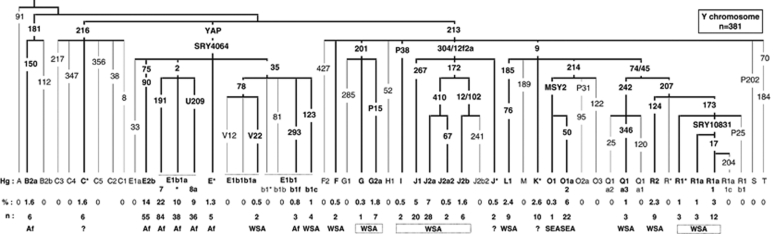
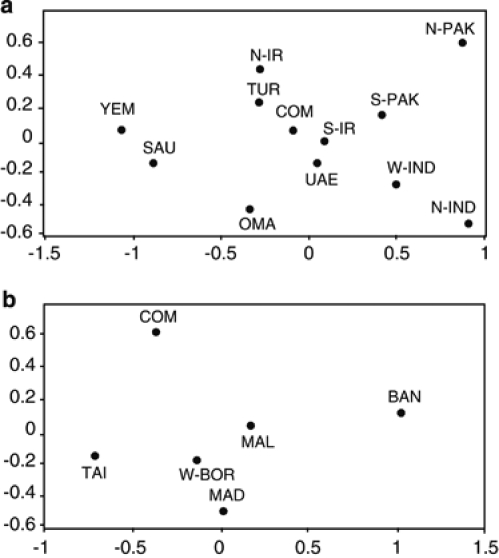
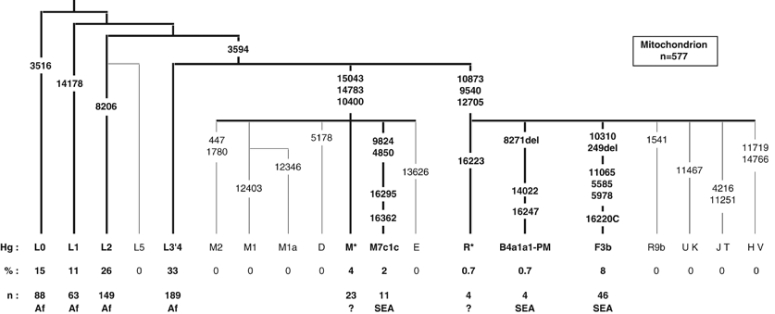
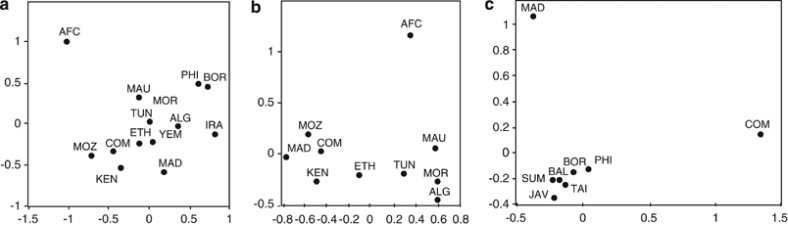
The Comoros Islands are situated off the coast of East Africa, at the northern entrance of the channel of Mozambique. Contemporary Comoros society displays linguistic, cultural and religious features that are indicators of interactions between African, Middle Eastern and Southeast Asian (SEA) populations. Influences came from the north, brought by the Arab and Persian traders whose maritime routes extended to Madagascar by 700-900 AD. Influences also came from the Far East, with the long-distance colonisation by Austronesian seafarers that reached Madagascar 1500 years ago. Indeed, strong genetic evidence for a SEA, but not a Middle Eastern, contribution has been found on Madagascar, but no genetic trace of either migration has been shown to exist in mainland Africa. Studying genetic diversity on the Comoros Islands could therefore provide new insights into human movement in the Indian Ocean. Here, we describe Y chromosomal and mitochondrial genetic variation in 577 Comorian islanders. We have defined 28 Y chromosomal and 9 mitochondrial lineages. We show the Comoros population to be a genetic mosaic, the result of tripartite gene flow from Africa, the Middle East and Southeast Asia. A distinctive profile of African haplogroups, shared with Madagascar, may be characteristic of coastal sub-Saharan East Africa. Finally, the absence of any maternal contribution from Western Eurasia strongly implicates male-dominated trade and religion as the drivers of gene flow from the North. The Comoros provides a first view of the genetic makeup of coastal East Africa.
Figures
References
-
- Beaujard P. The Indian Ocean in Eurasian and African World-Systems before the Sixteenth Century. J World Hist. 2005;16:411–465.
-
- Chaudhuri KN. Trade and Civilisation in the Indian Ocean: An Economic History from the Rise of Islam to 1750. Cambridge: Cambridge University Press; 1985.
-
- Allibert C. Le mot ‘ KOMR' dans l'océan indien. Etudes Océan Indien. 2001;31:13–33.
-
- Blench R.The ethnographic evidence for long-distance contacts between Oceania and East Africain Reade J (ed).: The Indian Ocean in Antiquity London, New York: Kegan Paul, British Museum; 1994461–470.
Publication types
MeSH terms
Substances
LinkOut - more resources
Full Text Sources
