Bim nuclear translocation and inactivation by viral interferon regulatory factor
- PMID: 20700448
- PMCID: PMC2916877
- DOI: 10.1371/journal.ppat.1001031
Bim nuclear translocation and inactivation by viral interferon regulatory factor
Abstract
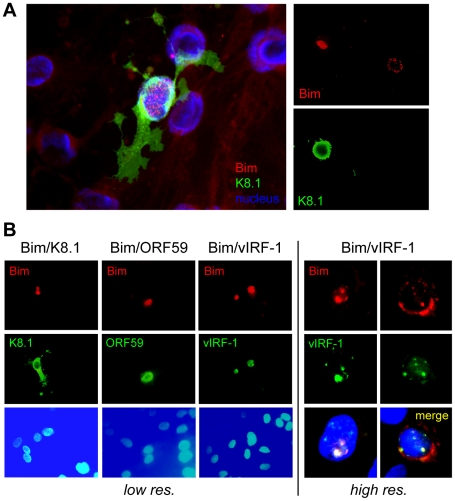
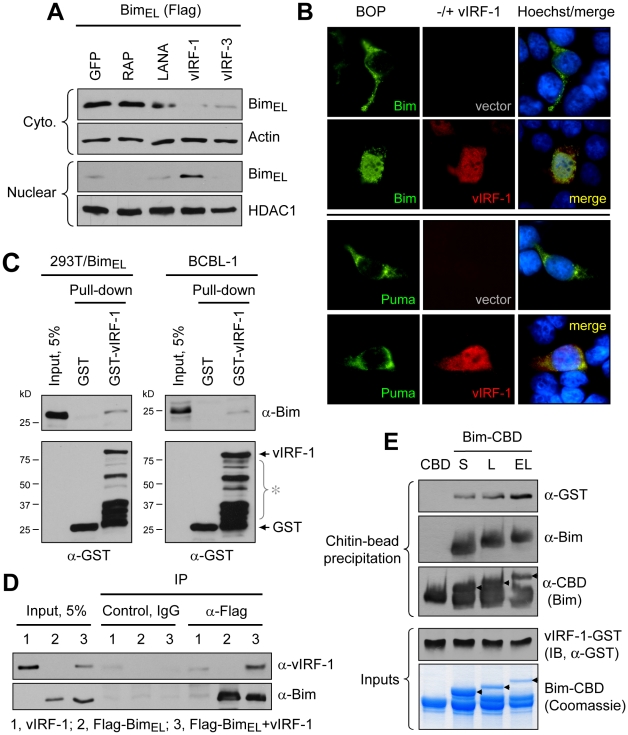
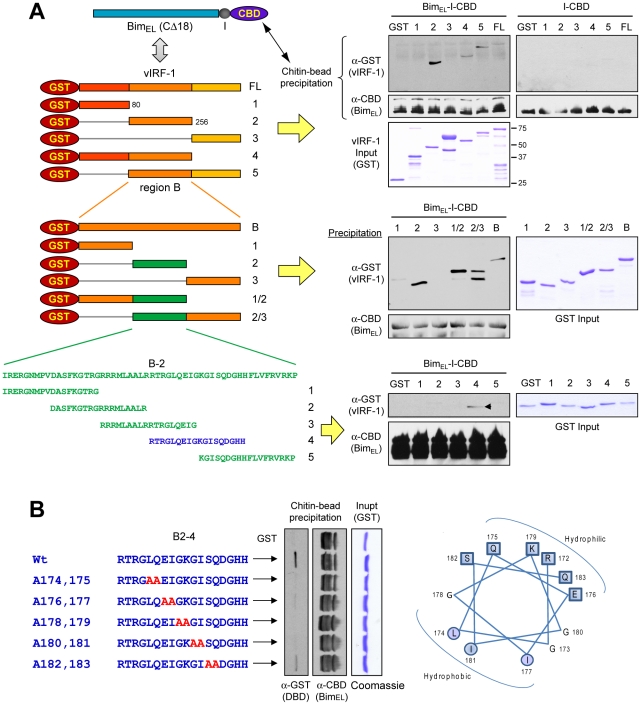
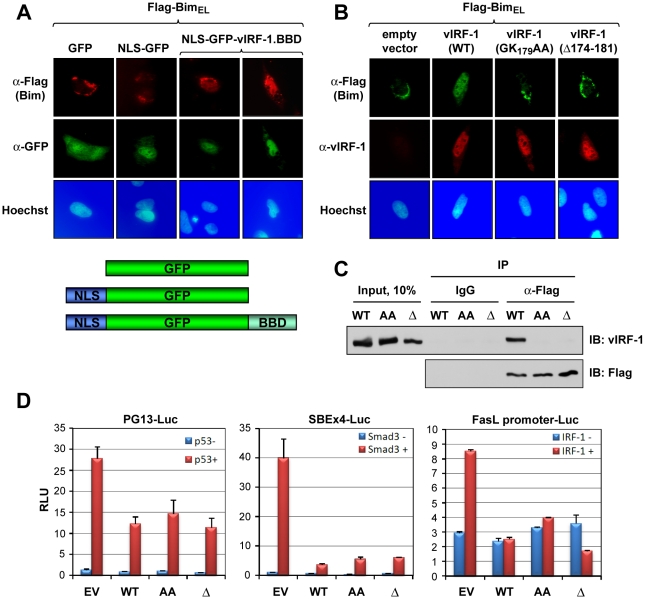
Viral replication efficiency is in large part governed by the ability of viruses to counteract pro-apoptotic signals induced by infection of the host cell. Human herpesvirus 8 (HHV-8) uses several strategies to block the host's innate antiviral defenses via interference with interferon and apoptotic signaling. Contributors include the four viral interferon regulatory factors (vIRFs 1-4), which function in dominant negative fashion to block cellular IRF activities in addition to targeting IRF signaling-induced proteins such as p53 and inhibiting other inducers of apoptosis such as TGFbeta receptor-activated Smad transcription factors. Here we identify direct targeting by vIRF-1 of BH3-only pro-apoptotic Bcl-2 family member Bim, a key negative regulator of HHV-8 replication, to effect its inactivation via nuclear translocation. vIRF-1-mediated relocalization of Bim was identified in transfected cells, by both immunofluorescence assay and western analysis of fractionated cell extracts. Also, co-localization of vIRF-1 and Bim was detected in nuclei of lytically infected endothelial cells. In vitro co-precipitation assays using purified vIRF-1 and Bim revealed direct interaction between the proteins, and Bim-binding residues of vIRF-1 were mapped by deletion and point mutagenesis. Generation and experimental utilization of Bim-refractory vIRF-1 variants revealed the importance of vIRF-1:Bim interaction, specifically, in pro-replication and anti-apoptotic activity of vIRF-1. Furthermore, blocking of the interaction with cell-permeable peptide corresponding to the Bim-binding region of vIRF-1 confirmed the relevance of vIRF-1:Bim association to vIRF-1 pro-replication activity. To our knowledge, this is the first report of an IRF protein that interacts with a Bcl-2 family member and of nuclear sequestration of Bim or any other member of the family as a means of inactivation. The data presented reveal a novel mechanism utilized by a virus to control replication-induced apoptosis and suggest that inhibitory targeting of vIRF-1:Bim interaction may provide an effective antiviral strategy.
Conflict of interest statement
The authors have declared that no competing interests exist.
Figures
References
-
- Carbone A, Gloghini A, Vaccher E, Zagonel V, Pastore C, et al. Kaposi's sarcoma-associated herpesvirus DNA sequences in AIDS-related and AIDS-unrelated lymphomatous effusions. Br J Haematol. 1996;94:533–543. - PubMed
-
- Soulier J, Grollet L, Oksenhendler E, Cacoub P, Cazals-Hatem D, et al. Kaposi's sarcoma-associated herpesvirus-like DNA sequences in multicentric Castleman's disease. Blood. 1995;86:1276–1280. - PubMed
-
- Arvanitakis L, Mesri EA, Nador RG, Said JW, Asch AS, et al. Establishment and characterization of a primary effusion (body cavity-based) lymphoma cell line (BC-3) harboring kaposi's sarcoma-associated herpesvirus (KSHV/HHV-8) in the absence of Epstein-Barr virus. Blood. 1996;88:2648–2654. - PubMed
-
- Nicholas J. Human herpesvirus 8-encoded proteins with potential roles in virus-associated neoplasia. Front Biosci. 2007;12:265–281. - PubMed
-
- Gao SJ, Boshoff C, Jayachandra S, Weiss RA, Chang Y, et al. KSHV ORF K9 (vIRF) is an oncogene which inhibits the interferon signaling pathway. Oncogene. 1997;15:1979–1985. - PubMed
Publication types
MeSH terms
Substances
Grants and funding
LinkOut - more resources
Full Text Sources
Research Materials
Miscellaneous