


The quadruple squeeze: defining the safe operating space for freshwater use to achieve a triply green revolution in the anthropocene
- PMID: 20701182
- PMCID: PMC2890077
- DOI: 10.1007/s13280-010-0033-4
The quadruple squeeze: defining the safe operating space for freshwater use to achieve a triply green revolution in the anthropocene
Abstract
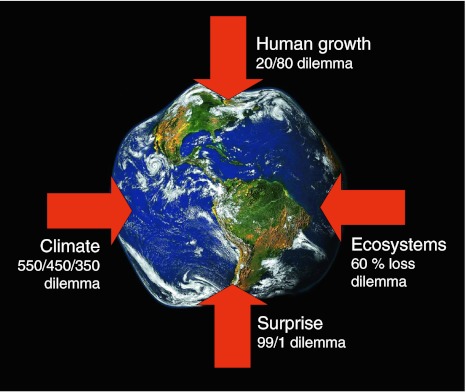
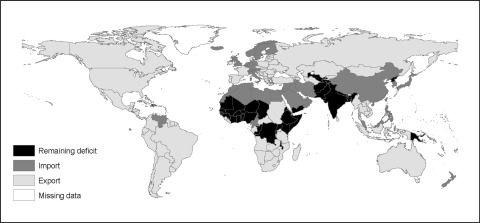
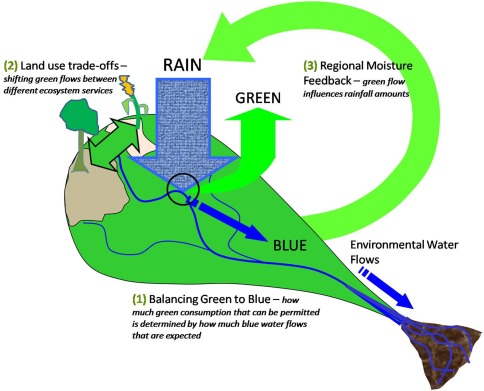
Humanity has entered a new phase of sustainability challenges, the Anthropocene, in which human development has reached a scale where it affects vital planetary processes. Under the pressure from a quadruple squeeze-from population and development pressures, the anthropogenic climate crisis, the anthropogenic ecosystem crisis, and the risk of deleterious tipping points in the Earth system-the degrees of freedom for sustainable human exploitation of planet Earth are severely restrained. It is in this reality that a new green revolution in world food production needs to occur, to attain food security and human development over the coming decades. Global freshwater resources are, and will increasingly be, a fundamental limiting factor in feeding the world. Current water vulnerabilities in the regions in most need of large agricultural productivity improvements are projected to increase under the pressure from global environmental change. The sustainability challenge for world agriculture has to be set within the new global sustainability context. We present new proposed sustainability criteria for world agriculture, where world food production systems are transformed in order to allow humanity to stay within the safe operating space of planetary boundaries. In order to secure global resilience and thereby raise the chances of planet Earth to remain in the current desired state, conducive for human development on the long-term, these planetary boundaries need to be respected. This calls for a triply green revolution, which not only more than doubles food production in many regions of the world, but which also is environmentally sustainable, and invests in the untapped opportunities to use green water in rainfed agriculture as a key source of future productivity enhancement. To achieve such a global transformation of agriculture, there is a need for more innovative options for water interventions at the landscape scale, accounting for both green and blue water, as well as a new focus on cross-scale interactions, feed-backs and risks for unwanted regime shifts in the agro-ecological landscape.
Figures
References
-
- Barron J, Okwach G. Run-off water harvesting for dry spell mitigation in maize (Zea mays L.): results from on-farm research in semi-arid Kenya. Agricultural Water Management. 2005;74(1):1–21. doi: 10.1016/j.agwat.2004.11.002. - DOI
-
- Barron J, Rockström J, Gichuki F, Hatibu N. Dry spell analysis and maize yields for two semi-arid locations in East Africa. Agricultural and Forest Meteorology. 2003;117(1–2):23–37. doi: 10.1016/S0168-1923(03)00037-6. - DOI
-
- Calder IR. The blue revolution: land use and integrated water resources management. London: Earthscan; 1999.
-
- Canadell JG, Le Quéré D, Raupach MR, Field CR, Buitenhuis E, Ciais P, Conway TJ, Gillett NP, Houghton RA, Marland G. Contributions to accelerating atmospheric CO2 growth from economic activity, carbon intensity, and efficiency of natural sinks. Proceedings of the National Academy of Sciences of the United States of America. 2007;104:18866–18870. doi: 10.1073/pnas.0702737104. - DOI - PMC - PubMed
MeSH terms
LinkOut - more resources
Full Text Sources
