. 2010 Aug 11:10:216.
doi: 10.1186/1471-2180-10-216.

Identification, expression and serological evaluation of the recombinant ATP synthase beta subunit of Mycoplasma pneumoniae

Affiliations

Identification, expression and serological evaluation of the recombinant ATP synthase beta subunit of Mycoplasma pneumoniae

Hélène Nuyttens et al. BMC Microbiol. .

Abstract

Background: Mycoplasma pneumoniae is responsible for acute respiratory tract infections (RTIs) common in children and young adults. As M. pneumoniae is innately resistant to beta-lactams antibiotics usually given as the first-line treatment for RTIs, specific and early diagnosis is important in order to select the right treatment. Serology is the most used diagnostic method for M. pneumoniae infections.

Results: In this study, we identified the M. pneumoniae ATP synthase beta subunit (AtpD) by serologic proteome analysis and evaluated its usefulness in the development of a serological assay. We successfully expressed and purified recombinant AtpD (rAtpD) protein, which was recognised by serum samples from M. pneumoniae-infected patient in immunoblots. The performance of the recombinant protein rAtpD was studied using a panel of serum samples from 103 infected patients and 86 healthy blood donors in an in-house IgM, IgA and IgG enzyme-linked immunosorbent assay (ELISA). The results of this assay were then compared with those of an in-house ELISA with a recombinant C-terminal fragment of the P1 adhesin (rP1-C) and of the commercial Ani Labsystems ELISA kit using an adhesin P1-enriched whole-cell extract. Performances of the rAtpD and rP1-C antigen combination were further assessed by binary logistic regression analysis. We showed that combination of rAtpD and rP1-C discriminated maximally between the patients infected with M. pneumoniae (children and adults) and the healthy subjects for the IgM class, performing better than the single recombinant antigens or the commercial whole-cell extract.

Conclusion: These results suggest that AtpD can be used as an antigen for the immunodiagnosis of early and acute M. pneumoniae infection in association with adhesin P1, providing an excellent starting point for the development of point-of-care diagnostic assays.


Figures
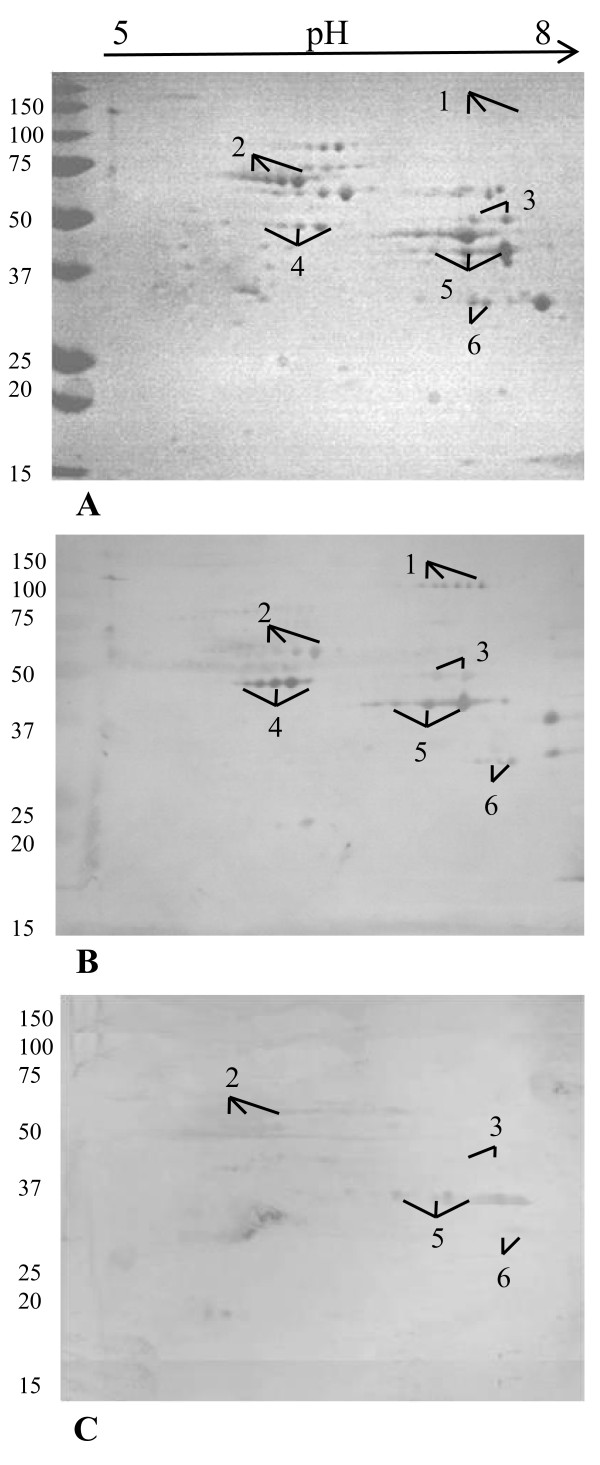
Figure 1
Figure 1
2D-E profile of M. pneumoniae M129 total extract and immunoblots. 2D-E profile of total extracts (A) and immunoblots probed with 10 serum samples from RTI patients infected with M. pneumoniae (B) or 10 serum samples from healthy blood donors (C). Labelled spots represent the M. pneumoniae antigenic proteins that were detected with serum samples from the study population. The gel spots were encoded using a protein number (Table 1), which was assigned based on their similar locations on different gels/membranes.
Figure 2
Figure 2
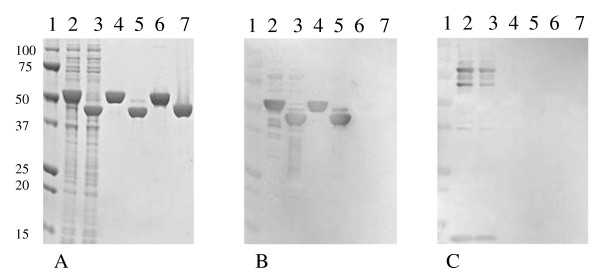
SDS-PAGE (A) and western blot analysis (B, C) of expressed and purified recombinant proteins. (A) SDS-PAGE analysis of the expression of rAtpD and rP1-C in E. coli extracts (lanes 2 and 3 for rAtpD and rP1-C, respectively) and of the purified recombinant proteins (lanes 4 and 5 for rAtpD and rP1-C, respectively). Two irrelevant his-tagged proteins of the same mass as rAtpD (lane 6) and rP1-C (lane 7) were purified and included in the study. (B, C) Western blot analysis of the expression of rAtpD and rP1-C in E. coli extracts (lanes 2 and 3, respectively), of the purified recombinant proteins (lanes 4 and 5 for rAtpD and rP1-C, respectively) and of the two irrelevant his-tagged proteins of the same mass as rAtpD (lane 6) and rP1-C (lane 7) with a pool of 10 serum samples from M. pneumoniae-positive patients (B) and with a pool of 10 healthy blood donors (C). Lanes: 1, standard protein marker; 2, induced rAtpD (about 50 kDa); 3, induced rP1-C (about 40 kDa); 4, purified rAtpD; 5, purified rP1-C; 6, irrelevant his-tagged protein of the same mass as rAtpD; 7, irrelevant his-tagged protein of the same mass as r P1-C. The numbers on the left indicate molecular masses (in kDa).
Figure 3
Figure 3
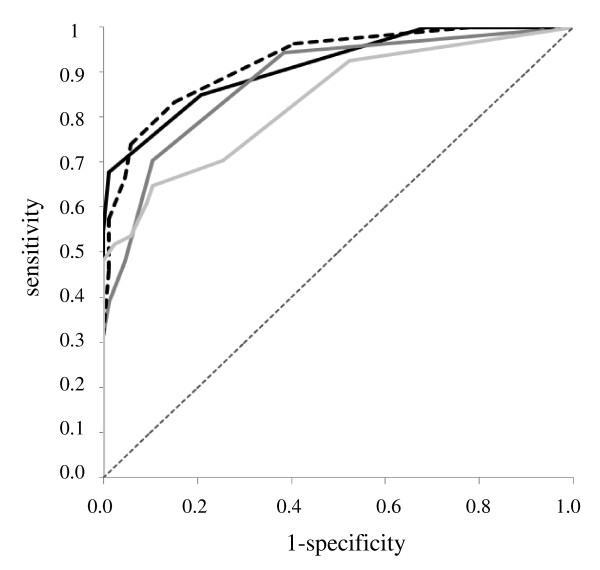
ROC analysis of the IgM rAtpD, rP1-C ELISAs, alone or combined, and the Ani Labsystems kit in children. ROC curves for each assay. Black line represent rAtpD (AUC = 0.923), dark gray line rP1-C (AUC = 0.897), black dotted line rAtpD-rP1-C combination (AUC = 0.925), light gray line Ani Labsystems (AUC = 0.824), gray dotted line median (AUC = 0.5).
Figure 4
Figure 4
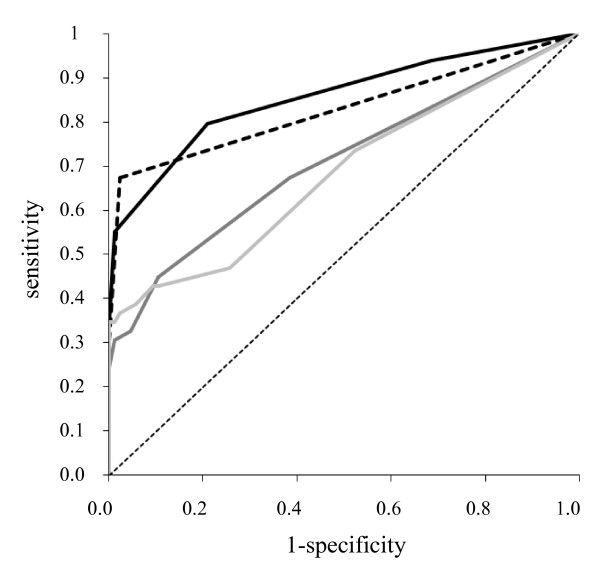
ROC analysis of the IgM rAtpD, rP1-C ELISAs, alone or combined, and the Ani Labsystems kit in adults. ROC curves for each assay. Black line represent rAtpD (AUC = 0.877), dark gray line rP1-C (AUC = 0.708), black dotted line rAtpD-rP1-C combination (AUC = 0.891), light gray line Ani Labsystems (AUC = 0.685), gray dotted line median (AUC = 0.5).

References

    1. Gerstenecker B, Jacobs E. Topological mapping of the P1-adhesin of Mycoplasma pneumoniae with adherence-inhibiting monoclonal antibodies. J Gen Microbiol. 1990;136:471–476. - PubMed
    1. Svenstrup HF, Nielsen PK, Drasbek M, Birkelund S, Christiansen G. Adhesion and inhibition assay of Mycoplasma genitalium and M. pneumoniae by immunofluorescence microscopy. J Med Microbiol. 2002;51:361–373. doi: 10.1016/S0167-7012(02)00113-6. - DOI - PubMed
    1. Willby MJ, Balish MF, Ross SM, Lee KK, Jordan JL, Krause DC. HMW1 is required for stability and localization of HMW2 to the attachment organelle of Mycoplasma pneumoniae. J Bacteriol. 2004;186:8221–8228. doi: 10.1128/JB.186.24.8221-8228.2004. - DOI - PMC - PubMed
    1. Waldo RH, Krause DC. Synthesis, stability, and function of cytadhesin P1 and accessory protein B/C complex of Mycoplasma pneumoniae. J Bacteriol. 2006;188:569–575. doi: 10.1128/JB.188.2.569-575.2006. - DOI - PMC - PubMed
    1. Chaudhry R, Varshney AK, Malhotra P. Adhesion proteins of Mycoplasma pneumoniae. Front Biosci. 2007;12:690–699. doi: 10.2741/2093. - DOI - PubMed

MeSH terms