. 2010 Aug 11:11:63.
doi: 10.1186/1471-2121-11-63.

Karyopherin alpha7 (KPNA7), a divergent member of the importin alpha family of nuclear import receptors

Affiliations

Karyopherin alpha7 (KPNA7), a divergent member of the importin alpha family of nuclear import receptors

Joshua B Kelley et al. BMC Cell Biol. .

Abstract

Background: Classical nuclear localization signal (NLS) dependent nuclear import is carried out by a heterodimer of importin alpha and importin beta. NLS cargo is recognized by importin alpha, which is bound by importin beta. Importin beta mediates translocation of the complex through the central channel of the nuclear pore, and upon reaching the nucleus, RanGTP binding to importin beta triggers disassembly of the complex. To date, six importin alpha family members, encoded by separate genes, have been described in humans.

Results: We sequenced and characterized a seventh member of the importin alpha family of transport factors, karyopherin alpha 7 (KPNA7), which is most closely related to KPNA2. The domain of KPNA7 that binds Importin beta (IBB) is divergent, and shows stronger binding to importin beta than the IBB domains from of other importin alpha family members. With regard to NLS recognition, KPNA7 binds to the retinoblastoma (RB) NLS to a similar degree as KPNA2, but it fails to bind the SV40-NLS and the human nucleoplasmin (NPM) NLS. KPNA7 shows a predominantly nuclear distribution under steady state conditions, which contrasts with KPNA2 which is primarily cytoplasmic.

Conclusion: KPNA7 is a novel importin alpha family member in humans that belongs to the importin alpha2 subfamily. KPNA7 shows different subcellular localization and NLS binding characteristics compared to other members of the importin alpha family. These properties suggest that KPNA7 could be specialized for interactions with select NLS-containing proteins, potentially impacting developmental regulation.


Figures
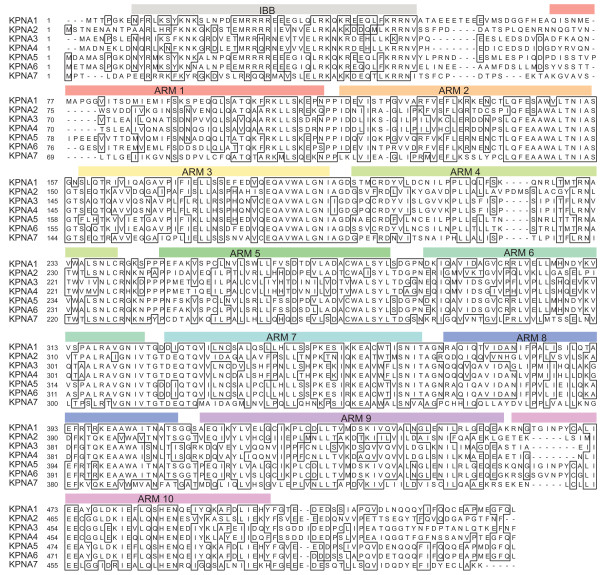
Figure 1
Figure 1
ClustalW alignment of the seven KPNA proteins that comprise the importin α family in humans. Positions of the armadillo repeats (ARM 1-10) and the importin β binding (IBB) domain are indicated with colored boxes. Amino acids which are identical in ≥ 4 of the KPNA proteins are boxed.
Figure 2
Figure 2
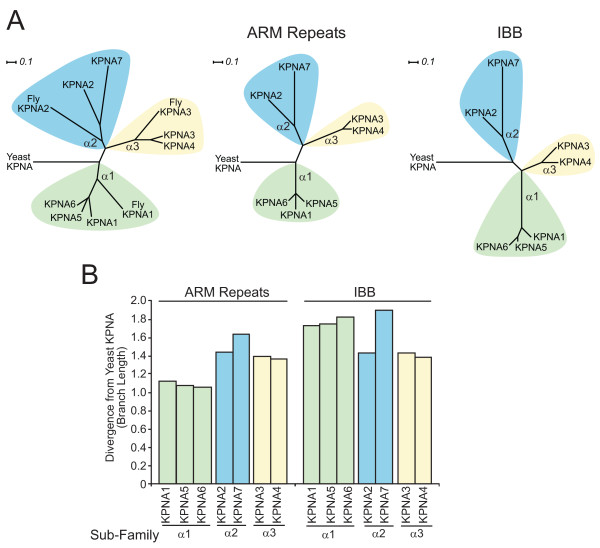
Phylogenetic analysis of the importin α family. (A) Phylogenetic trees generated using the KPNA protein sequences from human, D. melanogaster (fly), and S. cerevisiae (Yeast). The three subfamilies are shaded in green (a1 subfamily), blue (a2 subfamily) and yellow (a3 subfamily). Phylogenetic trees were also generated using the ARM repeat domains and the IBB domains. Scales bar is 0.1 branch length. of the human importin a family. The sole S. cerevisiae importin α, SRP1 (Yeast KPNA), is included as a common ancestor. D. melanogaster contains one member each of the α1, α2, and α3 subfamilies, which are included (Fly KPNA) to define the subfamilies. The phylogenetic trees labeled ARM repeats and IBB were generated using either the ARM repeat or IBB domains of all 7 human KPNA proteins. (B) Comparison of the divergence of the IBB and ARM repeat domains of the human KPNA proteins from the same domains in Yeast SRP1. Divergence was measured as branch length of the phylogenetic trees from SRP1 to the given domain of each KPNA.
Figure 3
Figure 3
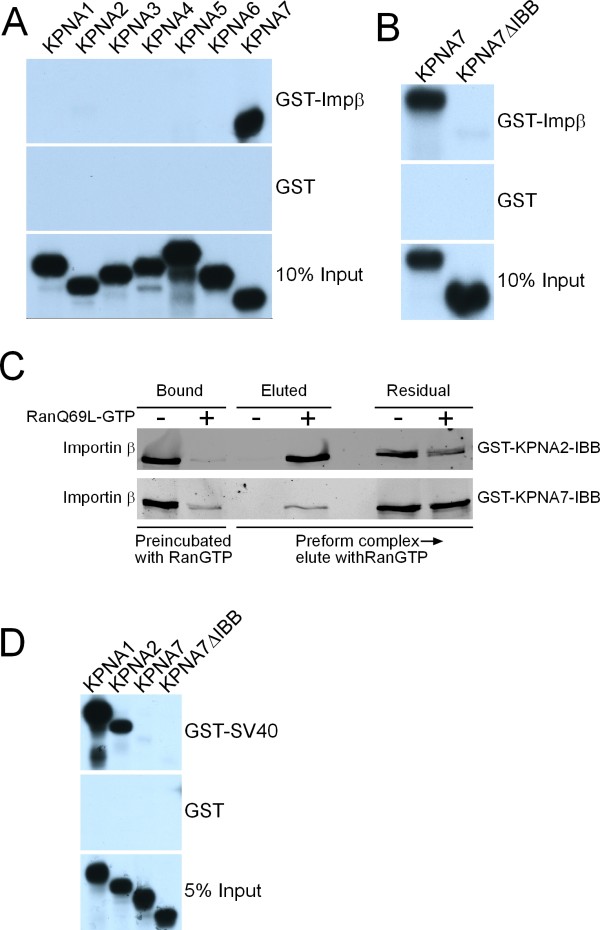
KPNA7 contains an N-terminal IBB. (A) KPNA proteins were translated as 35S-methionine labeled polypeptides and used in binding assays with GST-Importin β. (B) Full-length and ΔIBB forms of KPNA7 tested for binding to Importin β. (C) Importin β binding to the IBB of KPNA7 is RanGTP-sensitive. Recombinant Importin β binding to GST-IBB proteins was performed in the absence and presence of recombinant RanGTP, and by subsequent addition of RanGTP to preformed GST-IBB-importin β complexes. These assays were performed with the GTPase deficient RanQ69L mutant. Bound and eluted fractions were examined by immunoblotting using a monoclonal antibody to Importin β. (D) KPNA1, KPNA2, KPNA7, KPNA7 ΔIBB binding to GST-SV40 NLS using 35S-methionine labeled polypeptides.
Figure 4
Figure 4
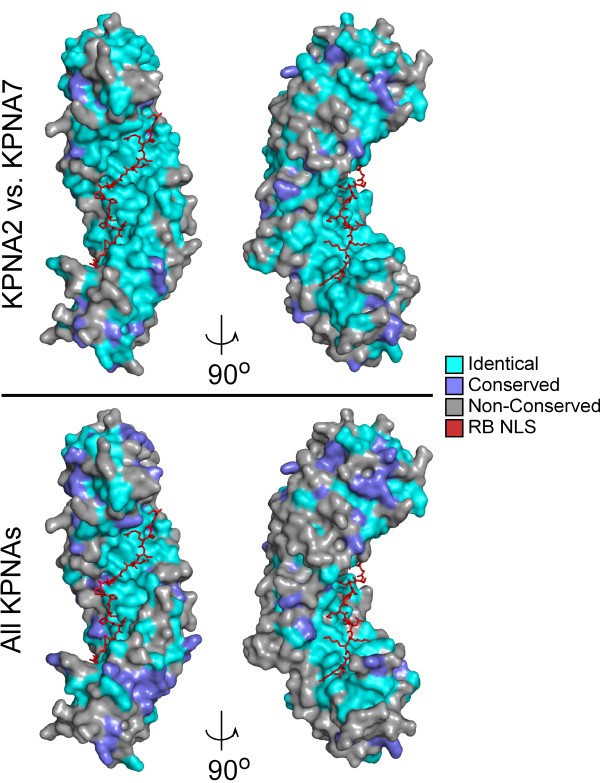
Structural model illustrating the conservation of amino acids that create the NLS binding surface in KPNA proteins. The ClustalW alignment of KPNA2 and KPNA7 (Top panel) or all of the KPNA's (bottom panel) was used to map identical (cyan), conserved (blue), and different (gray) residues onto the importin α/RB NLS (Red) structure 1PJM [30]. The left image is rotated 90° and shown on the right. Images were created using Pymol http://www.pymol.org/.
Figure 5
Figure 5
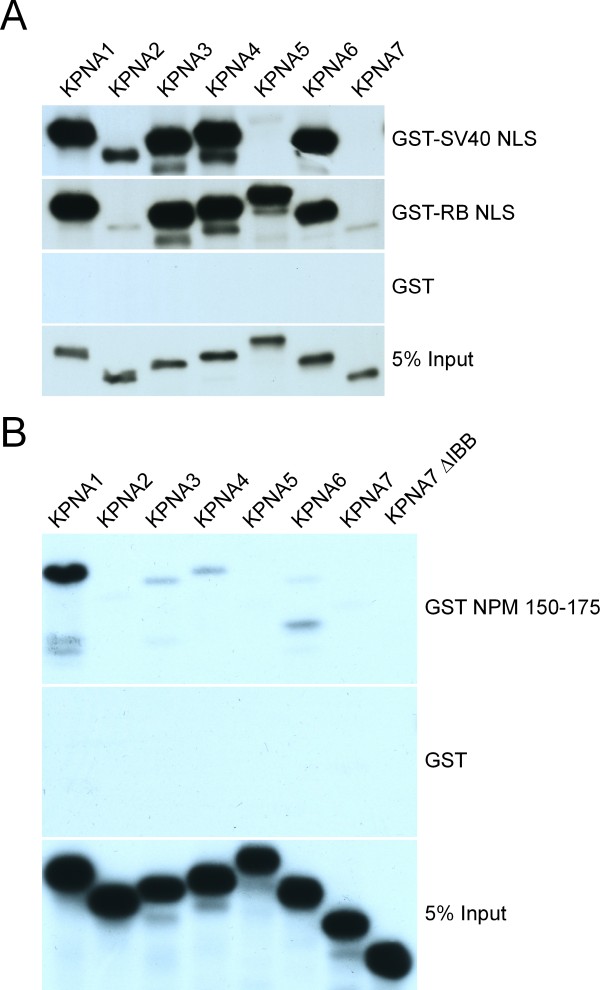
Monopartite and bipartite NLS binding of the importin α family. Binding reactions between in vitro translated 35 S methionine labeled human KPNA's in solution and (A) GST-SV40 NLS (monopartite) and GST-RB NLS (bipartite) immobilized upon glutathione agarose beads, or (B) GST-NPM NLS (NPM 150-175). As a negative control, GST was used alone.
Figure 6
Figure 6
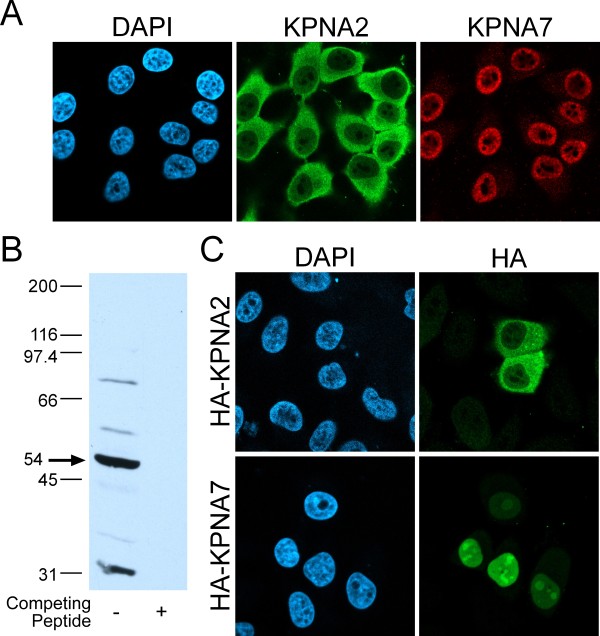
KPNA7 localizes to the nucleus in HeLa cells. (A) Immunofluorescence microscopy of endogenous KPNA2 and KPNA7 in HeLa cells shows that KPNA7 is nuclear at steady state. (B) HA-KPNA2 and HA-KPNA7 transfected into HeLa cells, and detected with an anti-HA antibody by immunofluorescence microscopy. (C) Immunoblot of HeLa lysates probed with purified anti-KPNA7, or anti-KPNA7 in the presence of excess KPNA7 peptide to show competition for antibody binding.

References

    1. Terry LJ, Shows EB, Wente SR. Crossing the nuclear envelope: hierarchical regulation of nucleocytoplasmic transport. Science. 2007;318(5855):1412–1416. doi: 10.1126/science.1142204. - DOI - PubMed
    1. Goldfarb DS, Corbett AH, Mason DA, Harreman MT, Adam SA. Importin alpha: a multipurpose nuclear-transport receptor. Trends Cell Biol. 2004;14(9):505–514. doi: 10.1016/j.tcb.2004.07.016. - DOI - PubMed
    1. Harel A, Forbes DJ. Importin beta: conducting a much larger cellular symphony. Mol Cell. 2004;16(3):319–330. - PubMed
    1. Pemberton LF, Paschal BM. Mechanisms of receptor-mediated nuclear import and nuclear export. Traffic. 2005;6(3):187–198. doi: 10.1111/j.1600-0854.2005.00270.x. - DOI - PubMed
    1. Fornerod M, Ohno M, Yoshida M, Mattaj I. CRM1 is an export receptor for leucine-rich nuclear export signals. Cell. 1997;90(6):1051–1060. doi: 10.1016/S0092-8674(00)80371-2. - DOI - PubMed

Publication types