


Anti-inflammatory activity and neutrophil reductions mediated by the JAK1/JAK3 inhibitor, CP-690,550, in rat adjuvant-induced arthritis
- PMID: 20701804
- PMCID: PMC2928212
- DOI: 10.1186/1476-9255-7-41
Anti-inflammatory activity and neutrophil reductions mediated by the JAK1/JAK3 inhibitor, CP-690,550, in rat adjuvant-induced arthritis
Abstract
Background: The Janus kinase (JAK) family of tyrosine kinases includes JAK1, JAK2, JAK3 and TYK2, and is required for signaling through Type I and Type II cytokine receptors. CP-690,550 is a potent and selective JAK inhibitor currently in clinical trials for rheumatoid arthritis (RA) and other autoimmune disease indications. In RA trials, dose-dependent decreases in neutrophil counts (PBNC) were observed with CP-690,550 treatment. These studies were undertaken to better understand the relationship between JAK selectivity and PBNC decreases observed with CP-690,550 treatment.
Methods: Potency and selectivity of CP-690,550 for mouse, rat and human JAKs was evaluated in a panel of in vitro assays. The effect of CP-690,550 on granulopoiesis from progenitor cells was also assessed in vitro using colony forming assays. In vivo the potency of orally administered CP-690,550 on arthritis (paw edema), plasma cytokines, PBNC and bone marrow differentials were evaluated in the rat adjuvant-induced arthritis (AIA) model.
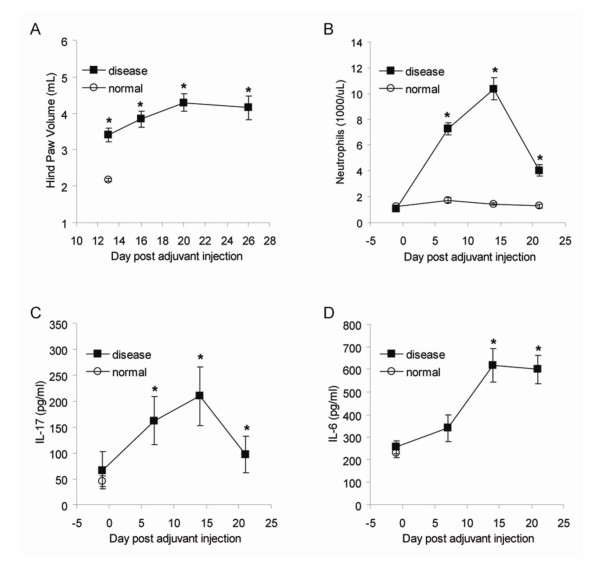
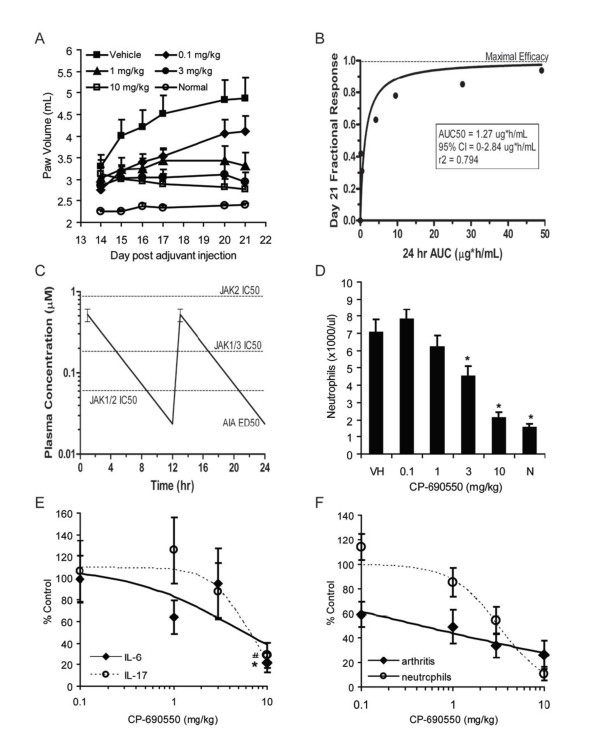
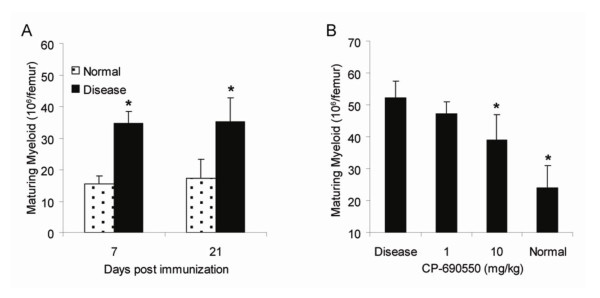
Results: CP-690,550 potently inhibited signaling through JAK1 and JAK3 with 5-100 fold selectivity over JAK2 in cellular assays, despite inhibiting all four JAK isoforms with nM potency in in vitro enzyme assays. Dose-dependent inhibition of paw edema was observed in vivo with CP-690,550 treatment. Plasma cytokines (IL-6 and IL-17), PBNC, and bone marrow myeloid progenitor cells were elevated in the context of AIA disease. At efficacious exposures, CP-690,550 returned all of these parameters to pre-disease levels. The plasma concentration of CP-690,550 at efficacious doses was above the in vitro whole blood IC50 of JAK1 and JAK3 inhibition, but not that of JAK2.
Conclusion: Results from this investigation suggest that CP-690,550 is a potent inhibitor of JAK1 and JAK3 with potentially reduced cellular potency for JAK2. In rat AIA, as in the case of human RA, PBNC were decreased at efficacious exposures of CP-690,550. Inflammatory end points were similarly reduced, as judged by attenuation of paw edema and cytokines IL-6 and IL-17. Plasma concentration at these exposures was consistent with inhibition of JAK1 and JAK3 but not JAK2. Decreases in PBNC following CP-690,550 treatment may thus be related to attenuation of inflammation and are likely not due to suppression of granulopoiesis through JAK2 inhibition.
Figures
References
-
- Changelian PS, Flanagan ME, Ball DJ, Kent CR, Magnuson KS, Martin WH, Brissette WH, McCurdy SP, Kudlacz EM, Conklyn MJ, Elliott EA, Koslov ER, Fisher MB, Strelevitz TJ, Yoon K, Whipple DA, Sun J, Munchhof MJ, Doty JL, Casavant JM, Blumenkopf TA, Hines M, Brown MF, Lillie BM, Subramanyam C, Shang-Poa C, Milici AJ, Beckius GE, Moyer JD, Su C, Woodworth TG, Gaweco AS, Beals CR, Littman BH, Fisher DA, Smith JF, Zagouras P, Magna HA, Saltarelli MJ, Johnson KS, Nelms LF, Des Etages SG, Hayes LS, Kawabata TT, Finco-Kent D, Baker DL, Larson M, Si M-S, Paniagua R, Higgins J, Holm B, Reitz B, Zhou Y-J, Morris RE, O'Shea JJ, Borie DC. Prevention of organ allograft rejection by a specific janus kinase 3 inhibitor. Science. 2003;302:875–878. doi: 10.1126/science.1087061. - DOI - PubMed
LinkOut - more resources
Full Text Sources
Other Literature Sources
Medical
Research Materials
Miscellaneous