


Comment
doi: 10.1186/cc9202.
Epub 2010 Aug 10.
Understanding immune dysfunctions in sepsis patients
- PMID: 20701813
- PMCID: PMC2945118
- DOI: 10.1186/cc9202
Item in Clipboard
Comment
Understanding immune dysfunctions in sepsis patients
Crit Care.
2010.
No abstract available
Figures
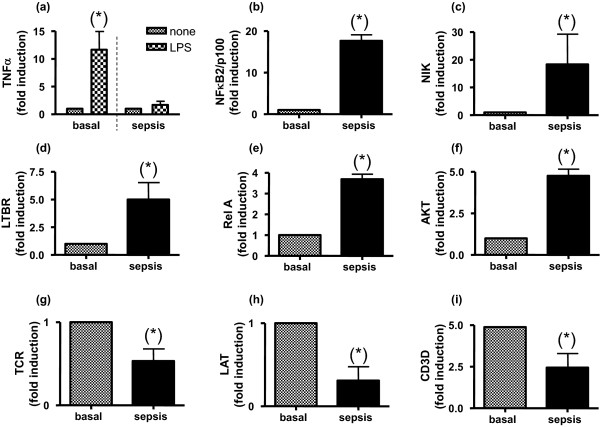
Alternative responses are activated in monocytes from septic patients. (a) to (f) Monocytes from septic patients (age 51 ± 12 years, mean ± standard deviation), who met the diagnostic criteria for sepsis, were isolated (n = 17). Blood samples were taken when they met the sepsis criteria for the first time. The following exclusion criteria were imposed: malignancy and chronic inflammatory diseases, treatments with steroids or immunosuppressive drugs during the past month, hepatic failure (serum aspartate aminotransferase and/or alanine aminotransferase level >100 IU/l; prothrombin time <60%, total bilirubin level >60 μmol/l), renal insufficiency (plasma creatinine level >200 μmol/l), AIDS, virus B orvirus C hepatitis, gestation, and age >70 years. Total RNA was then isolated and the levels of (a) TNFα, (b) NF-κB2/p100, (c) NF-κB-inducing kinase (NIK), (d) lymphotoxin β-receptor (LTBR), (e) v-rel reticuloendotheliosis viral oncogene homologue A (p65) (RelA) and (f) serine/threonine proteinkinase (AKT) were determined by real-time quantitative PCR. (a) In the case of TNFα, induction levels were also analysed when monocytes were challenged with lipopolysaccharide (LPS) (10 ng/ml) for 3 hours, ex vivo. (g) to (i) Lymphocytes from septic patients were isolated (n = 17). Total RNA was then isolated and the levels of (g) T-cell antigen receptor (TCR), (h) linked for activation of T cells (LAT) and (i) ΔCD3-TCR complex (CD3D) were determined by real-time quantitative PCR. The fold induction with respect to the basal is depicted. *P < 0.01 septic phase versus recovery phase (1 month afterwards).
Comment on
-
Early alterations of the innate and adaptive immune statuses in sepsis according to the type of underlying infection.Crit Care. 2010;14(3):R96. doi: 10.1186/cc9031. Epub 2010 May 26. Crit Care. 2010. PMID: 20504311 Free PMC article.
References
-
- Gogos C, Kotsaki A, Pelekanou A, Giannikopoulos G, Vaki I, Maravitsa P, Adamis S, Alexiou Z, Andrianopoulos G, Antonopoulou A, Athanassia S, Baziaka F, Charalambous A, Christodoulou S, Dimopoulou I, Floros I, Giannitsioti E, Gkanas P, Ioakeimidou A, Kanellakopoulou K, Karabela N, Karagianni V, Katsarolis I, Kontopithari G, Kopterides P, Koutelidakis I, Koutoukas P, Kranidioti H, Lignos M, Louis K. et al.Early alterations of the innate and adaptive immune statuses in sepsis according to the type of underlying infection. Crit Care. 2010;14:R96. doi: 10.1186/cc9031. - DOI - PMC - PubMed
-
- Escoll P, del Fresno C, Garcia L, Vallés G, Lendinez MJ, Arnalich F, López-Collazo E. Rapid up-regulation of IRAK-M expression following a second endotoxin challenge in human monocytes and in monocytes isolated from septic patients. Biochem Biophys Res Commun. 2003;311:465–472. doi: 10.1016/j.bbrc.2003.10.019. - DOI - PubMed
Publication types
MeSH terms
Substances
LinkOut - more resources
Full Text Sources
Medical
