


Leg length, skull circumference, and the prevalence of dementia in low and middle income countries: a 10/66 population-based cross sectional survey
- PMID: 20701817
- PMCID: PMC5391848
- DOI: 10.1017/S1041610210001274
Leg length, skull circumference, and the prevalence of dementia in low and middle income countries: a 10/66 population-based cross sectional survey
Abstract
Background: Adult leg length is influenced by nutrition in the first few years of life. Adult head circumference is an indicator of brain growth. There is a limited literature linking short legs and small skulls to an increased risk for cognitive impairment and dementia in late life.
Methods: One phase cross-sectional surveys were carried out of all residents aged over 65 years in 11 catchment areas in China, India, Cuba, Dominican Republic, Venezuela, Mexico and Peru (n = 14,960). The cross-culturally validated 10/66 dementia diagnosis, and a sociodemographic and risk factor questionnaire were administered to all participants, and anthropometric measures taken. Poisson regression was used to calculate prevalence ratios for the effect of leg length and skull circumference upon 10/66 dementia, controlling for age, gender, education and family history of dementia.
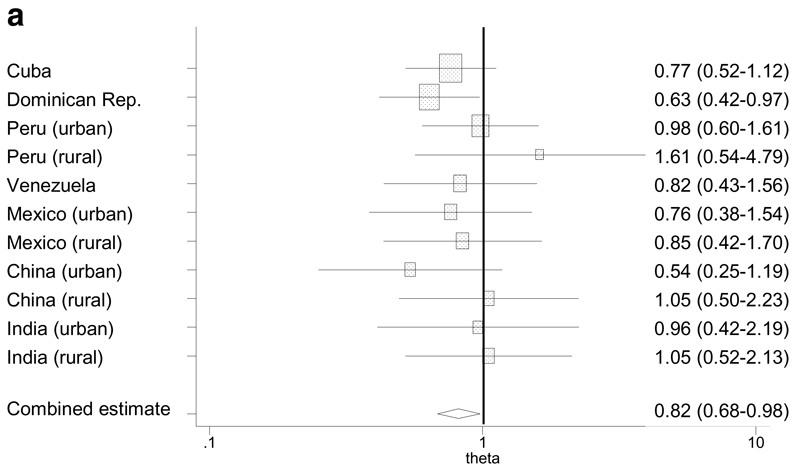
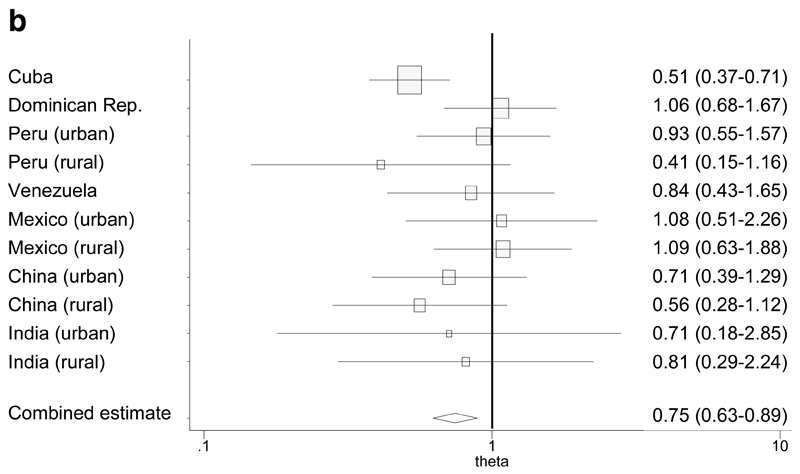
Results: The pooled meta-analyzed fixed effect for leg length (highest vs. lowest quarter) was 0.82 (95% CI, 0.68-0.98) and for skull circumference 0.75 (95% CI, 0.63-0.89). While point estimates varied between sites, the proportion of the variability attributable to heterogeneity between studies as opposed to sampling error (I2) was 0% for leg length and 22% for skull circumference. The effects were independent and not mediated by family history of dementia. The effect of skull circumference was not modified by educational level or gender, and the effect of leg length was not modified by gender.
Conclusions: Since leg length and skull circumference are said to remain stable throughout adulthood into old age, reverse causality is an unlikely explanation for the findings. Early life nutritional programming, as well as neurodevelopment may protect against neurodegeneration.
Conflict of interest statement
None
Figures
References
-
- Bartholomeusz HH, Courchesne E, Karns CM. Relationship between head circumference and brain volume in healthy normal toddlers, children, and adults. Neuropediatrics. 2002;33:239–241. - PubMed
-
- Bickel H, Riemenschneider M, Kurz A. [Associations between dementia and head circumference as a measure of brain reserve--results from the Bavarian School sisters study] Psychiatrische Praxis. 2006;33:138–144. - PubMed
-
- Borenstein GA, et al. Head circumference and incident Alzheimer's disease: modification by apolipoprotein E. Neurology. 2001;57:1453–1460. - PubMed
-
- Copeland JRM, Dewey ME, Griffith-Jones HM. A computerised psychiatric diagnostic system and case nomenclature for elderly subjects: GMS and AGECAT. Psychological Medicine. 1986;16:89–99. - PubMed
-
- Edland SD, et al. Total intracranial volume: normative values and lack of association with Alzheimer's disease. Neurology. 2002;59:272–274. - PubMed
Publication types
MeSH terms
Grants and funding
LinkOut - more resources
Full Text Sources
Medical
