


Mycobacterium tuberculosis Beijing lineage favors the spread of multidrug-resistant tuberculosis in the Republic of Georgia
- PMID: 20702677
- PMCID: PMC2953096
- DOI: 10.1128/JCM.00715-10
Mycobacterium tuberculosis Beijing lineage favors the spread of multidrug-resistant tuberculosis in the Republic of Georgia
Abstract
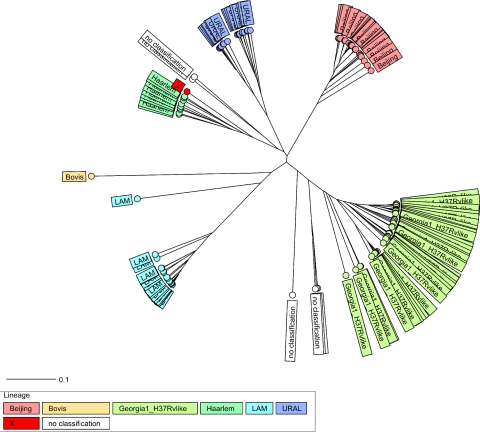
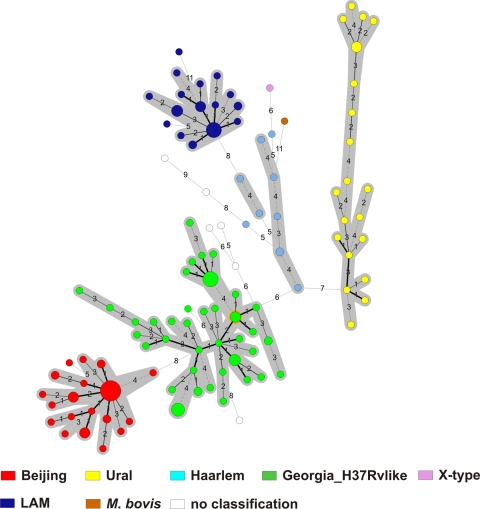
High rates and transmission of multidrug-resistant (MDR) tuberculosis (TB) have been associated with the Mycobacterium tuberculosis complex (MTBC) Beijing lineage, pointing to the importance of pathogen genetic factors for the modulation of infection outcome and epidemiology. We present here an in-depth analysis of the population structure of MTBC strains from the Republic of Georgia, a high-incidence setting at the Black Sea Coast. Phylogenetic lineages were identified based on 24-locus MIRU-VNTR (for mycobacterial interspersed repetitive unit-variable number tandem repeat) and spoligotyping analysis. Clusters of strains with identical genotyping profiles were determined as an indicator for the rate of recent transmission. Among the 183 M. tuberculosis isolates investigated, the most prominent lineage found was Beijing (26%), followed by the LAM (18%), Ural (12%), and Haarlem (5%) strains. A closely related previously undefined phylogenetic group (62 strains) showed a genotyping pattern similar to laboratory strain H37RV and was denominated as "Georgia-H37RV-like." Although isoniazid resistance was found among strains of different lineages, MDR TB was nearly completely restricted to Beijing strains (P < 0.0001). Approximately 50% of the isolates were grouped in clusters, indicating a high rate of recent transmission. Our data indicate that, in addition to the confirmation of the importance of Beijing genotype strains for the TB epidemiology in former Soviet Union countries, a high-population diversity with strains of the LAM, Ural, Haarlem, and a previously undefined lineage represents nearly two-thirds of the strains found in Georgia. Higher rates among previously treated and MDR TB patients point to a higher potential of lineage Beijing to escape therapy and develop MDR TB.
Figures
References
-
- Allix-Béguec, C., D. Harmsen, T. Weniger, P. Supply, and S. Niemann. 2008. Evaluation and user-strategy of MIRU-VNTRplus, a multifunctional database for on-line analysis of genotyping data and phylogenetic identification of Mycobacterium tuberculosis complex isolates. J. Clin. Microbiol. 46:2692-2699. - PMC - PubMed
-
- Aziz, M. A., A. Wright, A. Laszlo, A. De Muynck, F. Portaels, A. Van Deun, C. Wells, P. Nunn, L. Blanc, and M. Raviglione. 2006. Epidemiology of antituberculosis drug resistance (the Global Project on Anti-Tuberculosis Drug Resistance Surveillance): an updated analysis. Lancet 368:2142-2154. - PubMed
-
- Blower, S. M., and T. Chou. 2004. Modeling the emergence of the “hot zones”: tuberculosis and the amplification dynamics of drug resistance. Nat. Med. 10:1111-1116. - PubMed
-
- Brudey, K., J. R. Driscoll, L. Rigouts, W. M. Prodinger, A. Gori, S. A. Al Hajoj, C. Allix, L. Aristimuno, J. Arora, V. Baumanis, L. Binder, P. Cafrune, A. Cataldi, S. Cheong, R. Diel, C. Ellermeier, J. T. Evans, M. Fauville-Dufaux, S. Ferdinand, D. Garcia de Viedma, C. Garzelli, L. Gazzola, H. M. Gomes, M. C. Guttierez, P. M. Hawkey, P. D. van Helden, G. V. Kadival, B. N. Kreiswirth, K. Kremer, M. Kubin, S. P. Kulkarni, B. Liens, T. Lillebaek, M. L. Ho, C. Martin, C. Martin, I. Mokrousov, O. Narvskaia, Y. F. Ngeow, L. Naumann, S. Niemann, I. Parwati, Z. Rahim, V. Rasolofo-Razanamparany, T. Rasolonavalona, M. L. Rossetti, S. Rusch-Gerdes, A. Sajduda, S. Samper, I. G. Shemyakin, U. B. Singh, A. Somoskovi, R. A. Skuce, D. van Soolingen, E. M. Streicher, P. N. Suffys, E. Tortoli, T. Tracevska, V. Vincent, T. C. Victor, R. M. Warren, S. F. Yap, K. Zaman, F. Portaels, N. Rastogi, and C. Sola. 2006. Mycobacterium tuberculosis complex genetic diversity: mining the fourth international spoligotyping database (SpolDB4) for classification, population genetics and epidemiology. BMC. Microbiol. 6:23. - PMC - PubMed
MeSH terms
Substances
LinkOut - more resources
Full Text Sources
