


Malaria risk in Corsica, former hot spot of malaria in France
- PMID: 20704707
- PMCID: PMC2927611
- DOI: 10.1186/1475-2875-9-231
Malaria risk in Corsica, former hot spot of malaria in France
Abstract
Background: The prevalence of Plasmodium falciparum and Plasmodium vivax malaria was very high in Corsica just before the Second World War. The last outbreak was in 1972 and the most recent indigenous case was in 2006.
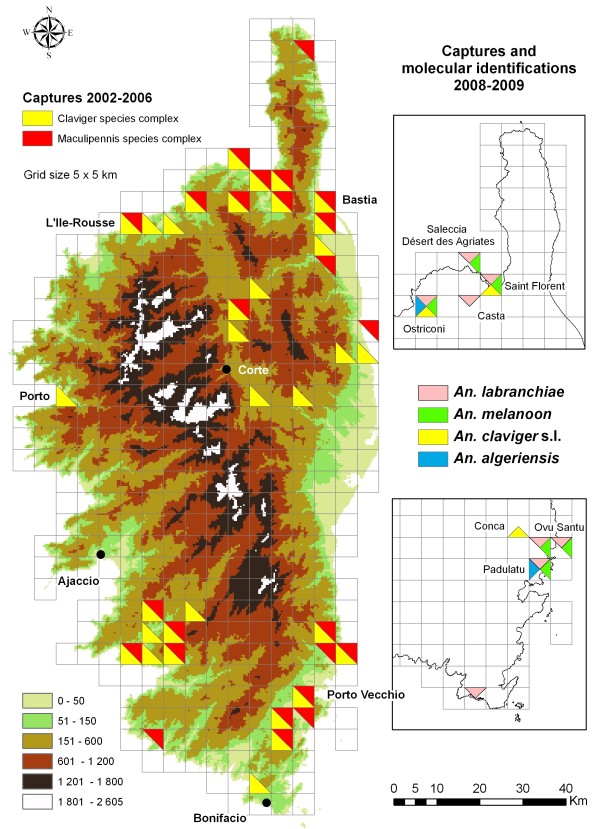
Results: Analysis of historical data shows that anopheline vectors were abundant. Recent surveys demonstrated that potential vectors are still present in Corsica, despite the likely disappearance of Anopheles sacharovi. Moreover, P. falciparum can develop experimentally into these mosquitoes, notably Anopheles labranchiae, which is locally abundant, and parasites are regularly introduced into the island.
Discussion, conclusions: The presence of vectors, the introduction of parasites and the conducive climate raise questions about the possibility of malaria re-emerging and becoming re-established in Corsica. Analysis of historic and current parasitological and entomological data shows that the current theoretical risk of indigenous cases or malaria foci is negligible, particularly since there is very little contact between humans and Anopheles mosquitoes, Plasmodium carriers are reliably treated and there is a widespread vector control on the island.
Figures
References
-
- Rodhain F, Charmot G. Evaluation des risques de reprise de la transmission du paludisme en France. Med Mal Infectieuses. 1982;12:231–236. doi: 10.1016/S0399-077X(82)80037-1. - DOI
-
- Rezza G, Nicoletti L, Angelini R, Romi R, Finarelli AC, Panning M, Cordioli P, Fortuna C, Boros S, Magurano F, Silvi G, Angelini P, Dottori M, Ciufolini MG, Majori GC. Infection with chikungunya virus in Italy: an outbreak in a temperate region. Lancet. 2007;370:1840–1846. doi: 10.1016/S0140-6736(07)61779-6. - DOI - PubMed
-
- Alten B, Kampen H, Fontenille D. In: Emerging Pests and Vector-Borne Diseases in Europe. Takken W, Knols BGJ, editor. Wageningen, Wageningen Academic Publishers; 2007. Malaria in Southern Europe: resurgence from the past? pp. 35–58.
Publication types
MeSH terms
LinkOut - more resources
Full Text Sources
Medical
