. 2010 Sep 10;39(5):821-7.
doi: 10.1016/j.molcel.2010.07.019. Epub 2010 Aug 12.

"Depupylation" of prokaryotic ubiquitin-like protein from mycobacterial proteasome substrates

Affiliations

"Depupylation" of prokaryotic ubiquitin-like protein from mycobacterial proteasome substrates

Kristin E Burns et al. Mol Cell. .

Abstract

Ubiquitin (Ub) provides the recognition and specificity required to deliver proteins to the eukaryotic proteasome for destruction. Prokaryotic ubiquitin-like protein (Pup) is functionally analogous to Ub in Mycobacterium tuberculosis (Mtb), as it dooms proteins to the Mtb proteasome. Studies suggest that Pup and Ub do not share similar mechanisms of activation and conjugation to target proteins. Dop (deamidase of Pup; Mtb Rv2112c/MT2172) deamidates the C-terminal glutamine of Pup to glutamate, preparing it for ligation to target proteins by proteasome accessory factor A (PafA). While studies have shed light on the conjugation of Pup to proteins, it was not known if Pup could be removed from substrates in a manner analogous to the deconjugation of Ub from eukaryotic proteins. Here, we show that Mycobacteria have a "depupylase" activity provided by Dop. The discovery of a depupylase strengthens the parallels between the Pup- and Ub-tagging systems of prokaryotes and eukaryotes, respectively.


Figures

Fig. 1
Fig. 1
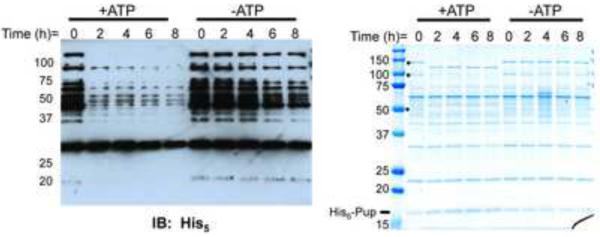
The pupylome is unstable in the presence of ATP. Stability of the pupylome in the presence and absence of ATP was analyzed by anti-His5 immunoblotting (left) and CBB staining (right) of 12% SDS-PAGE gels. Black dots indicate protein bands that change in the presence of ATP over time.
Fig. 2
Fig. 2
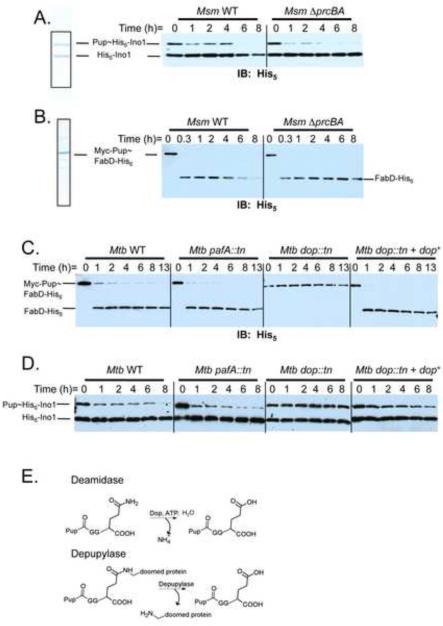
Depupylation of substrates in mycobacterial lysates. (A) Pup~His6-Ino1 and His6-Ino1 were purified by Ni-NTA affinity chromatography as previously described (left) (Burns et al., 2009). The Pup~His6-Ino1/His6-Ino1 mixture and (B) Myc-Pup~FabD-His6 were added to Msm WT and Msm ΔprcBA lysates and stability was monitored by removing aliquots at the indicated times and adding sample buffer to stop the reaction. Samples were analyzed by 12% SDS-PAGE followed by immunoblotting with antibodies to His5. (C)–(D) Same assay in (B) but using Mtb WT and proteasome-associated mutant lysates. The dop mutation was complemented in single copy. (E) Deamidase reaction catalyzed by Dop (top) resembles the putative depupylase reaction (bottom). “tn” indicates the transposon ΦMycoMarT7. All strains are described in Table S1. See also figure S1.
Fig. 3
Fig. 3
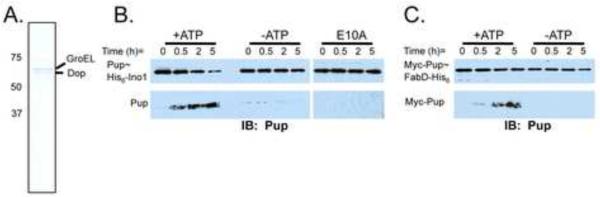
Recombinant Mtb Dop has depupylase activity. (A) CBB staining of His6-tagged MtDop purified from ΔprcBAMsm. (B) Depupylation of Pup~His6-Ino1/His6-Ino1 was monitored by removing aliquots at the indicated times and adding sample buffer to stop the reaction. Samples were analyzed by immunoblotting with antibodies to Pup. The same substrate was analyzed with mtDopE10A purified from ΔprcBAMsm. ATP was added to the reaction. (C) Another substrate, Myc-Pup~FabD-His6, was also assayed for depupylation by MtDop-His6. Free Pup was detected with the more sensitive chemiluminescent “Femto” reagent (see Supplemental Experimental Procedures). See also figure S2.
Fig. 4
Fig. 4
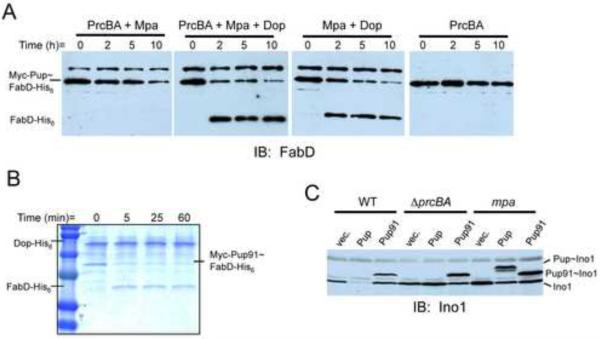
In vitro and in vivo functional analysis of Dop and depupylation. (A) Reconstitution of proteasome-Mpa degradation of the substrate Myc-Pup~FabD-His6 showed that Dop could rescue FabD from degradation. Substrate stability was monitored by removing aliquots at the indicated times and adding sample buffer to stop the reaction. Samples were analyzed by SDS-PAGE followed by immunoblotting with polyclonal antibodies to Mtb FabD-His6. The cross-reactive band is recombinant Mpa. (B) In a reaction similar to that in Fig 3, Myc-Pup91~FabD-His6 was tested as a substrate for MtDop-His6 and analyzed by CBB staining. (C) Analysis of Ino1 in Msm ectopically over expressing his6-pup91 or his6-pup. Free Ino1 accumulates in degradation defective MsmprcBA or mpa) or in Msm expressing his6-pup91. Pup~Ino1 only accumulated in the mpa mutant.

References

    1. Brunger AT, DeLaBarre B. NSF and p97/VCP: similar at first, different at last. FEBS Lett. 2003;555:126–133. - PubMed
    1. Burns KE, Darwin KH. Pupylation versus ubiquitylation: tagging for proteasome-dependent degradation. Cell Microbiol. 2010;12:424–431. - PMC - PubMed
    1. Burns KE, Liu WT, Boshoff HI, Dorrestein PC, Barry CE., 3rd Proteasomal protein degradation in Mycobacteria is dependent upon a prokaryotic ubiquitin-like protein. J Biol Chem. 2009;284:3069–3075. - PMC - PubMed
    1. Burns KE, Pearce MJ, Darwin KH. Prokaryotic ubiquitin-like protein provides a two-part degron to Mycobacterium proteasome substrates. J Bacteriol. 2010;192:2933–2935. - PMC - PubMed
    1. Cayli S, Klug J, Chapiro J, Frohlich S, Krasteva G, Orel L, Meihardt A. COP9 Signalosome Interacts ATP-dependently with p91/Valosin-containg Protein (VCP) and Controls the Ubiquitination Status of Proteins Bound to p97/VCP. Journal of Biological Chemistry. 2009;284:34944–34953. - PMC - PubMed

Publication types

MeSH terms

Substances

LinkOut - more resources