


Walking speed threshold for classifying walking independence in hospitalized older adults
- PMID: 20705685
- PMCID: PMC2967707
- DOI: 10.2522/ptj.20100018
Walking speed threshold for classifying walking independence in hospitalized older adults
Abstract
Background: Walking speed norms and several risk thresholds for poor health outcomes have been published for community-dwelling older adults. It is unclear whether these values apply to hospitalized older adults.
Objective: The purpose of this study was to determine the in-hospital walking speed threshold that best differentiates walking-independent from walking-dependent older adults.
Design: This was a cross-sectional study.
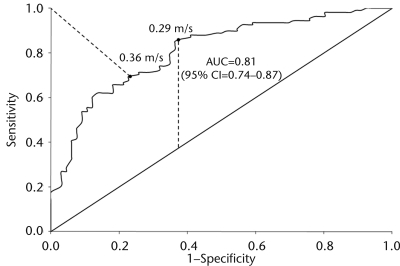
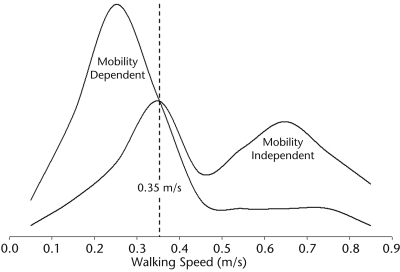
Methods: This study recruited a convenience sample of 174 ambulatory adults aged 65 years and older who had been admitted to a medical-surgical unit of a university hospital. The participants' mean (SD) age was 75 (7) years. Fifty-nine percent were women, 66% were white, and more than 40% were hospitalized for cardiovascular problems. Usual-pace walking speed was assessed over 2.4 m. Walking independence was assessed through self-report. Several methods were used to determine the threshold speed that best differentiated walking-independent patients from walking-dependent patients. Approaches included a receiver operating characteristic (ROC) curve, sensitivity and specificity, and frequency distributions.
Results: The participants' mean (SD) walking speed was 0.43 (0.23) m/s, and 62% reported walking independence. Nearly 75% of the patients walked more slowly than the lowest community-based risk threshold, yet 90% were discharged home. Overall, cut-point analyses suggested that 0.30 to 0.35 m/s may be a meaningful threshold for maintaining in-hospital walking independence. For simplicity of clinical application, 0.35 m/s was chosen as the optimal cut point for the sample. This threshold yielded a balance between sensitivity and specificity (71% for both). Limitations The limitations of this study were the small size of the convenience sample and the single health outcome measure.
Conclusions: Walking speeds of older adults who are acutely ill are substantially slower than established community-based norms and risk thresholds. The threshold identified, which was approximately 50% lower than the lowest published community-based risk threshold, may serve as an initial risk threshold or target value for maintaining in-hospital walking independence.
Figures
References
-
- Berkman LF, Seeman TE, Albert M, et al. High, usual and impaired functioning in community-dwelling older men and women: findings from the MacArthur Foundation Research Network on Successful Aging. J Clin Epidemiol. 1993;46:1129–1140 - PubMed
-
- Cesari M, Kritchevsky SB, Penninx BW, et al. Prognostic value of usual gait speed in well-functioning older people: results from the Health, Aging and Body Composition Study. J Am Geriatr Soc. 2005;53:1675–1680 - PubMed
-
- Guralnik JM, Ferrucci L, Pieper CF, et al. Lower extremity function and subsequent disability: consistency across studies, predictive models, and value of gait speed alone compared with the short physical performance battery. J Gerontol A Biol Sci Med Sci. 2000;55:M221–M231 - PubMed
-
- Haworth JA. Gait, aging and dementia. Rev Clin Gerontol. 2008;18:39–52
Publication types
MeSH terms
Grants and funding
LinkOut - more resources
Full Text Sources
