


Invasive predators deplete genetic diversity of island lizards
- PMID: 20706576
- PMCID: PMC2919386
- DOI: 10.1371/journal.pone.0012061
Invasive predators deplete genetic diversity of island lizards
Abstract
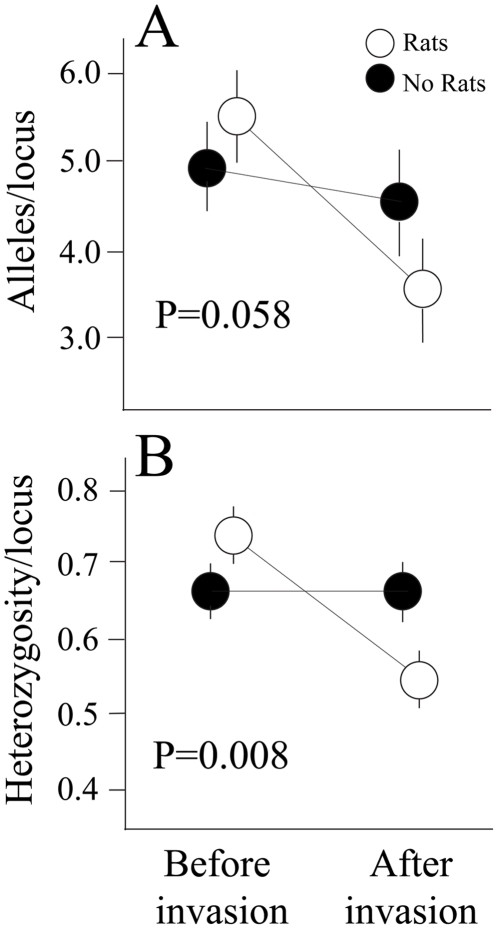
Invasive species can dramatically impact natural populations, especially those living on islands. Though numerous examples illustrate the ecological impact of invasive predators, no study has examined the genetic consequences for native populations subject to invasion. Here we capitalize on a natural experiment in which a long-term study of the brown anole lizard (Anolis sagrei) was interrupted by rat invasion. An island population that was devastated by rats recovered numerically following rat extermination. However, population genetic analyses at six microsatellite loci suggested a possible loss of genetic diversity due to invasion when compared to an uninvaded island studied over the same time frame. Our results provide partial support for the hypothesis that invasive predators can impact the genetic diversity of resident island populations.
Conflict of interest statement
Figures

References
-
- Hadfield MG, Saufler JE. The demographics of destruction: isolated populations of arboreal snails and sustained predation by rats on the island of Moloka'i 1982–2006. Biological Invasions. 2009;11:1595–1609.
-
- Towns DR, Atkinson IAE, Daugherty CH. Have the harmful effects of introduced rats on islands been exaggerated? Biological Invasions. 2006;8:863–891.
-
- Koper N, Mozel KE, Henderson DC. Recent declines in northern tall-grass prairies and effects of patch structure on community persistence. Biological Conservation. 2010;143:220–229.
-
- Thomson D. Measuring the effects of invasive species on the demography of a rare endemic plant. Biological Invasions. 2005;7:615–624.
-
- Nei M, Maruyama T, Chakraborty R. Bottleneck Effect and Genetic-Variability in Populations. Evolution. 1975;29:1–10. - PubMed
Publication types
MeSH terms
LinkOut - more resources
Full Text Sources
