


Association of childhood obesity with atopic and nonatopic asthma: results from the National Health and Nutrition Examination Survey 1999-2006
- PMID: 20707763
- PMCID: PMC2975947
- DOI: 10.3109/02770903.2010.489388
Association of childhood obesity with atopic and nonatopic asthma: results from the National Health and Nutrition Examination Survey 1999-2006
Abstract
Background: Obesity and asthma prevalence have both risen among children over the last several decades, and research efforts increasingly suggest that obesity is associated with asthma. Some, but not all, studies have shown that the effect of obesity on asthma is stronger among nonatopic individuals than among those with atopy. Systemic inflammation may be a factor in this relationship.
Objective: To examine the association of obesity with atopic and nonatopic asthma among U.S. children and to assess the role of C-reactive protein.
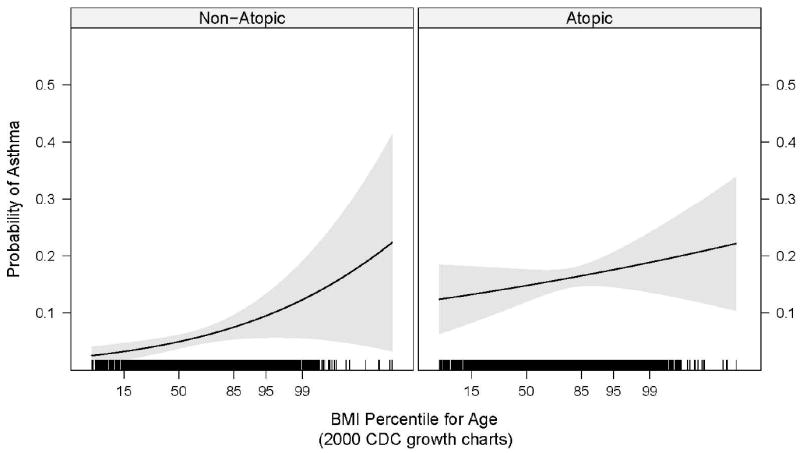
Design: Nationally representative data from the National Health and Nutrition Examination Survey (NHANES) were used to examine the relationship of weight to current asthma using logistic regression. Overweight was defined as ≥ 85th percentile of body mass index (BMI)-for-age and obesity was defined as ≥ 95th percentile of BMI-for-age. The presence of at least one positive allergen-specific immunoglobulin E (IgE) was used to stratify the relationship by atopic status in 2005-2006 data (n = 3387). Setting and Participants. Stratified, multistage probability sampling was used to identify survey participants. This analysis includes children ages 2-19 (n = 16,074) from the 1999-2006 NHANES who have information on BMI and current asthma.
Main outcome measure: Self-report of doctor-diagnosed current asthma.
Results: Obesity was significantly related to current asthma among children and adolescents (odds ratio [OR]: 1.68, 95% confidence interval [CI]: 1.33, 2.12). The association was stronger in nonatopic children (OR: 2.46, 95% CI: 1.21, 5.02) than in atopic children (OR: 1.34, 95% CI: 0.70, 2.57) (interaction p value = .09). C-reactive protein levels were associated with current asthma in nonatopic children, but not after adjusting for BMI.
Conclusion: Excess weight in children is associated with higher rates of asthma, especially asthma that is not accompanied by allergic disease.
Conflict of interest statement
Figures
References
-
- Ogden CL, Carroll MD, Curtin LR, McDowell MA, Tabak CJ, Flegal KM. Prevalence of overweight and obesity in the United States, 1999-2004. JAMA. 2006;295:1549–1555. - PubMed
-
- Akinbami L. The state of childhood asthma, United States, 1980-2005. MMWR. 2006:1–24. - PubMed
-
- Chinn S. Obesity and asthma: evidence for and against a causal relation. J Asthma. 2003;40:1–16. - PubMed
-
- Ford ES. The epidemiology of obesity and asthma. J Allergy Clin Immunol. 2005;115:897–909. - PubMed
-
- Shore SA, Johnston RA. Obesity and asthma. Pharmacol Ther. 2006;110:83–102. - PubMed
Publication types
MeSH terms
Substances
Grants and funding
LinkOut - more resources
Full Text Sources
Medical
Research Materials
