


ReCGiP, a database of reproduction candidate genes in pigs based on bibliomics
- PMID: 20707928
- PMCID: PMC3224910
- DOI: 10.1186/1477-7827-8-96
ReCGiP, a database of reproduction candidate genes in pigs based on bibliomics
Abstract
Background: Reproduction in pigs is one of the most economically important traits. To improve the reproductive performances, numerous studies have focused on the identification of candidate genes. However, it is hard for one to read all literatures thoroughly to get information. So we have developed a database providing candidate genes for reproductive researches in pig by mining and processing existing biological literatures in human and pigs, named as ReCGiP.
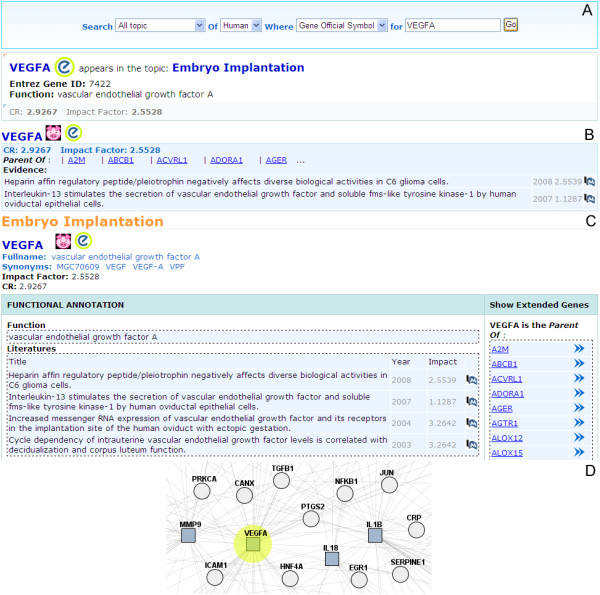
Description: Based on text-mining and comparative genomics, ReCGiP presents diverse information of reproduction-relevant genes in human and pig. The genes were sorted by the degree of relevance with the reproduction topics and were visualized in a gene's co-occurrence network where two genes were connected if they were co-cited in a PubMed abstract. The 'hub' genes which had more 'neighbors' were thought to be have more important functions and could be identified by the user in their web browser. In addition, ReCGiP provided integrated GO annotation, OMIM and biological pathway information collected from the Internet. Both pig and human gene information can be found in the database, which is now available.
Conclusions: ReCGiP is a unique database providing information on reproduction related genes for pig. It can be used in the area of the molecular genetics, the genetic linkage map, and the breeding of the pig and other livestock. Moreover, it can be used as a reference for human reproduction research.
Figures
References
-
- Short TH, Rothschild MF, Southwood OI, McLaren DG, De Vries A, Van der Steen H, Eckardt GR, Tuggle CK, Helm J, Vaske DA. Effect of the estrogen receptor locus on reproduction and production traits in four commercial pig lines. Am Soc Animal Sci. 1997;75:3138–3142. - PubMed
-
- Rothschild MF, Soller M. Candidate gene analysis to detect genes controlling traits of economic importance in domestic livestock. Probe. 1997;8:13–20.
Publication types
MeSH terms
LinkOut - more resources
Full Text Sources
