


Predicting response to leuprolide of women with premenstrual dysphoric disorder by daily mood rating dynamics
- PMID: 20708199
- PMCID: PMC3262182
- DOI: 10.1016/j.jpsychires.2010.07.006
Predicting response to leuprolide of women with premenstrual dysphoric disorder by daily mood rating dynamics
Abstract
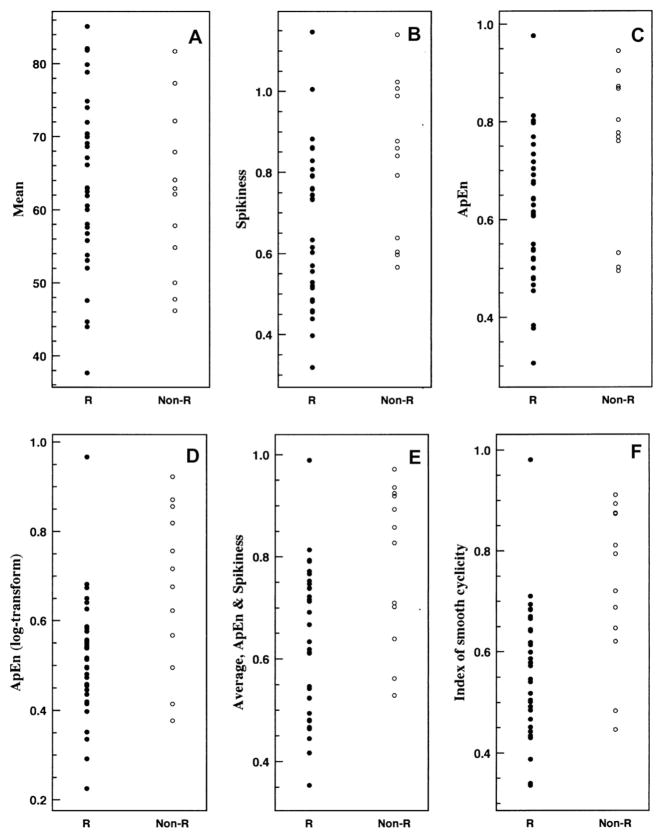
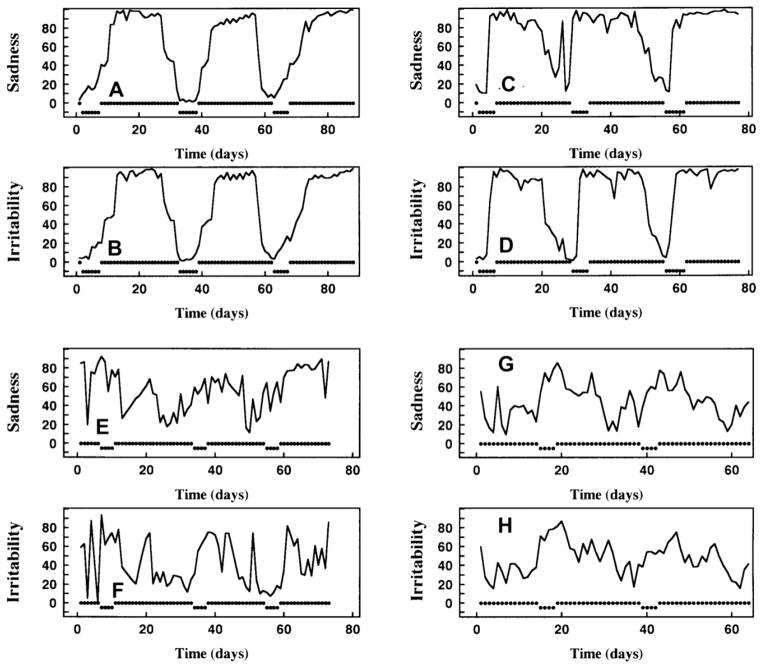
Approximately 60-70 percent of women with premenstrual dysphoric disorder (PMDD) show symptomatic improvement in response to the GnRH agonist leuprolide acetate, which suppresses ovarian function. However, it has been very difficult to either predict or understand why some women respond, while others do not. We applied several complementary statistical methods to the dynamics of pre-treatment mood rating data to determine possible predictors of response for women with PMDD. We compared responders (n = 33) to nonresponders (n = 12) in clinical trials of leuprolide (three months in duration) as a treatment for PMDD, on the basis of pre-trial daily self-ratings of sadness, anxiety, and irritability. We analyzed both sequential irregularity (approximate entropy, ApEn) and a quantification of spikiness of these series, as well as a composite measure that equally weighted these two statistics. Both ApEn and Spikiness were significantly smaller for responders than nonresponders (P ≤ 0.005); the composite measure was smaller for responders compared with nonresponders (P ≤ 0.002) and discriminated between the subgroups with high sensitivity and specificity. In contrast, mean symptom levels were indistinct between the subgroups. Relatively regular and non-spiky pre-trial dynamics of mood ratings predict a positive response to leuprolide by women with PMDD with high probability, moreover based on typically less than 3 months of daily records. The statistical measures may have broad and direct applicability to behavioral studies for many psychiatric disorders, facilitating both accurate diagnosis and the prediction of response to treatment.
Copyright © 2010 Elsevier Ltd. All rights reserved.
Conflict of interest statement
None declared.
Figures
References
-
- Akay M, Lipping T, Moodie K, Hoopes PJ. Effects of hypoxia on the complexity of respiratory patterns during maturation. Early Human Development. 2002;70:55–71. - PubMed
-
- American College of Obstetricians and Gynecologists. ACOG practice bulletin 15. Washington, DC: ACOG; 2000. Clinical management guidelines for obstetricians-gynecologists:premenstrual syndrome.
-
- American Psychiatric Association. Diagnostic and statistical manual of mental disorders. 4. Washington, DC: American Psychiatric Association; 1994.
-
- Angst J, Sellaro R, Stolar M, Merikangas KR, Endicott J. The epidemiology of perimenstrual psychological symptoms. Acta Psychiatrica Scandinavica. 2001;104:110–6. - PubMed
-
- Brown CS, Ling FW, Andersen RN, Farmer RG, Arheart KL. Efficacy of depot leuprolide in premenstrual syndrome: effect of symptom severity and type in a controlled trial. Obstetrics and Gynecology. 1994;84:779–86. - PubMed
Publication types
MeSH terms
Substances
Grants and funding
LinkOut - more resources
Full Text Sources
Medical
Research Materials
