. 2010 Oct;26(10):425-30.
doi: 10.1016/j.tig.2010.07.002. Epub 2010 Aug 12.

Maintenance of duplicate genes and their functional redundancy by reduced expression

Affiliations

Maintenance of duplicate genes and their functional redundancy by reduced expression

Wenfeng Qian et al. Trends Genet. 2010 Oct.

Abstract

Although evolutionary theories predict functional divergence between duplicate genes, many old duplicates still maintain a high degree of functional similarity and are synthetically lethal or sick, an observation that has puzzled many geneticists. We propose that expression reduction, a special type of subfunctionalization, facilitates the retention of duplicates and the conservation of their ancestral functions. Consistent with this hypothesis, gene expression data from both yeasts and mammals show a substantial decrease in the level of gene expression after duplication. Whereas the majority of the expression reductions are likely to be neutral, some are apparently beneficial to rebalancing gene dosage after duplication.


Figures

Fig. 1
Fig. 1
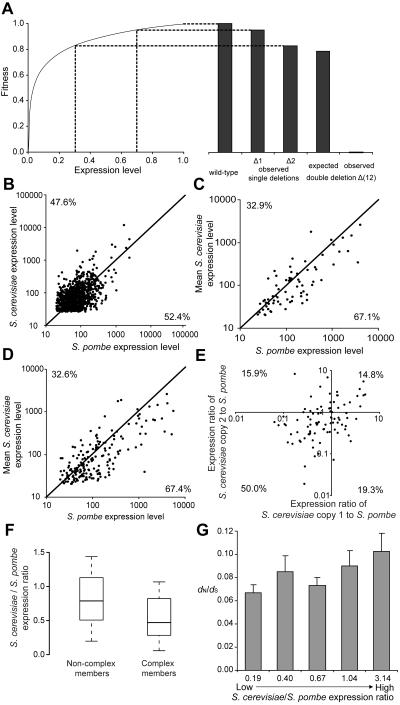
Expression reduction after gene duplication in yeasts. (A) Because fitness is a concave function of expression level, there is negative epistasis between duplicates with reduced expression. Synthetic lethality is observed in this hypothetical example. The fitness of the double deletion strain expected under no epistasis is calculated assuming multiplicative fitness effects of single deletions. (B) Expression levels of one-to-one orthologs in S. cerevisiae and S. pombe. Each dot represents a one-to-one orthologous pair. The diagonal line indicates identical expressions in the two species. Fractions of orthologs below and above the diagonal line are indicated. (C) Expression levels of two-to-one orthologs that are negatively epistatic in S. cerevisiae. Each dot represents a two-to-one ortholog. The expression level of the single gene in S. pombe and the mean expression of the duplicates in S. cerevisiae are presented. The fraction of dots below the diagonal is significantly greater than that in (B) (P = 0.006). (D) Expression levels of all two-to-one orthologs. The fraction of dots below the diagonal is significantly greater than that in (B) (P = 2×10⁻⁵). (E) Expression ratios between S. cerevisiae and S. pombe for all two-to-one orthologs. The fraction of dots in the lower-left quadrant is significantly greater than expected (P = 6×10⁻⁶). (F)S. cerevisiae duplicates involved in the same protein complexes have lower S. cerevisiae/S. pombe expression ratios (P < 0.05). The values of upper quartile, median, and lower quartile are indicated in each box, whereas the bars outside the box indicate semiquartile ranges. (G) Two-to-one orthologs with lower mean S. cerevisiae expression relative to S. pombe expression show lower nonsynonymous/synonymous rate ratios (dN/dS) between S. cerevisiae duplicates (P < 0.05 for unbinned data). The five bins are of equal sample size and the mean expression ratio and mean dN/dS value for each bin are presented. The error bars show one standard error.
Fig. 2
Fig. 2
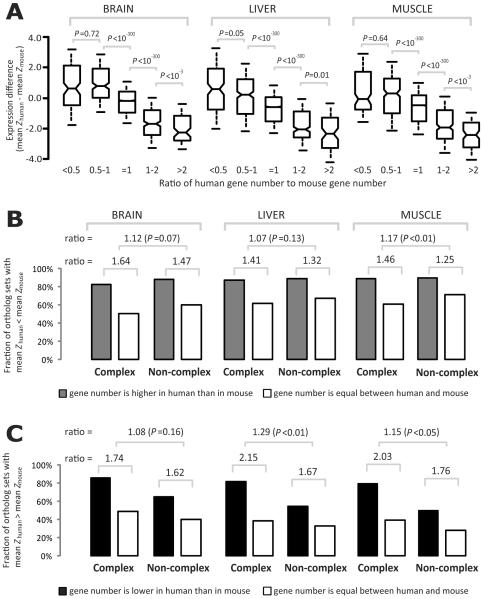
Expression reduction after gene duplication in mammals. (A) Mean expression of a human-mouse orthologous set in a species reduces as the number of paralogs in that species increases. The values of upper quartile, median, and lower quartile are indicated in each box, whereas the bars outside the box indicate semiquartile ranges. P-values between boxes are from one-tail Mann-Whitney U tests. Spearman's rank correlation coefficients for the unbinned data of the three tissues are −0.178 (P < 10−106), −0.159 (P < 10−82) and −0.152 (P < 10−77), respectively. (B) Proteins functioning as subunits of complexes are subject to more widespread expression reductions after gene duplication, evident from orthologous sets in which human genes outnumber mouse genes. P-values are estimated from 10,000 parametric bootstrapping replications. (C) Proteins functioning as subunits of complexes are subject to more widespread expression reductions after gene duplication, evident from orthologous sets in which mouse genes outnumber human genes.

References

    1. Ohno S. Evolution by Gene Duplication. Springer; Verlag: 1970.
    1. Zhang J. Evolution by gene duplication-an update. Trends Ecol. Evol. 2003;18:292–298.
    1. Lynch M, Force A. The probability of duplicate gene preservation by subfunctionalization. Genetics. 2000;154:459–473. - PMC - PubMed
    1. He X, Zhang J. Rapid subfunctionalization accompanied by prolonged and substantial neofunctionalization in duplicate gene evolution. Genetics. 2005;169:1157–1164. - PMC - PubMed
    1. DeLuna A, et al. Exposing the fitness contribution of duplicated genes. Nat Genet. 2008;40:676–681. - PubMed

Publication types