


Associative symmetry and stimulus-class formation by pigeons: the role of non-reinforced baseline relations
- PMID: 20708666
- PMCID: PMC2975765
- DOI: 10.1016/j.beproc.2010.07.012
Associative symmetry and stimulus-class formation by pigeons: the role of non-reinforced baseline relations
Abstract
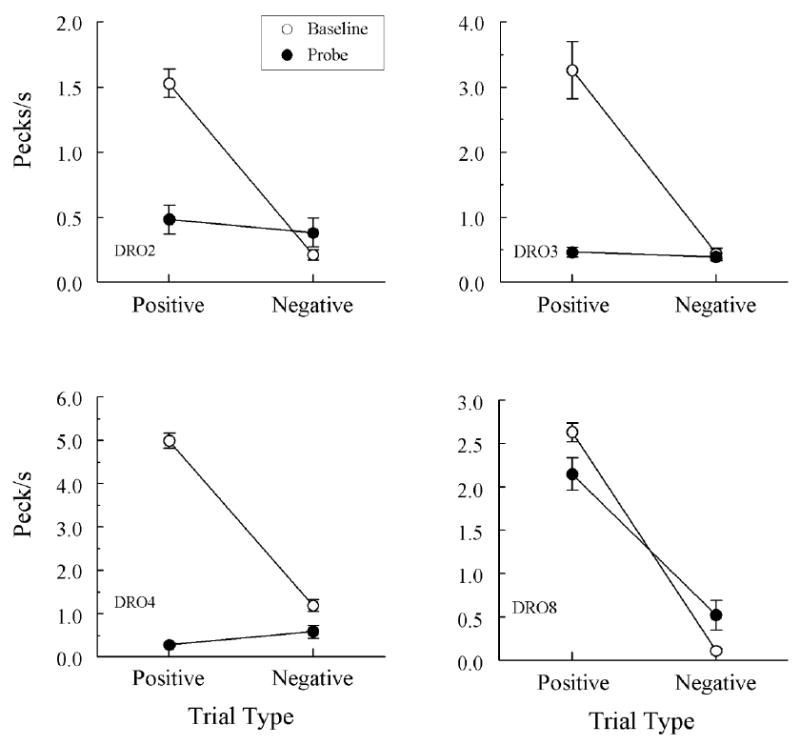
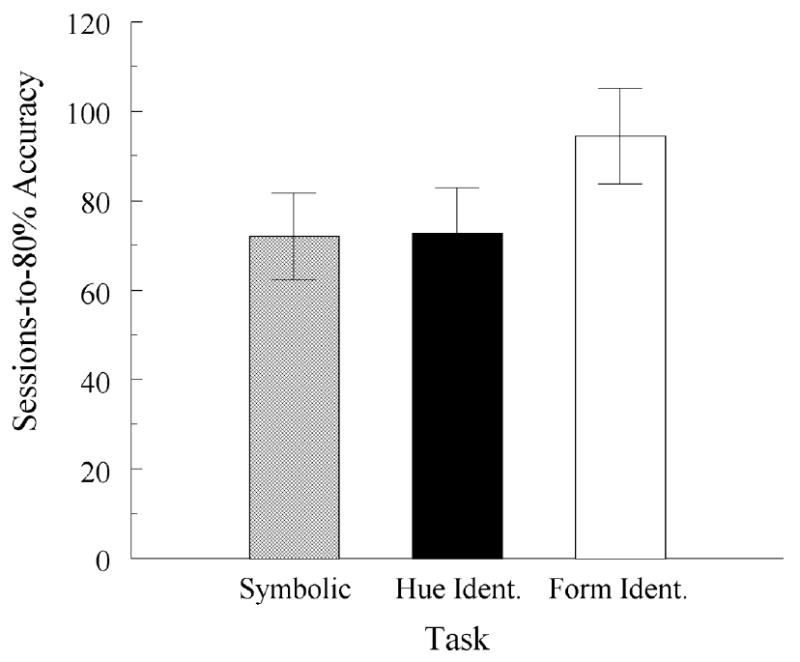
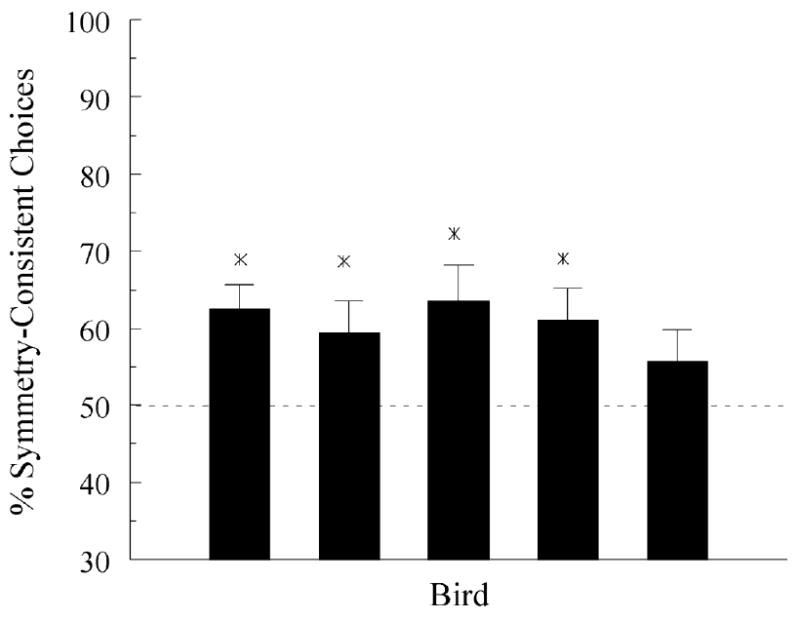
Two experiments tested the assumption of Urcuioli's (2008) theory of pigeons' equivalence-class formation that consistent non-reinforcement of certain stimulus combinations in successive matching juxtaposed with consistent reinforcement of other combinations generates stimulus classes containing the elements of the reinforced combinations. In Experiment 1, pigeons were concurrently trained on symbolic (AB) and two identity (AA and BB) successive tasks in which half of all identity trials ended in non-reinforcement but all AB trials were reinforced, contingent upon either responding or not responding to the comparisons. Subsequent symmetry (BA) probe trials showed evidence of symmetry in one of four pigeons. In Experiment 2, pigeons learned three pair-comparison tasks in which left versus right spatial choices were reinforced after the various sample-comparison combinations comprising AB, AA, and BB conditional discriminations. Non-differentially reinforced BA probe trials following acquisition showed some indication of symmetrical choice responding. The overall results contradict the theoretical predictions derived from Urcuioli (2008) and those from Experiment 2 challenge other stimulus-class analyses as well.
Copyright © 2010 Elsevier B.V. All rights reserved.
Figures

References
-
- Dube WV, McIlvane WJ. Some implications of a stimulus control topography analysis for emergent behavior and stimulus classes. In: Zentall TR, Smeets PM, editors. Stimulus class formation in humans and animals. New York: Elsevier; 1996. pp. 197–218.
MeSH terms
Grants and funding
LinkOut - more resources
Full Text Sources
