


Semi-solid gels function as physical barriers to human immunodeficiency virus transport in vitro
- PMID: 20709109
- PMCID: PMC3072786
- DOI: 10.1016/j.antiviral.2010.08.006
Semi-solid gels function as physical barriers to human immunodeficiency virus transport in vitro
Abstract
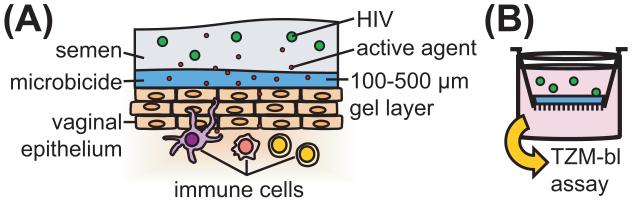
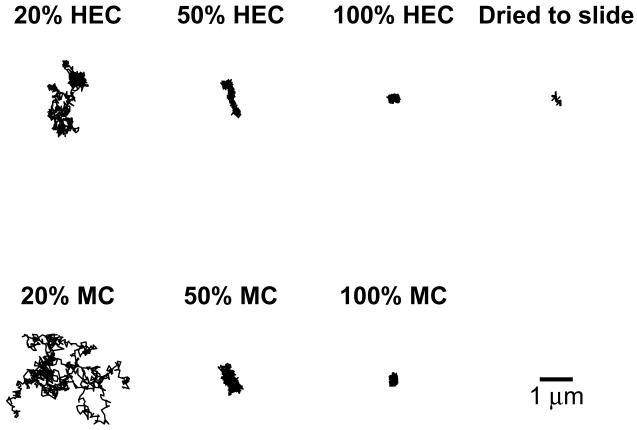
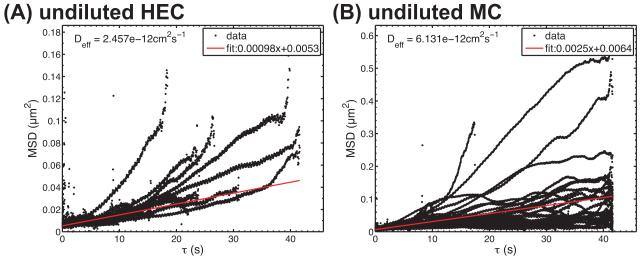
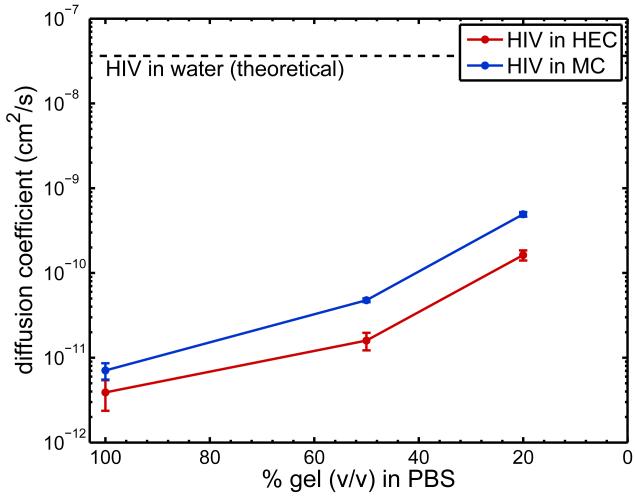
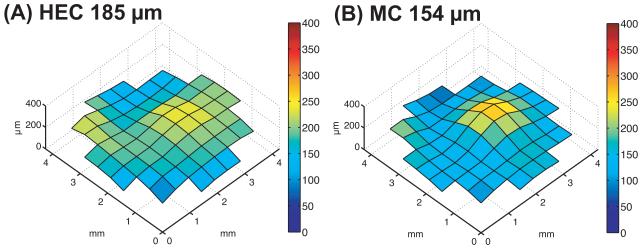
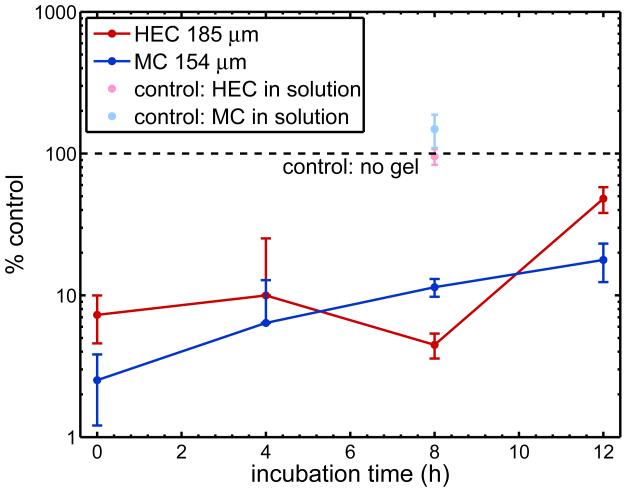
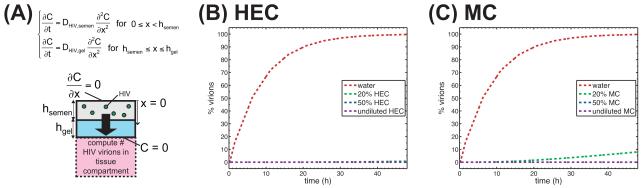
Vaginal gels may act as physical barriers to HIV during sexual transmission. However, the extent and significance of this effect are not well understood. During male-to-female sexual transmission of HIV, semen containing infectious HIV is present within the lower female reproductive tract. In cases where a topical gel has previously been applied to the vaginal epithelium, virions must move through gel layers before reaching vulnerable tissue. This additional barrier could affect the functioning of anti-HIV microbicide gels and placebos. To better understand HIV transport in gels, we: (1) quantified diffusion coefficients of HIV virions within semi-solid delivery vehicles; and (2) tested the barrier functioning of thin gel layers in a Transwell system. Two gels used as placebos in microbicides clinical trials, hydroxyethyl cellulose (HEC) and methylcellulose (MC), were found to hinder HIV transport in vitro. The diffusion coefficients for HIV virions in undiluted HEC and MC were 4±2 x 10⁻¹² and 7±1 x 10⁻¹² cm²/s, respectively. These are almost 10,000 times lower than the diffusion coefficient for HIV in water. Substantial gel dilution (80%:diluent/gel, v/v) was required before diffusion coefficients rose to even two orders of magnitude lower than those in water. In the Transwell system, gel layers of approximately 150-μm thickness reduced HIV transport. There was a log reduction in the amount of HIV that had breached the Transwell membrane after 0-, 4-, and 8-h incubations. The ability of a gel to function as a physical barrier to HIV transport from semen to tissue will also depend on its distribution over the epithelium and effects of dilution by vaginal fluids or semen. Results here can serve as a baseline for future design of products that act as barriers to HIV transmission. The potential barrier function of placebo gels should be considered in the design and interpretation of microbicides clinical trials.
Copyright © 2010 Elsevier B.V. All rights reserved.
Figures
References
-
- Abdool Karim S, Coletti A, Richardson B, Ramjee G, Hoffman I, Chirenje M, Taha T, Kapina M, Maslankowski L, Soto-Torres L. Safety and effectiveness of vaginal microbicides BufferGel and 0.5% PRO 2000/5 gel for the prevention of HIV infection in women: results of the HPTN 035 Trial; 16th Conference on Retroviruses and Opportunistics Infections; Montreal, QC, CANADA. 2009.
-
- Balimane PV, Chong S, Morrison RA. Current methodologies used for evaluation of intestinal permeability and absorption. Journal of Pharmacological and Toxicological Methods. 2000;44:301–312. - PubMed
-
- Barnhart KT, Pretorius ES, Timbers K, Shera D, Shabbout M, Malamud D. In vivo distribution of a vaginal gel: MRI evaluation of the effects of gel volume, time and simulated intercourse. Contraception. 2004;70:498–505. - PubMed
-
- Behrens I, Pena AIV, Alonso MJ, Kissel T. Nanoparticles in Human Intestinal Cell Lines and Rats: The Effect of Mucus on Particle Adsorption. Pharmaceutical Research. 2002 - PubMed
-
- Behrens I, Stenberg P, Artursson P, Kissel T. Transport of Lipophilic Drug Molecules in a New Mucus-Secreting Cell Culture Model Based on HT29-MTX …. Pharmaceutical Research. 2001 - PubMed
Publication types
MeSH terms
Substances
Grants and funding
LinkOut - more resources
Full Text Sources
Other Literature Sources
Medical
