Review
. 2011 Apr;10(2):191-200.
doi: 10.1016/j.arr.2010.07.005. Epub 2010 Aug 10.

Contemporary human genetic strategies in aging research

Affiliations
Review

Contemporary human genetic strategies in aging research

Cinnamon S Bloss et al. Ageing Res Rev. 2011 Apr.

Abstract

Human aging is a complex, multifactorial process influenced by a number of genetic and non-genetic factors. This article first reviews genetic strategies for human aging research and considers the advantages and disadvantages of each. We then discuss the issue of phenotypic definition for genetic studies of aging, including longevity/life span, as well as disease-free survival and other endophenotypes. Finally, we argue that extensions of this area of research, including incorporation of gene×environment interactions, multivariate phenotypes, integration of functional genomic annotations, and exploitation of orthology - many of which are already initiated and ongoing - are critical to advancing this field.


Figures

Figure 1
Figure 1
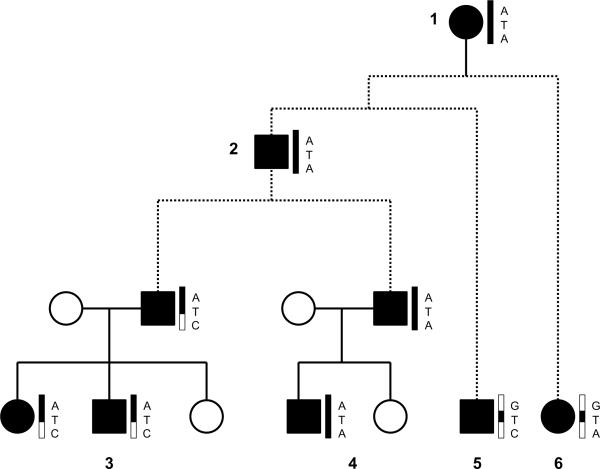
Diagrammatic representation of the hypothetical transmission of a genetic variant influencing lifespan from a distant relative, as well as chromosomal markers flanking the variant. Solid lines denote exact generational links, whereas dotted lines denote lines of descent involving a large number of generations. Shaded pedigree members have a specific lifespan phenotype. Vertical rectangles next to pedigree member symbols reflect a single chromosome and letters next to the rectangle reflect nucleotides at SNP loci. Shading within the rectangles indicates chromosomal material from the founder (denoted by the number 1) who introduced the life span-influencing nucleotide variation `T' into the population. This founder had `A' nucleotides at SNP positions flanking the site of the life span-influencing locus. The entire founder haplotype `A-T-A' was preserved during transmission to individual 2. However, recombination events during meioses in individuals with the line of descent from individual 1 to individuals 5 and 6 caused individuals 5 and 6 to only inherit the `T' allele associated with the life span-influencing phenotype. Due to a recombination event in the line of descent from individual 2 to the father in nuclear family 3, the father in nuclear family 3 only inherited the `A-T' haplotype encompassing the 1st two markers from ancestor 2 but not the ancestral founder allele `A' at the third locus. However, this `A-T' haplotype was preserved in the transmission of the chromosome harboring the `T' life span-influencing variant to two offspring in the nuclear family. The father in nuclear family 5 inherited the entire founder `A-T-A' haplotype and transmitted it in its entirely to one of his offspring due to a lack of recombination. Thus, although two siblings share part (`A-T') of the ancestral founder chromosomal haplotype harboring the `T' life span-influencing nucleotide (`A-T-A'), and an offspring in nuclear family 4 inherited the entire `A-T-A' haplotype, all the individuals in the latest generation with the life span phenotype only share the `T' ancestral functional nucleotide inherited from individual 1.
Figure 2
Figure 2
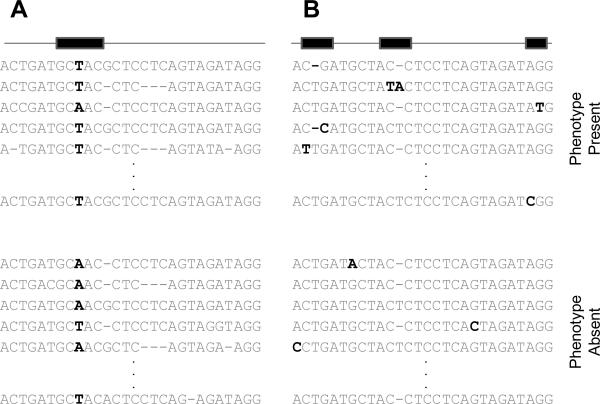
Two hypothetical situations arising from sequencing studies pursued in order to identify variations associated with a particular phenotype. Letters refer to adjacent nucleotides in haploid sequence obtained from individuals with and without a particular longevity-related phenotype. Dashes indicate deletions or absent nucleotides. Shaded rectangles above the sequence denote functional elements within the sequence. In Figure 2a, a common variant, in bold, is associated with the presence/absence of the phenotype. Note that due to phenocopies, incomplete penetrance, and other factors influencing the phenotype, some, but not all individuals with/without the phenotype have exactly the same nucleotide at the position of the common functional variant. In Figure 2b a series of rare variations (in bold) in functional regions of the sequence are greater in frequency among the individuals with the phenotype. Note that some individuals without the phenotype also possess rare variations but they are not in functional regions and hence are not likely to influence the phenotype.
Figure 3
Figure 3
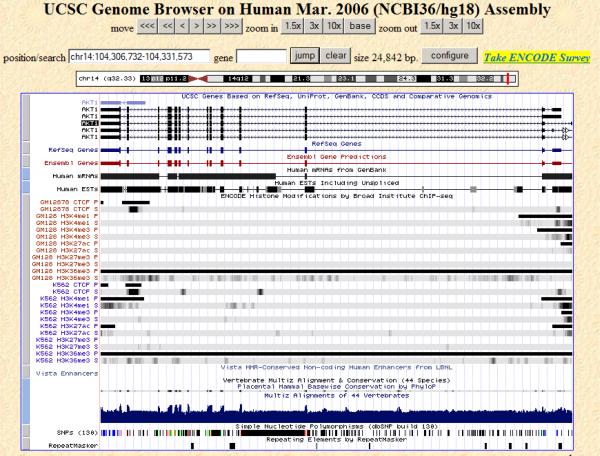
Functional annotation of the AKT1 gene obtained from the UCSC genome browser (http://genome.ucsc.edu/; chromosome 14, base positions: 104,306,732-104,331,573) recently shown to harbor variations associated with human longevity [54]. The figure reveals the amount of information amassed about the AKT1 gene. The base locations and positions of coding regions and known mRNAs and spliced transcripts are depicted in the upper portions of the figure (e.g., `Refseq genes' and `Human ESTs'). The middle portions of the figure provide the locations of empirically identified regulatory elements in the region including enhancers and silencers obtained from protein-DNA binding studies involving different transcription factors (e.g., `CTCF' and `H3K4me1'). Cross species nucleotide conservation levels, the locations of known single nucleotide polymorphisms, and the locations of repeated sequences are provided in the lower portions of the figure.

References

    1. Tan Q, Zhao JH, Zhang D, Kruse TA, Christensen K. Power for genetic association study of human longevity using the case-control design. Am J Epidemiol. 2008;168:890–896. - PMC - PubMed
    1. Manolio TA. Study designs to enhance identification of genetic factors in healthy aging. Nutr Rev. 2007;65:S228–233. - PubMed
    1. Fallin MD, Matteini A. Genetic epidemiology in aging research. J Gerontol A Biol Sci Med Sci. 2009;64:47–60. - PMC - PubMed
    1. Lander ES, Weinberg RA. Genomics: journey to the center of biology. Science. 2000;287:1777–1782. - PubMed
    1. Lander ES, Schork NJ. Genetic dissection of complex traits. Science. 1994;265:2037–2048. - PubMed

Publication types