. 2010 Oct 1;26(19):2438-44.
doi: 10.1093/bioinformatics/btq466. Epub 2010 Aug 13.

ChEA: transcription factor regulation inferred from integrating genome-wide ChIP-X experiments

Affiliations

ChEA: transcription factor regulation inferred from integrating genome-wide ChIP-X experiments

Alexander Lachmann et al. Bioinformatics. .

Abstract

Motivation: Experiments such as ChIP-chip, ChIP-seq, ChIP-PET and DamID (the four methods referred herein as ChIP-X) are used to profile the binding of transcription factors to DNA at a genome-wide scale. Such experiments provide hundreds to thousands of potential binding sites for a given transcription factor in proximity to gene coding regions.

Results: In order to integrate data from such studies and utilize it for further biological discovery, we collected interactions from such experiments to construct a mammalian ChIP-X database. The database contains 189,933 interactions, manually extracted from 87 publications, describing the binding of 92 transcription factors to 31,932 target genes. We used the database to analyze mRNA expression data where we perform gene-list enrichment analysis using the ChIP-X database as the prior biological knowledge gene-list library. The system is delivered as a web-based interactive application called ChIP Enrichment Analysis (ChEA). With ChEA, users can input lists of mammalian gene symbols for which the program computes over-representation of transcription factor targets from the ChIP-X database. The ChEA database allowed us to reconstruct an initial network of transcription factors connected based on shared overlapping targets and binding site proximity. To demonstrate the utility of ChEA we present three case studies. We show how by combining the Connectivity Map (CMAP) with ChEA, we can rank pairs of compounds to be used to target specific transcription factor activity in cancer cells.

Availability: The ChEA software and ChIP-X database is freely available online at: http://amp.pharm.mssm.edu/lib/chea.jsp.


Figures

Fig. 1.
Fig. 1.
Screen-shot from the ChIP-X database web application. Users can interactively adjust the normalized peak height threshold to determine the genes that are regulated by the transcription factor.
Fig. 2.
Fig. 2.
Screen-shot from the ChEA program web application. Users can cut and paste input lists of genes in the text box on the left. The system reports a ranked list of transcription factors/experiments (concatenated string that includes the transcription factor and the PubMed ID linking the factor to a specific study) based on over-representation of transcription factor putative targets in the input list.
Fig. 3.
Fig. 3.
Transcription factor/target gene similarity distance table based on hierarchical clustering on 122 experiments from the manually extracted ChIP-X database. Transcription factors are considered similar if target genes reported from a ChIP-X study implicate significant overlap (Jaccard's Coefficient). Detailed labels of all experiments are shown in the Supplementary Figures.
Fig. 4.
Fig. 4.
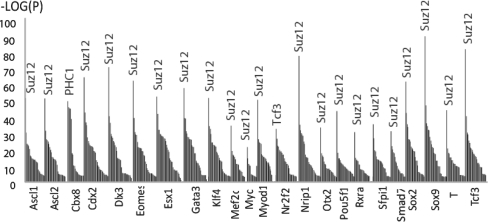
ChEA analysis of the top 500 genes that changed in their mRNA expression after 50 over-expression experiments of single transcription factors in mESCs. The P-value rankings from ChEA for each transcription factor over-expression perturbation are inverse log transformed. The top-ranked transcription factors reported by ChEA are labeled (peaks in the bar graph). Out of the 50 perturbations, only those factors that reached a low P-value of 1.0E-22 are labeled for clarity. Full results are available in Supplementary Table S5.
Fig. 5.
Fig. 5.
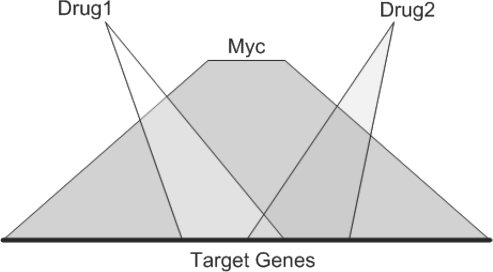
Illustration of the concept of using pair-wise drug perturbations to target the Myc target gene space.

References

    1. Andén NE, et al. Evidence for a central noradrenaline receptor stimulation by clonidine. Life Science. 1970;9:513–523. - PubMed
    1. Berger S, et al. Genes2Networks: connecting lists of gene symbols using mammalian protein interactions databases. BMC Bioinformatics. 2007;8:372. - PMC - PubMed
    1. Bromberg KD, et al. Design logic of a cannabinoid receptor signaling network that triggers neurite outgrowth. Science. 2008;320:903–909. - PMC - PubMed
    1. Chuang H.-Y, et al. Network-based classification of breast cancer metastasis. Mol. Syst. Biol. 2007;3 - PMC - PubMed
    1. Geva-Zatorsky N, et al. Protein dynamics in drug combinations: a linear superposition of individual-drug responses. Cell. 2010;140:643–651. - PubMed

Publication types

Substances