. 2010 Oct 29;285(44):33914-22.
doi: 10.1074/jbc.M110.116590. Epub 2010 Aug 13.

Vacuolar cation/H+ antiporters of Saccharomyces cerevisiae

Affiliations

Vacuolar cation/H+ antiporters of Saccharomyces cerevisiae

Olivier Cagnac et al. J Biol Chem. .

Abstract

We previously demonstrated that Saccharomyces cerevisiae vnx1Δ mutant strains displayed an almost total loss of Na(+) and K(+)/H(+) antiporter activity in a vacuole-enriched fraction. However, using different in vitro transport conditions, we were able to reveal additional K(+)/H(+) antiporter activity. By disrupting genes encoding transporters potentially involved in the vnx1 mutant strain, we determined that Vcx1p is responsible for this activity. This result was further confirmed by complementation of the vnx1Δvcx1Δ nhx1Δ triple mutant with Vcx1p and its inactivated mutant Vcx1p-H303A. Like the Ca(2+)/H(+) antiporter activity catalyzed by Vcx1p, the K(+)/H(+) antiporter activity was strongly inhibited by Cd(2+) and to a lesser extend by Zn(2+). Unlike as previously observed for NHX1 or VNX1, VCX1 overexpression only marginally improved the growth of yeast strain AXT3 in the presence of high concentrations of K(+) and had no effect on hygromycin sensitivity. Subcellular localization showed that Vcx1p and Vnx1p are targeted to the vacuolar membrane, whereas Nhx1p is targeted to prevacuoles. The relative importance of Nhx1p, Vnx1p, and Vcx1p in the vacuolar accumulation of monovalent cations will be discussed.


Figures
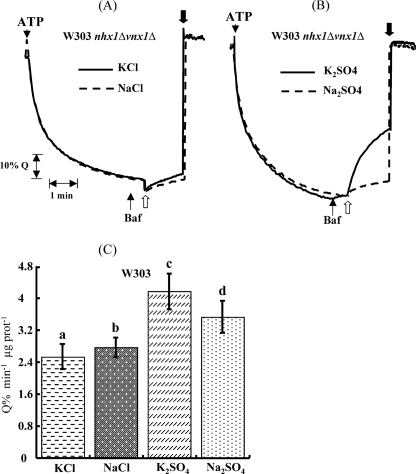
FIGURE 1.
FIGURE 1.
Salt-dependent cation/H+ transport across the vacuolar membrane. Proton movements were monitored by following the fluorescence quenching of acridine orange as described under “Experimental Procedures” and supplemental Fig. 1S. At the indicated times, vacuole acidification was initiated by the addition of ATP. After a steady-state acidic inside pH gradient was attained, the activity of the H+-ATPase was partially inhibited by the addition of bafilomycin (Baf). A and B, cation/proton antiport using isolated vacuoles of the OC02 yeast strain (nhx1Δ, vnx1Δ) was monitored as the recovery of fluorescence quench upon addition of 100 mm of Na+ or K+ (white arrows). At the indicated time, 20 mm of (NH4)2SO4 was added to collapse the ΔpH across the vacuolar membrane to recover 100% of the fluorescence (black arrows). Traces are representative of at least three independent experiments. C, effect of the counter anion on the transport rate has been measured in isolated vacuoles from the wild type strain W303. The initial rates of cation-dependent H+ movement were assayed by measuring the initial rates of fluorescence quench recovery after addition of 100 mm chloride salts or 50 mm sulfate salts as indicated in the figure. Data represent the means ±S.D. of six measurements from three independent preparations. Bars with different letters indicate values that are significantly different when compared with the other three conditions tested as determined by a two-tailed t test (p < 0.009) (GraphPad software).
FIGURE 2.
FIGURE 2.
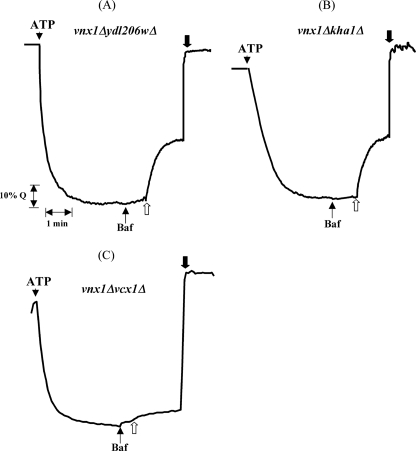
Identification of Vcx1p as a potential K+/H+ antiporter by a reverse genetic approach. Exchange of potassium against protons across the vacuolar membrane of BY double mutant strains was monitored using K2SO4 as indicated. At the indicated times bafilomycin (Baf), 100 mm K+ equivalent (white arrows), and 20 mm of (NH4)2SO4 were added (black arrows). Traces are representative of three measurements of the same vacuolar preparation.
FIGURE 3.
FIGURE 3.
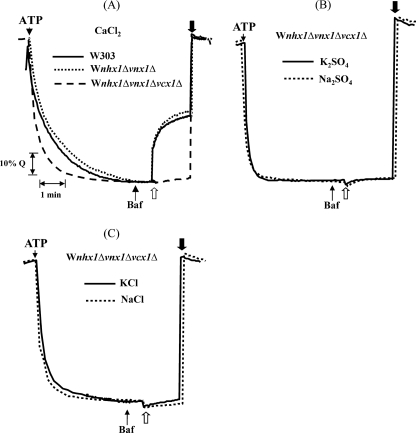
Effect of VCX1 disruption on vacuolar transport of potassium and calcium. At the indicated time (white arrow), 12.5 μm CaCl2 was added to visualize the recovery of fluorescence in the presence or absence of Vcx1p (A). At the indicated time (white arrow) 50 mm Na2SO4 and K2SO4 (B) or 100 mm of NaCl and KCl (C) was added to collapse the pH gradient across the vacuolar membrane of W303 nhx1Δvnx1Δvcx1Δ resulting in a cation-dependent H+ movement and alkalinization of the vesicular lumen. Traces are representative of at least three independent experiments. Baf, bafilomycin.
FIGURE 4.
FIGURE 4.
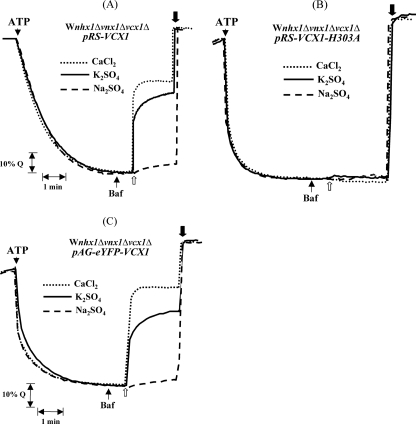
Transport activity measured in isolated vacuoles of the W303 triple mutant strain complemented with VCX1 genes and derivatives. The yeast strain W303 nhx1Δvnx1Δvcx1Δ was transformed with the yeast integrative vectors pRS306 Gal1 or pAG306 eYFP into which VCX1 or VCX1-H303A had been previously introduced by recombination as described under “Experimental Procedures.” The correct genomic integration of plasmids was verified by PCR. Acridine orange fluorescence recovery mediated by Vcx1p (A), Vcx1p-H303A (B), and eYFP::Vcx1p (C), by the addition of 50 mm Na2SO4 (- - -), 50 mm K2SO4 (formula image), or 12.5 μm CaCl2 (···), was monitored after the establishment of a pH gradient and partial inhibition of the H+-ATPase by bafilomycin A (Baf). Traces are representative of three experiments using independent membrane preparations from independent clones.
FIGURE 5.
FIGURE 5.
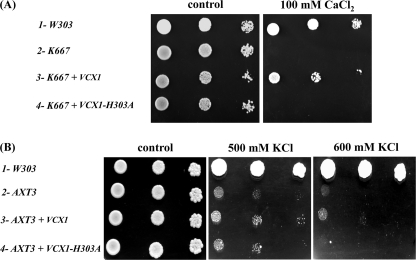
Growth of various mutant strains expressing VCX1 and VCX1-H303A in the presence of toxic concentrations of cations. Both VCX1 and VCX1-H303A were introduced into the yeast shuttle vector pYES-DEST52 using Gateway recombination as described under “Experimental Procedures.” Each construct was introduced into K667 (cnb1Δ pmc1Δ vcx1Δ) and AXT3 (ena1-2Δ nha1Δ nhx1Δ) mutant strains. Each strain was grown, and serial dilutions were made as described under “Experimental Procedures.” Five microliters of each dilution were spotted onto YPG medium with addition of a high concentration of CaCl2 (A) or KCl (B) as indicated. Plates were incubated at 30 °C for 2–5 days.
FIGURE 6.
FIGURE 6.
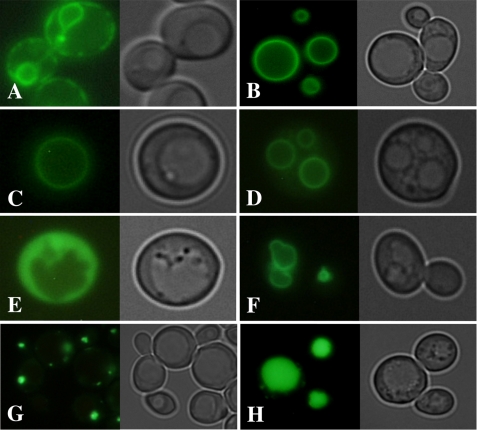
Vacuolar localization of Vcx1p and Vcx1p-H303A mutant. The localization was performed using the triple mutant strain OC05 (nhx1Δvnx1Δvcx1Δ). Cells were transformed with yeast expression vectors of the pAG series (see “Experimental Procedures”). A, vacuolar Ca2+/H+ exchanger Vcx1p fused to GFP at the C terminus displayed a typical signal of ER localization as observed for the vacuolar Na+/H+ exchanger Vnx1p in the same conditions (16). When Vnx1p was fused to eYFP at the N terminus (B), the fluorescent signal was observed at the vacuolar membrane. An identical localization for Vcx1p (C) and its inactive mutant form Vcx1p-H303A (D) was observed when they were fused to eYFP at their N termini. The same results were obtained using the yeast strain K667 and AXT3 (data not shown). Fluorescence was observed in the cytosol of cells expressing a free form of eYFP (E). A positive control of vacuolar membrane localization was obtained using the vacuolar ATPase Vph1p subunit fused to GFP at the C terminus (F). Nhx1p::eGFP chimeric protein was used to visualize PVC localization (G), although the vacuolar lumen was stained by accumulation of GFP specifically targeted to the vacuolar lumen by addition of the signal peptide of carboxypeptidase Y at the N terminus (H). Images were acquired as described under “Experimental Procedures” using an excitation 450–490-nm bandpass filter and an emission 515-nm cuton long pass filter.
FIGURE 7.
FIGURE 7.
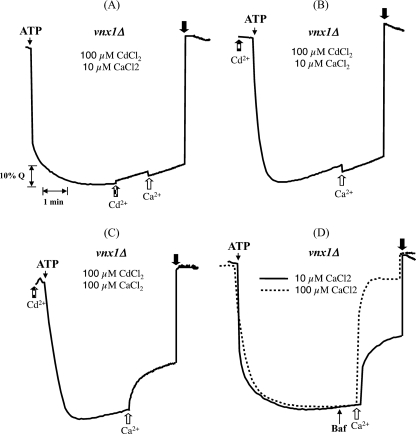
Inhibition of Ca2+/H+ exchange activity in presence of Cd2+. Vacuoles isolated from the yeast strain BY vnx1Δ were used to visualize the effect of 100 μm CdCl2 on the Ca2+/H+ exchange activity mediated by Vcx1p. CdCl2 was added to the reaction mixture 1 min before the addition of Ca2+ (A) or before the initiation of fluorescence quenching by the addition of ATP (B) as indicated by the gray arrow. The fluorescence recovery was followed after addition of 10 μm (A and B) or 100 μm CaCl2 (C) as indicated by the white arrow. The same experiments were performed in the absence of CdCl2 (D). Traces are representative of two experiments using independent membrane preparations. Baf, bafilomycin A.
FIGURE 8.
FIGURE 8.
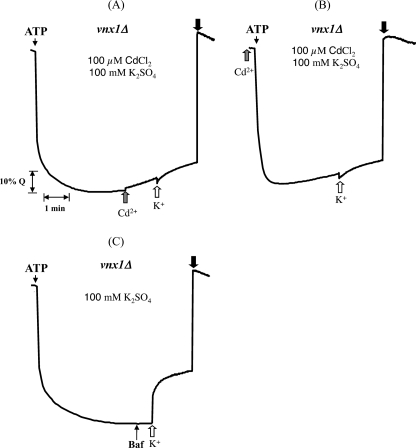
Inhibition of K+/H+ exchange activity in presence of Cd2+. Inhibition of the K+/H+ exchange reaction by Cd2+ was assayed as described in Fig. 7. The fluorescence recovery was followed after the addition of 50 mm K2SO4 (A and B) as indicated by the white arrow. The same experiments were performed in the absence of CdCl2 (C). Traces are representative of two experiments using independent membrane preparations. Baf, bafilomycin A.
FIGURE 9.
FIGURE 9.
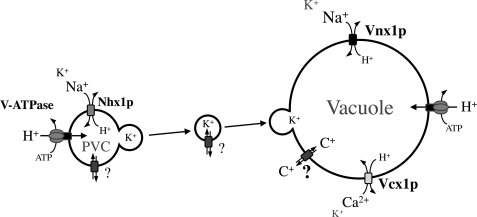
Model for cation accumulation in the vacuole. Vacuolar membrane-bound antiporters Vcx1p and Vnx1p use the proton gradient generated by the V-ATPase to energize the transport of cations into the lumen of the main vacuole. The contribution of the pre-vacuolar alkali cation/H+ antiporter, Nhx1p, in the accumulation of K+ and Na+ remains to be determined. Nhx1p could play a role in the loading of the PVC from which vesicles containing ions are sent to the main vacuoles and therefore contribute to the accumulation of ions in the vacuolar lumen. Knowing the importance of Nhx1p in the control of the vesicular trafficking, this antiporter could play a role in the targeting of uncharacterized cation transporters (?) to the vacuolar membrane and indirectly affect ion homeostasis of the vacuole.

References

    1. Epstein W. (2003) Prog. Nucleic Acid Res. Mol. Biol. 75, 293–320 - PubMed
    1. Rodríguez-Navarro A. (2000) Biochim. Biophys. Acta 1469, 1–30 - PubMed
    1. Maathuis F. J. (2009) Curr. Opin. Plant. Biol. 12, 250–258 - PubMed
    1. Prior C., Potier S., Souciet J. L., Sychrova H. (1996) FEBS Lett. 387, 89–93 - PubMed
    1. Nass R., Cunningham K. W., Rao R. (1997) J. Biol. Chem. 272, 26145–26152 - PubMed

Publication types