Review
. 2010 Sep;31(9):1095-102.
doi: 10.1038/aps.2010.127. Epub 2010 Aug 16.

COX-mediated endothelium-dependent contractions: from the past to recent discoveries

Affiliations
Review

COX-mediated endothelium-dependent contractions: from the past to recent discoveries

Michael Sze-Ka Wong et al. Acta Pharmacol Sin. 2010 Sep.

Abstract

Endothelial cells release various substances to control the tone of the underlying vascular smooth muscle. Nitric oxide (NO) is the best defined endothelium-derived relaxing factor (EDRF). Endothelial cells can also increase vascular tone by releasing endothelium-derived contracting factors (EDCF). The over-production of EDCF contributes to the endothelial dysfunctions which accompanies various vascular diseases. The present review summarizes and discusses the mechanisms leading to the release of EDCFs derived from the metabolism of arachidonic acid. This release can be triggered by agonists such as acetylcholine, adenosine nucleotides or by stretch. All these stimuli are able to induce calcium influx into the endothelial cells, an effect which can be mimicked by calcium ionophores. The augmentation in intracellular calcium ion concentration initiates the release of EDCF. Downstream processes include activation of phospholipase A(2) (PLA(2)), cyclooxygenases (COX) and the production of reactive oxygen species (ROS) and vasoconstrictor prostanoids (endoperoxides, prostacyclin, thromboxane A(2) and other prostaglandins) which subsequently diffuse to, and activate thromboxane-prostanoid (TP) receptors on the vascular smooth muscle cells leading to contraction.


Figures
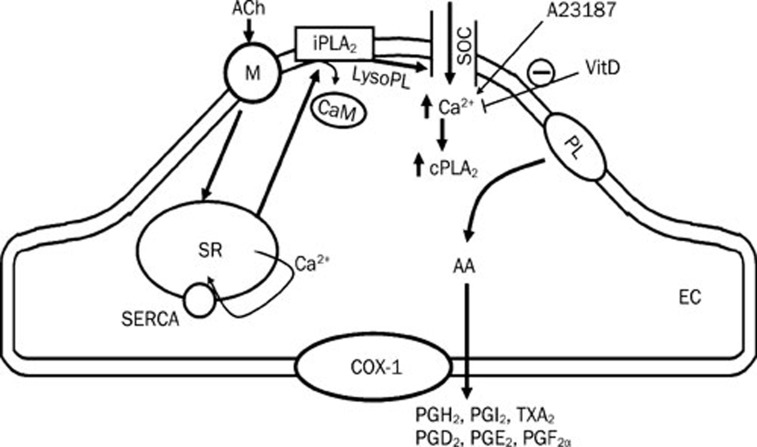
Figure 1
Figure 1
Acetylcholine (ACh) activates muscarinic receptors (M) on the endothelial cell membrane and triggers the release of calcium from intracellular stores. The resulting calcium-depletion process displaces the inhibitory calmodulin (CaM) from iPLA2. Activated iPLA2 produces lysophospholipids (LysoPL) which in turn open store-operated calcium channels (SOCs) leading to the influx of extracellular calcium into the endothelial cells. This large influx of calcium ions then activates cPLA2 which catalyze the production of arachidonic acids (AA). The later is then metabolized by cyclooxygenase-1 (COX-1) to prostanoids. 1,25-Dihydroxyvitamin D3 (Vit D) acutely reduces endothelium-dependent contraction by inhibiting the calcium surge. cPLA2=calcium dependent phospholipase A2; EC=endothelial cells; iPLA2=calcium independent phospholipase A2; PGD2=prostaglandin D2; PGE2=prostaglandin E2; PGF=prostaglandin F; PGH2=endoperoxides; PGI2=prostacyclin; PL=phospholipids; SERCA=sarco/endoplasmic reticulum Ca2+-ATPase; SR=sarcoplasmic reticulum; TXA2=thromoboxane A2.
Figure 2
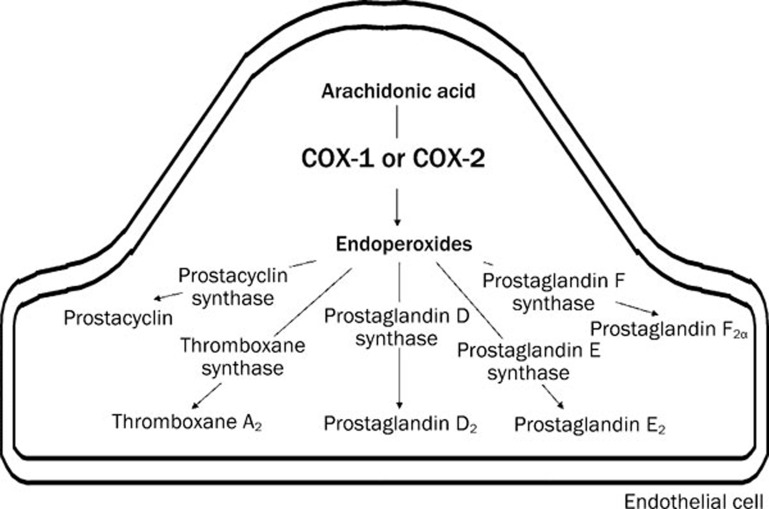
Figure 2
Metabolism of arachidonic acid into specific prostanoids. Arachidonic acid is converted to endoperoxides by the activity of cyclooxygenase (COX). Endoperoxides are then converted to various prostaglandins by their respective synthase.
Figure 3
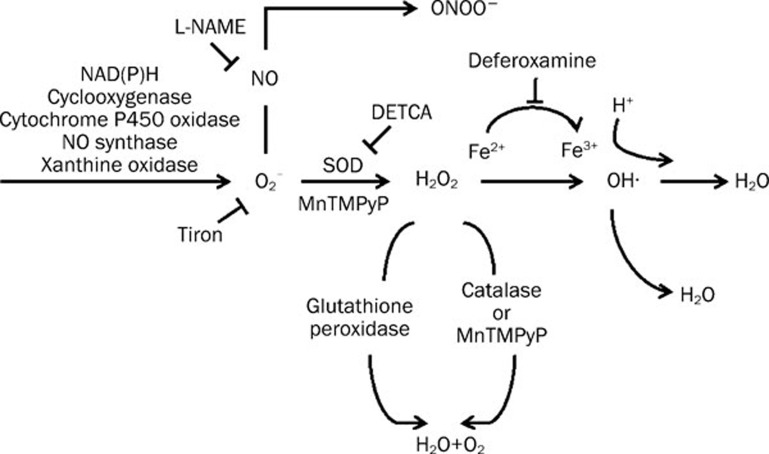
Figure 3
Formation of oxygen-derived free radicals of relevance for endothelium-dependent responses, and pharmacological agents commonly used to determine their importance. Superoxide anions (O2) can be generated from molecular oxygen by the actions of various enzymes. O2 can react with NO to form peroxynitrite (ONOO). It can also be converted to hydrogen peroxide (H2O2) by superoxide dismutase (SOD). H2O2 can be transformed to hydroxyl radicals by ferrous ions or converted to H2O by catalase and glutathione. Tiron scavenges O2 inside cells. DETCA inhibits SOD. Deferoxamine is an iron chelator that scavenges hydroxyl radicals. L-NAME inhibits NO synthase. MnTMPyP mimics the combined effect of SOD and catalase. DETCA=diethyldithiocarbamic acid; GSH=glutathione; GSSG=glutathione disulphide; L-NAME=Nω-nitro-L-arginine methyl ester hydrochloride; MnTMPyP=Mn(III)tetrakis(1-methyl-4-pyridyl)porphyrin pentachloride; NO=nitric oxide; tiron=4,5-dihydroxy-1,3-benzenedisulphonic acid. (Adapted from Shi et al 2007, by permission)Arachidonic acid is converted to endoperoxides by the activity of cyclooxygenase (COX). Endoperoxides are then converted to various prostaglandins by their respective synthase.
Figure 4
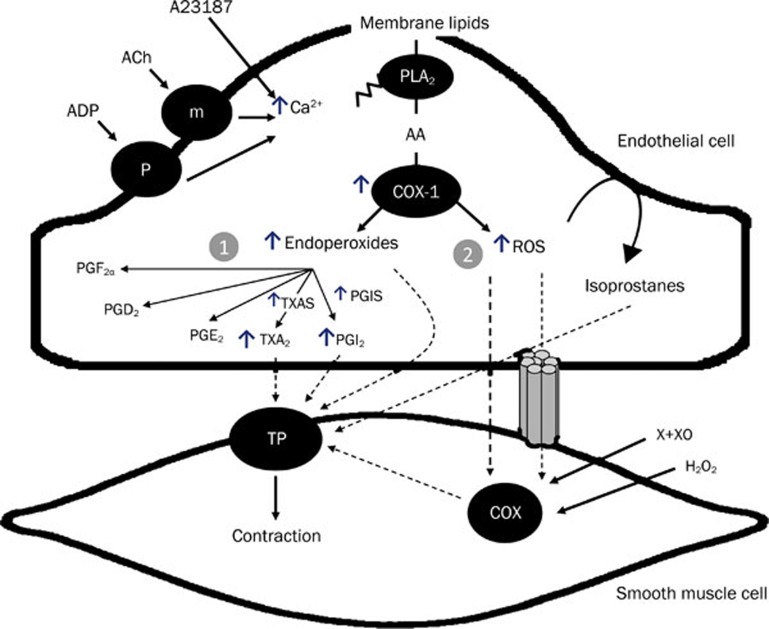
Figure 4
Endothelium-dependent contraction is likely to be comprised of two components: generation of prostanoids and ROS. Each component depends on the activity of endothelial COX-1 and the stimulation of the TP receptors located on the smooth muscle to evoke contraction. In the SHR aorta, there is an increased expression of COX-1 and EP3 receptors, increased release of calcium, ROS, endoperoxides and other prostanoids, which facilitates the greater occurrence of endothelium-dependent contraction in the hypertensive rat. The necessary increase in intracellular calcium can be triggered by receptor-dependent agonists, such as acetylcholine or ADP, or mimicked with calcium increasing agents, such as the calcium ionophore A23187. The abnormal increase in intracellular ROS can be mimicked by the exogenous addition of H2O2 or the generation of extracellular ROS by incubation of xanthine with xanthine oxidase. AA=arachidonic acid; ACh=acetycholine; ADP=adenosine diphosphate; H2O2=hydrogen peroxide;m=muscarinic receptors; P=purinergic receptors; PGD2=prostaglandin D2; PGE2=prostaglandin E2; PGF=prostaglandin F; PGI2=prostacyclin; PLA2=phospholipase A2; ROS=reactive oxygen species; TXA2= thromboxane A2; X+XO=xanthine plus xanthine oxidase. (Adapted from Tang and Vanhoutte, 2009, by permission).

References

    1. Furchgott RF, Zawadzki JV. The obligatory role of endothelial-cells in the relaxation of arterial smooth-muscle by acetylcholine. Nature. 1980;288:373–76. - PubMed
    1. Furchgott RF, Vanhoutte PM. Endothelium-derived relaxing and contracting factors. FASEB J. 1989;3:2007–18. - PubMed
    1. Luescher TF, Vanhoutte PM.The Endothelium: Modulator of Cardiovascular Function Boca RatonFL CRC Press; 1990
    1. Vanhoutte PM. The other endothelium-derived vasoactive factors. Circulation. 1993;87:V9–17.
    1. Gluais P, Edwards G, Weston AH, Vanhoutte PM, Feletou M. Hydrogen peroxide and endothelium-dependent hyperpolarization in the guinea-pig carotid artery. Eur J Pharmacol. 2005;513:219–24. - PubMed

MeSH terms