. 2010 Aug;23(4):403-13.
doi: 10.1089/vim.2010.0025.

A variable region in GP4 of European-type porcine reproductive and respiratory syndrome virus induces neutralizing antibodies against homologous but not heterologous virus strains

Affiliations

A variable region in GP4 of European-type porcine reproductive and respiratory syndrome virus induces neutralizing antibodies against homologous but not heterologous virus strains

Merijn Vanhee et al. Viral Immunol. 2010 Aug.

Abstract

Porcine reproductive and respiratory syndrome virus (PRRSV) can induce severe reproductive failure in sows, and is involved in the porcine respiratory disease complex. The glycoprotein GP4 of the European prototype PRRSV strain Lelystad virus (LV) contains a linear neutralizing epitope that is located in a highly variable region. The current study aimed to evaluate the antibody response against this and other epitopes on GP4 to infection of pigs with European-type PRRSV. It was shown that three virus strains, differing in the region that corresponds to the neutralizing epitope on GP4 of LV, strongly induce antibodies against this area. Antibodies against the epitopes of the different virus strains were purified from polyclonal swine sera, and used in virus-neutralization tests on primary alveolar macrophages. This revealed that antibodies against the variable region in GP4 of different virus strains are able to neutralize infection with homologous but not heterologous virus strains.


Figures
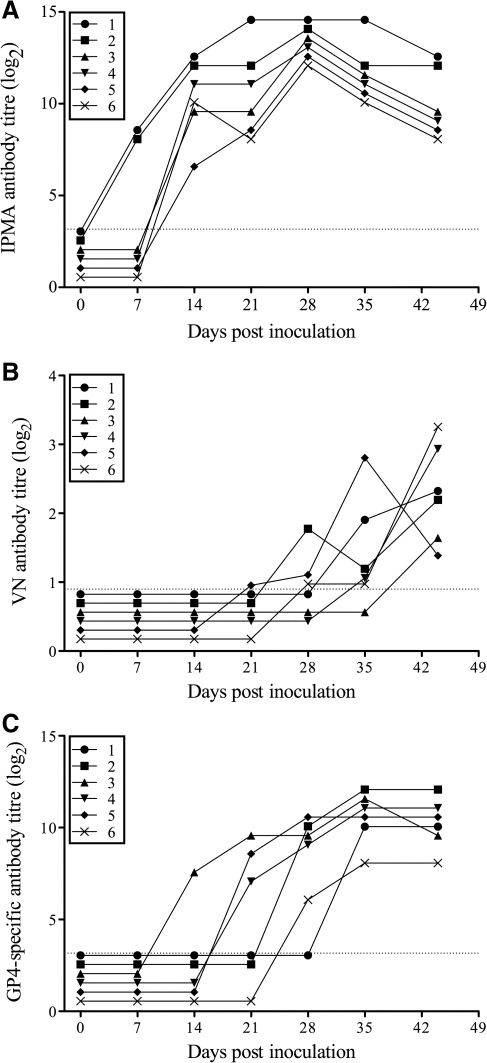
FIG. 1.
FIG. 1.
Virus-specific (A), virus-neutralizing (B), and GP4-specific (C) antibody titers upon infection with LV. Virus-specific antibody titers (log2) were determined by IPMA, virus-neutralizing antibody titers (log2) by classical seroneutralization testing on Marc-145 cells, and GP4-specific antibody titers (log2) by IPMA on GP4-expressing Hek-293T cells for six LV-infected pigs at different time points post-inoculation. The dotted lines represent detection limits (1–6 = pig no. 1–6).
FIG. 2.
FIG. 2.
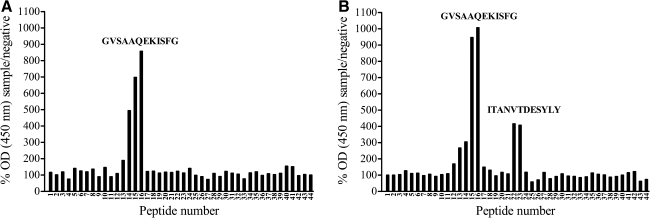
GP4 pepscan profiles of sera derived from LV-infected pigs. Sera collected at 44 d p.i. with LV were diluted 1:100 and used in a pepscan analysis with overlapping peptides covering GP4 of LV. OD (450 nm) values at each peptide were determined for both the test sample and a negative serum sample, and the OD for the test sample was expressed as the relative percentage of the negative control value for each peptide separately (percentage sample/negative). Signals were considered positive when the percentage sample/negative at a certain peptide was more than two times the mean percentage sample/negative over all peptides. Graph A represents a serum sample in which antibodies against peptides 14–16 were detected (core sequence GVSAAQEKISFG). Graph B represents a serum sample in which antibodies against peptides 14–16 as well as 22–23 (core sequence ITANVTDESYLY) were detected.
FIG. 3.
FIG. 3.
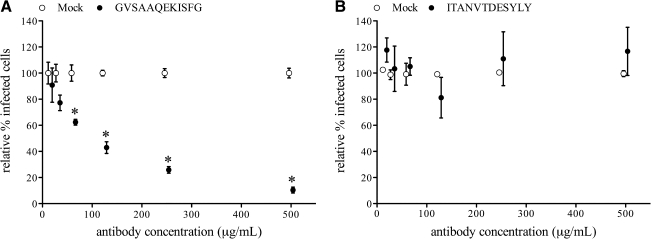
Reduction of LV replication in PAM by serum antibodies against peptides GVSAAQEKISFG (A) and ITANVTDESYLY (B). A single replication virus-neutralization test was performed with a 1:2 dilution series (500–16 μg/mL) of epitope-specific serum antibodies, purified from polyclonal serum by peptide affinity chromatography. Protein A purified immunoglobulins of a PRRSV-negative pig were included as mock antibodies (open symbols). The number of infected cells for each antibody dilution was set relative to the mean number of infected cells for all mock conditions within one experiment. The means and standard deviations of three experiments were calculated and are given in the graphs. Statistically significant differences (*p < 0.01) were observed with GVSAAQEKISFG-specific antibodies, compared to mock antibodies for antibody concentrations between 500 and 63 μg/mL.
FIG. 4.
FIG. 4.
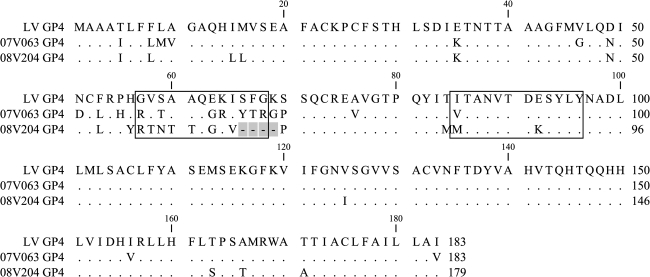
Alignment of the GP4 aa sequences of PRRSV strains LV, 07V063, and 08V204. The ORF4 sequences of PRRSV strain 07V063 and 08V204 were determined by PCR and cycle sequencing, and the deduced aa sequences were aligned to the GP4 sequence of LV. Dots represent residues that are identical to LV, and hyphens indicate gaps. Boxes indicate regions that are recognized by sera in pepscan analyses.
FIG. 5.
FIG. 5.
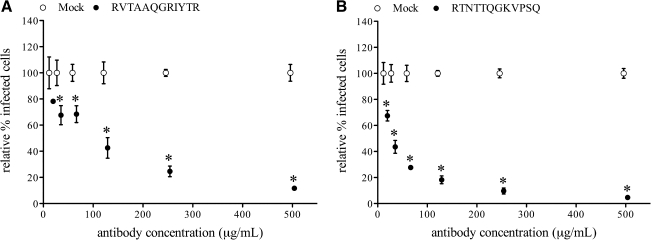
Reduction of replication of 07V063 (A), or 08V204 (B), in PAM by serum antibodies against peptides RVTAAQGRIYTR and RTNTTQGKVPSQ, respectively. A single replication virus-neutralization test with homologous virus was performed with a 1:2 dilution series (500–16 μg/mL) of epitope-specific serum antibodies, purified from polyclonal serum by peptide affinity chromatography. Protein A purified immunoglobulins of a PRRSV-negative pig were included as mock antibodies (open symbols). The number of infected cells for each antibody dilution was set relative to the mean number of infected cells for all mock conditions within one experiment. The means and standard deviations of three experiments were calculated and are given in the graphs. Statistically significant differences (*p < 0.01) were observed with RVTAAQGRIYTR-specific antibodies, compared to mock antibodies, for antibody concentrations between 500 and 31 μg/mL in the test with virus strain 07V063. In the test with virus strain 08V204, statistically significant differences (*p < 0.01) were observed with RTNTTQGKVPSQ-specific antibodies, compared to mock antibodies, for antibody concentrations between 500 and 16 μg/mL.
FIG. 6.
FIG. 6.
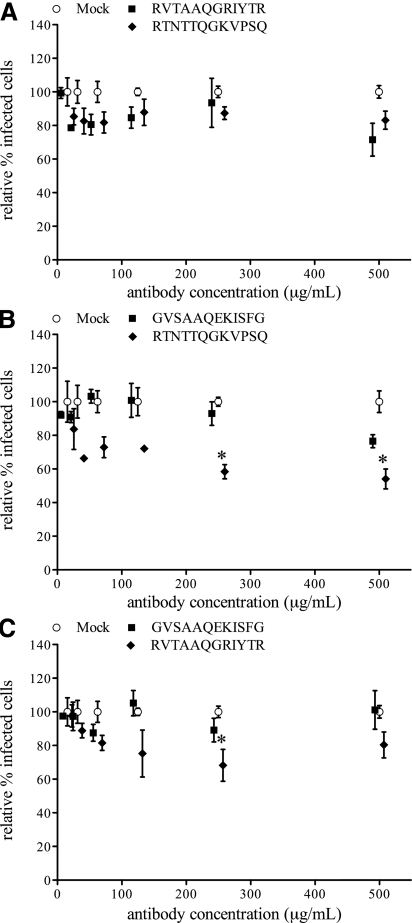
Reduction of replication of LV (A), 07V063 (B) and 08V204 (C) in PAM by antibodies against the neutralizing epitopes on GP4 of the respective heterologous virus strains. Single-replication virus-neutralization tests were performed with LV, 07V063, and 08V204, with a 1:2 dilution series (500–16 μg/mL) of serum antibodies against the neutralizing epitope of the two respective heterologous virus strains. Epitope-specific antibodies were purified from polyclonal serum by peptide affinity chromatography. Protein A purified immunoglobulins of a PRRSV-negative pig were included as mock antibodies (open symbols). The number of infected cells for each antibody dilution was set relative to the mean number of infected cells for all mock conditions within one experiment. The means and standard deviations of three experiments were calculated and are given in the graphs. Statistically significant differences (*p < 0.01) were observed with RTNTTQGKVPSQ-specific antibodies, compared to mock antibodies, for antibody concentrations of 500 and 250 μg/mL in the test with virus strain 07V063 (B). In the test with virus strain 08V204 (C), statistically significant differences (*p < 0.01) were observed with RVTAAQGRIYTR-specific antibodies, compared to mock antibodies, for an antibody concentration of 250 μg/mL.

Comment in

  • A focus on humoral immunity.
    Woodland DL. Woodland DL. Viral Immunol. 2010 Aug;23(4):341. doi: 10.1089/vim.2010.ed23.4. Viral Immunol. 2010. PMID: 20712477 No abstract available.

References

    1. Allende R. Lewis TL. Lu Z, et al. North American and European porcine reproductive and respiratory syndrome viruses differ in non-structural protein coding regions. J Gen Virol. 1999;80(Pt 2):307–315. - PubMed
    1. Calvert JG. Slade DE. Shields SL. Jolie R. Mannan RM. Ankenbauer RG. Welch SK. CD163 expression confers susceptibility to porcine reproductive and respiratory syndrome viruses. J Virol. 2007;81:7371–7379. - PMC - PubMed
    1. Cancel-Tirado SM. Evans RB. Yoon KJ. Monoclonal antibody analysis of porcine reproductive and respiratory syndrome virus epitopes associated with antibody-dependent enhancement and neutralization of virus infection. Vet Immunol Immunopathol. 2004;102:249–262. - PMC - PubMed
    1. Chen C. Okayama H. High-efficiency transformation of mammalian cells by plasmid DNA. Mol Cell Biol. 1987;7:2745–2752. - PMC - PubMed
    1. Christianson WT. Collins JE. Benfield DA, et al. Experimental reproduction of swine infertility and respiratory syndrome in pregnant sows. Am J Vet Res. 1992;53:485–488. - PubMed

Publication types

MeSH terms

LinkOut - more resources