


Use of manual and powered wheelchair in children with cerebral palsy: a cross-sectional study
- PMID: 20712899
- PMCID: PMC2933698
- DOI: 10.1186/1471-2431-10-59
Use of manual and powered wheelchair in children with cerebral palsy: a cross-sectional study
Abstract
Background: Mobility is important for the cognitive and psychosocial development of children. Almost one third of children with cerebral palsy (CP) are non-ambulant. Wheelchairs can provide independent mobility, allowing them to explore their environment. Independent mobility is vital for activity and participation and reduces the dependence on caregivers. The purpose of this study was to describe the use of manual and powered wheelchair indoors and outdoors in relation to the degree of independent wheelchair mobility or need for assistance in a total population of children with CP.
Methods: A cross-sectional study was performed including all children aged 3-18 years with CP living in southern Sweden during 2008. Data was extracted from a register and health care programme for children with CP (CPUP). There were a total of 562 children (326 boys, 236 girls) in the register. Information on the child's use of manual and powered wheelchair indoors and outdoors and the performance in self-propelling or need for assistance were analysed related to age, CP subtype and gross motor function.
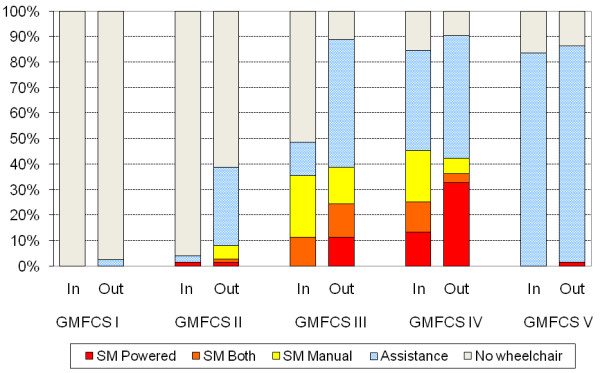
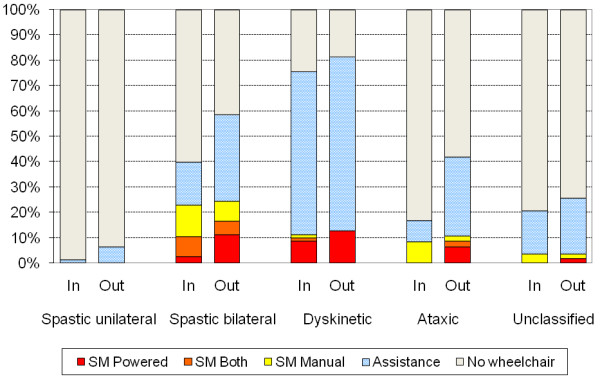
Results: Wheelchairs for mobility indoors were used by 165 (29%) of the 562 children; 61 used wheelchair for independent mobility (32 using manual only, 12 powered only, 17 both) and 104 were pushed by an adult. For outdoor mobility wheelchairs were used by 228 children (41%); 66 used a wheelchair for independent mobility (18 using manual only, 36 powered only, 12 both) and 162 were pushed. The use of wheelchair increased with age and was most frequent in the spastic bilateral and dyskinetic subtypes. Most powered wheelchairs were operated by children at GMFCS level IV.
Conclusion: In this total population of children with CP, aged 3-18 years, 29% used a wheelchair indoors and 41% outdoors. A majority using manual wheelchairs needed adult assistance (86%) while powered wheelchairs provided independent mobility in most cases (86%). To achieve a high level of independent mobility, both manual and powered wheelchairs should be considered at an early age for children with impaired walking ability.
Figures
References
-
- Rosenbaum P, Paneth N, Leviton A, Goldstein M, Bax M, Damiano D, Dan B, Jacobsson B. A report: the definition and classification of cerebral palsy April 2006. Dev Med Child Neurol Suppl. 2007;49(Feb s109):8–14. - PubMed
-
- Fernandes T. Independent mobility for children with disabilities. International Journal of Therapy and Rehabilitation. 2006;13(7):329–333.
Publication types
MeSH terms
LinkOut - more resources
Full Text Sources
Medical
Miscellaneous
