Review
. 2010 Nov;43(16-17):1269-77.
doi: 10.1016/j.clinbiochem.2010.07.027. Epub 2010 Aug 14.

Tracer-based metabolomics: concepts and practices

Affiliations
Review

Tracer-based metabolomics: concepts and practices

W-N Paul Lee et al. Clin Biochem. 2010 Nov.

Abstract

Tracer-based metabolomics is a systems biology tool that combines advances in tracer methodology for physiological studies, high throughput "-omics" technologies and constraint based modeling of metabolic networks. It is different from the commonly known metabolomics or metabonomics in that it is a targeted approach based on a metabolic network model in cells. Because of its complexity, it is the least understood among the various "-omics." In this review, the development of concepts and practices of tracer-based metabolomics is traced from the early application of radioactive isotopes in metabolic studies to the recent application of stable isotopes and isotopomer analysis using mass spectrometry; and from the modeling of biochemical reactions using flux analysis to the recent theoretical formulation of the constraint based modeling. How these newer experimental methods and concepts of constraint-based modeling approaches can be applied to metabolic studies is illustrated by examples of studies in determining metabolic responses of cells to pharmacological agents and nutrient environment changes.


Figures

Figure 1
Figure 1
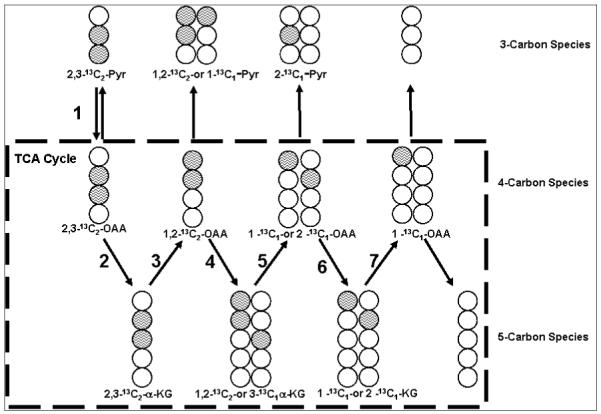
Labeling of 3-carbon-, 4-carbon and 5-carbon metabolic intermediates from [1,2-13C2]-glucose or [2, 3-13C2]-lactate through the TCA cycle. Open circles represent 12C carbons and shaded circles represent 13C carbons. The direction of flow of TCA cycle substrates is indicated by the numbered arrow. Pyr stands for pyruvate, OAA for oxaloacetate and KG for ketoglutarate.
Figure 2
Figure 2
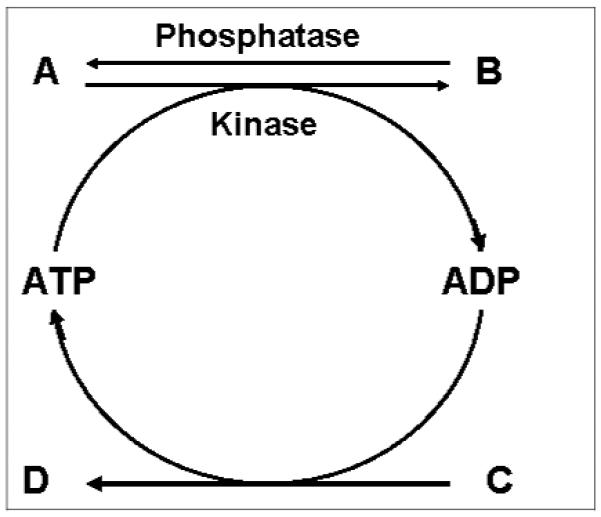
A kinase reaction as an example of futile cycle and a constraint pathway. In this example, the kinase pathway from A to B is constrained by availability of ATP and the reaction of C to D.
Figure 3
Figure 3
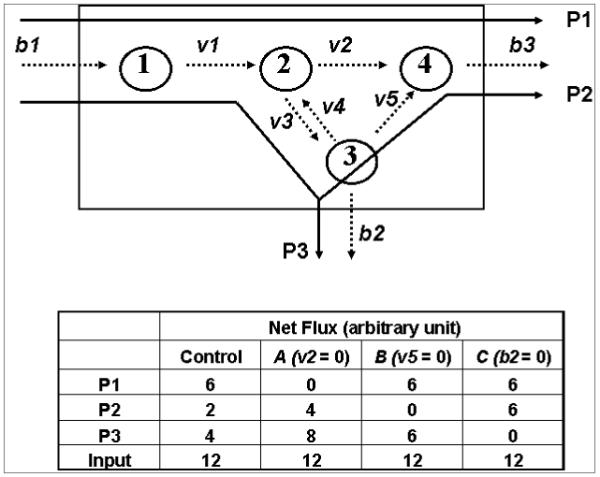
An example of a metabolic network showing reactions as internal and external fluxes; and “extreme pathways” (from Lee [16] with permission). Internal fluxes are indicated by v’s, exchange fluxes by b’s and the extreme pathways by P’s. The metabolic network can be viewed as a simplified model of pentose synthesis, where substrate (1) stands for glucose, (2) for glucose-6-P, (3) fructose-6-P, and (4) ribose-P. b1 stands for glucose uptake; b2 for glycolysis and b3 for nucleic acid synthesis. For illustration purposes, the numerical values of P1, P2, and P3 are constructed using the following hypothetical rules: b1 = 12, v2=v3, v3>>v4, and b2=2v5. Reactions v2, v5, and b2 are set to zero for phenotype A, B, and C respectively.
Figure 4a
Figure 4a
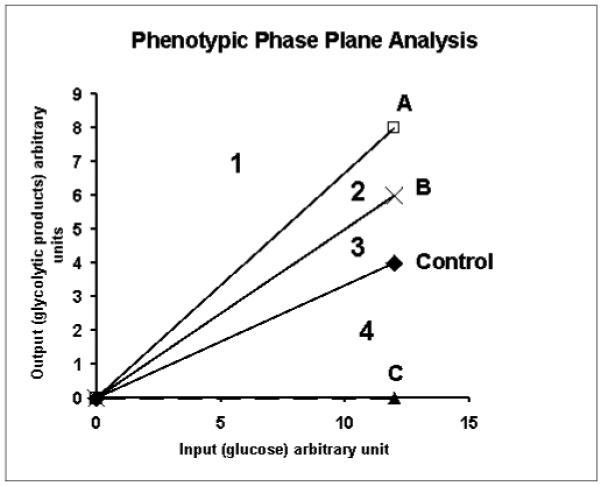
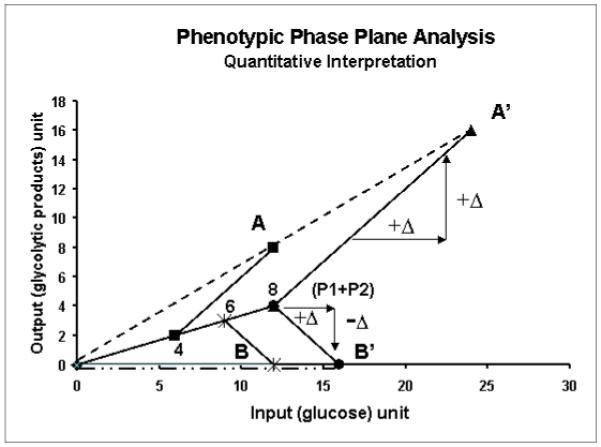
Phenotypic phase plane analysis of metabolic system of Figure 3 demonstrating the use of phenotypic phase plane analysis for metabolic phenotyping. The vectors representing phenotypes of control, A, B, and C divide the phenotypic phase plane in to four regions.
Figure 4b
Figure 4b
Phenotypic phase plane analysis of metabolic system of Figure 3 demonstrating the use of isocline for comparing metabolic differences between two phenotypes. The quantity of (P1+P2) is scaled onto the control vector to form the (P1+P2) axis. The slope of an isocline indicates the changes in the “extreme pathways” as compared to control for the same result in the output (P1+P2).
Figure 5
Figure 5
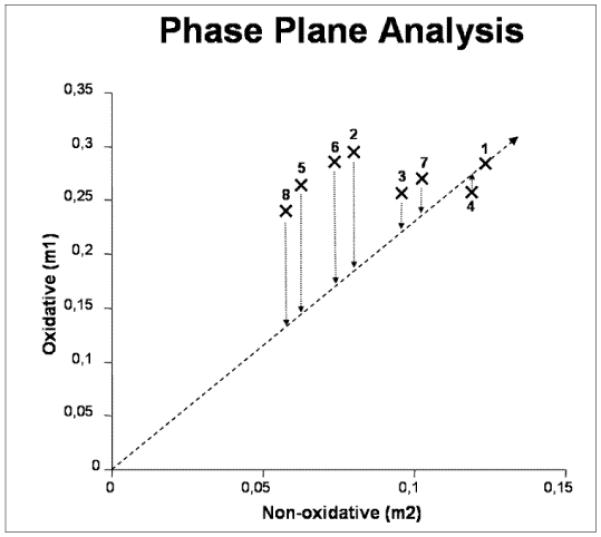
An example of the use of phenotypic phase plane analysis in a study of drug resistance HT29. The observed m1 (oxidative pentose pathway) to m2 (non-oxidative pentose pathway) of cell treated with different combination of drugs are plotted (from Ramos-Montoya et al. [53] with permission). Point #1 is the “control” phenotype of untreated cells; phenotype of oxythiamine (OT) treatment, point #2; dehydroepiandrosterone (DHEA) treatment, point #3 and methotrexate (MTX) treatment, point #4. Phenotypes of the combined treatment are point #5 combined OT+DHEA treatment; point #6 and #7 are for (OT+MTX) and (DHEA+MTX); and point #8, treatment with (OT+DHEA+MTX). Superimposing cell viability on the control phenotype vector creates a new viability axis. The isoclines are lines connecting the degree of cell viability to the metabolic phenotype characterized by (m1, m2).
Figure 6
Figure 6
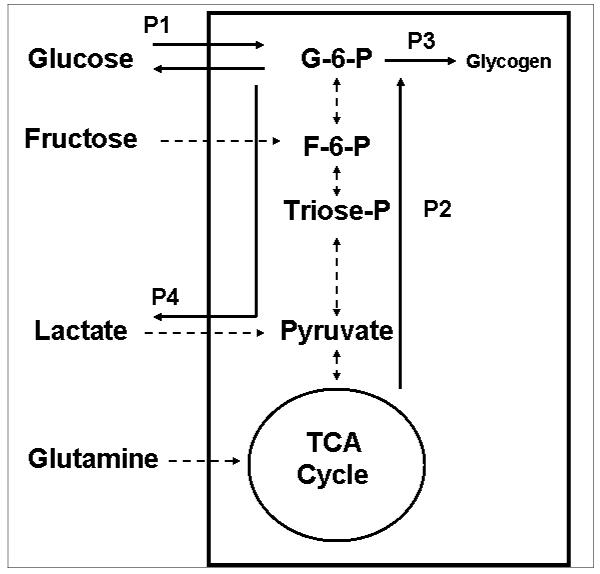
Glucose metabolic network in hepatocytes. The glycolytic and gluconeogenic pathways of hepatocytes were studied by modifying the culture medium conditions, namely, glucose only, glucose + fructose, glucose + lactate and glucose + glutamine. The balance of flux analysis was carried out around glucose-6-phosphate [54]. The resultant extreme pathways are indicated as P1, P2, P3, and P4. The extreme pathways include many internal and external fluxes indicated by the broken arrows.
Figure 7a
Figure 7a
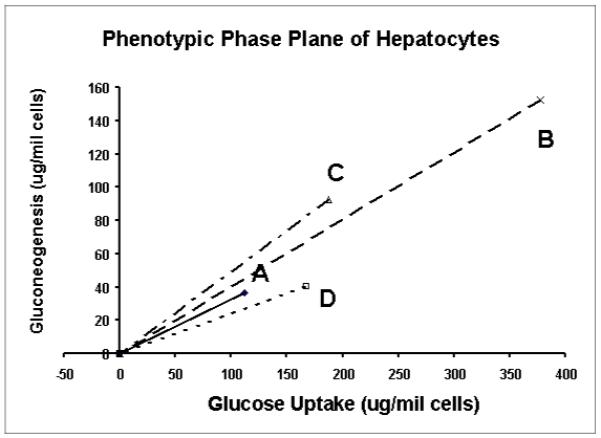
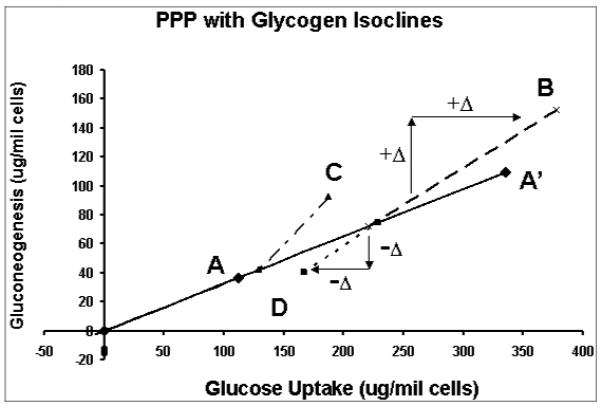
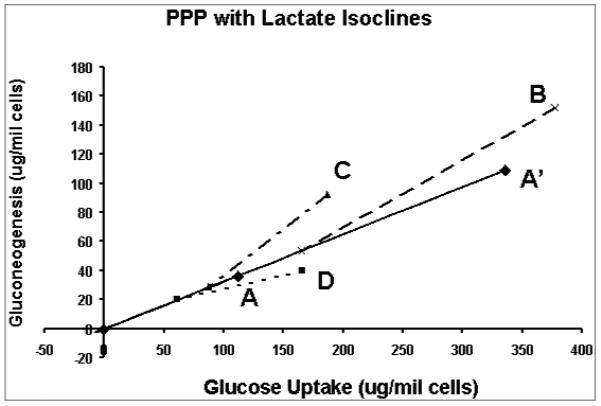
An example of the use of phenotypic phase plane analysis in a study of metabolic responses of isolated hepatocytes to substrate environment changes (data are from reference 54). Vector A represents the phenotype under glucose only medium, B, C, and D are phenotypes of cells with the addition of wither fructose, lactate or glutamine in the incubation medium respectively. In this and subsequent figures, the symbol Δ stands for the condition of added lactate, x for the condition of added fructose, □ for the condition of added glutamine, and ◇ for the control (glucose only condition).
Figure 7b
Figure 7b
Quantitative comparison of metabolic responses of isolated hepatocytes using glycogen isoclines. The quantities of glycogen produced in the hepatocytes under the different conditions are scaled onto the control vector to construct the isoclines.
Figure 7c
Figure 7c
Quantitative comparison of metabolic responses of isolated hepatocytes using lactate isoclines. The quantities of lactate produced from the hepatocytes under the different conditions are scaled onto the control vector to construct the isoclines.

References

    1. Lindon JC, Nicholson JK, Holmes E, Antti H, Bollard ME, Keun H, Beckonert O, Ebbels TM, Reily MD, Robertson D, Stevens GJ, Luke P, Breau AP, Cantor GH, Bible RH, Niederhauser U, Senn H, Schlotterbeck G, Sidelmann UG, Laursen SM, Tymiak A, Car BD, Lehman-McKeeman L, Colet JM, Loukaci A, Thomas C. Contemporary Issues in Toxicology The Role of Metabonomics in Toxicology and Its Evaluation by The COMET Project. Toxicol Appl Pharmacol. 2003;187:137–146. - PubMed
    1. Lindon JC, Keun HC, Ebbels TM, Pearce JM, Holmes E, Nicholson JK. The Consortium for Metabonomic Toxicology (COMET): Aims, Activities and Achievements. Pharmacogenomics. 2005;6:691–699. - PubMed
    1. Nicholson JK, Connelly J, Lindon JC, Holmes E. Metabonomics: A Platform For Studying Drug Toxicity and Gene Function. Nat Rev Drug Discov. 2002;1:153–161. - PubMed
    1. Raamsdonk LM, Teusink B, Broadhurst D, Zhang N, Hayes A, Walsh MC, Berden JA, Brindle KM, Kell DB, Rowland JJ, Westerhoff HV, van Dam K, Oliver SG. A Functional Genomics Strategy That Uses Metabolome Data to Reveal The Phenotype of Silent Mutations. Nat. Biotechnol. 2001;19:45–50. - PubMed
    1. Dettmer K, Aronov PA, Hammock BD. Mass Spectrometry-Based Metabolomics. Mass Spectrom Rev. 2007;26:51–78. - PMC - PubMed

Publication types

LinkOut - more resources