


Estrogen receptor-alpha gene expression in the cortex: sex differences during development and in adulthood
- PMID: 20713055
- PMCID: PMC3016448
- DOI: 10.1016/j.yhbeh.2010.08.004
Estrogen receptor-alpha gene expression in the cortex: sex differences during development and in adulthood
Abstract
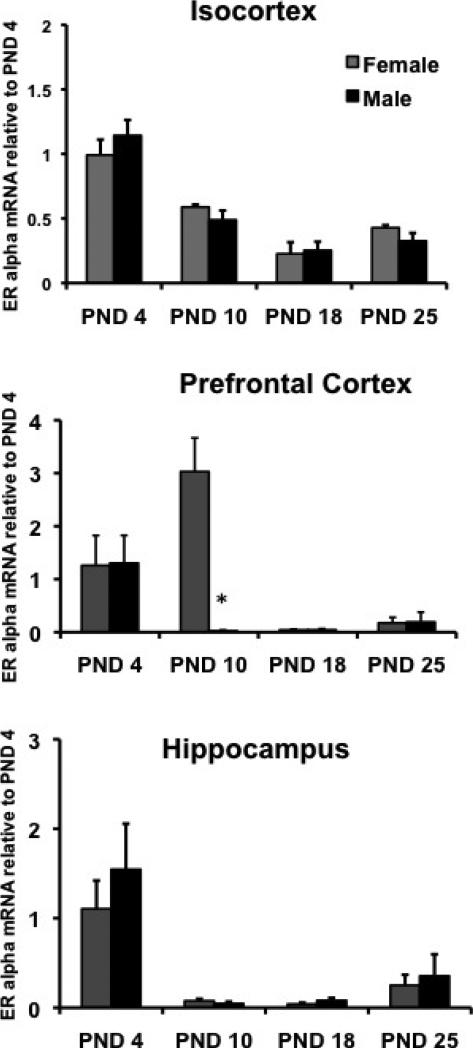
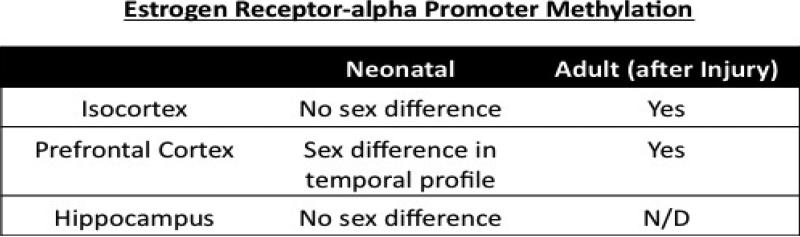
17β-estradiol is a hormone with far-reaching organizational, activational and protective actions in both male and female brains. The organizational effects of early estrogen exposure are essential for long-lasting behavioral and cognitive functions. Estradiol mediates many of its effects through the intracellular receptors, estrogen receptor-alpha (ERα) and estrogen receptor-beta (ERβ). In the rodent cerebral cortex, estrogen receptor expression is high early in postnatal life and declines dramatically as the animal approaches puberty. This decline is accompanied by decreased expression of ERα mRNA. This change in expression is the same in both males and females in the developing isocortex and hippocampus. An understanding of the molecular mechanisms involved in the regulation of estrogen receptor alpha (ERα) gene expression is critical for understanding the developmental, as well as changes in postpubertal expression of the estrogen receptor. One mechanism of suppressing gene expression is by the epigenetic modification of the promoter regions by DNA methylation that results in gene silencing. The decrease in ERα mRNA expression during development is accompanied by an increase in promoter methylation. Another example of regulation of ERα gene expression in the adult cortex is the changes that occur following neuronal injury. Many animal studies have demonstrated that the endogenous estrogen, 17β-estradiol, is neuroprotective. Specifically, low levels of estradiol protect the cortex from neuronal death following middle cerebral artery occlusion (MCAO). In females, this protection is mediated through an ERα-dependent mechanism. ERα expression is rapidly increased following MCAO in females, but not in males. This increase is accompanied by a decrease in methylation of the promoter suggesting a return to the developmental program of gene expression within neurons. Taken together, during development and in adulthood, regulation of ERα gene expression in the cortex can occur by DNA methylation and in a sex-dependent fashion in the adult brain.
Copyright © 2010 Elsevier Inc. All rights reserved.
Figures
References
-
- Alkayed NJ, et al. Gender-linked brain injury in experimental stroke. Stroke. 1998;29:159–65. discussion 166. - PubMed
-
- Anderson RH, et al. Relationships between sexual activity, plasma testosterone, and the volume of the sexually dimorphic nucleus of the preoptic area in prenatally stressed and non-stressed rats. Brain Res. 1986;370:1–10. - PubMed
-
- Ballestar E, Wolffe AP. Methyl-CpG-binding proteins. Targeting specific gene repression. Eur J Biochem. 2001;268:1–6. - PubMed
-
- Bird AP, Wolffe AP. Methylation-induced repression--belts, braces, and chromatin. Cell. 1999;99:451–4. - PubMed
-
- Chaban VV, et al. A membrane estrogen receptor mediates intracellular calcium release in astrocytes. Endocrinology. 2004;145:3788–95. - PubMed
Publication types
MeSH terms
Substances
Grants and funding
LinkOut - more resources
Full Text Sources
