


Ecosystem services and agriculture: tradeoffs and synergies
- PMID: 20713396
- PMCID: PMC2935121
- DOI: 10.1098/rstb.2010.0143
Ecosystem services and agriculture: tradeoffs and synergies
Abstract
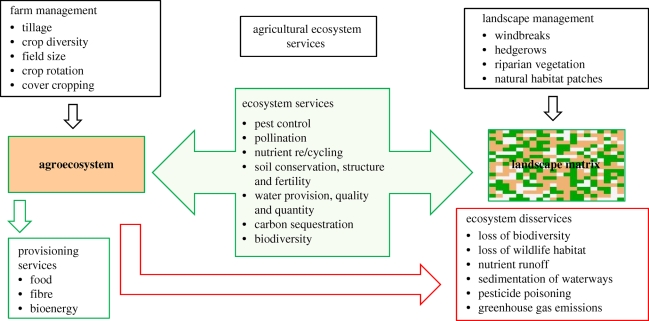
Agricultural ecosystems provide humans with food, forage, bioenergy and pharmaceuticals and are essential to human wellbeing. These systems rely on ecosystem services provided by natural ecosystems, including pollination, biological pest control, maintenance of soil structure and fertility, nutrient cycling and hydrological services. Preliminary assessments indicate that the value of these ecosystem services to agriculture is enormous and often underappreciated. Agroecosystems also produce a variety of ecosystem services, such as regulation of soil and water quality, carbon sequestration, support for biodiversity and cultural services. Depending on management practices, agriculture can also be the source of numerous disservices, including loss of wildlife habitat, nutrient runoff, sedimentation of waterways, greenhouse gas emissions, and pesticide poisoning of humans and non-target species. The tradeoffs that may occur between provisioning services and other ecosystem services and disservices should be evaluated in terms of spatial scale, temporal scale and reversibility. As more effective methods for valuing ecosystem services become available, the potential for 'win-win' scenarios increases. Under all scenarios, appropriate agricultural management practices are critical to realizing the benefits of ecosystem services and reducing disservices from agricultural activities.
Figures
References
-
- Aizen M. A., Garibaldi L. A., Cunningham S. A., Klein A. M.2009How much does agriculture depend on pollinators? Lessons from long-term trends in crop production. Ann. Bot. 103, 1579–1588 (doi:10.1093/aob/mcp076) - DOI - PMC - PubMed
-
- Andow D. A.1991Vegetational diversity and arthropod population response. Annu. Rev. Entomol. 36, 561–586 (doi:10.1146/annurev.en.36.010191.003021) - DOI
-
- Badgley C., Moghtader J., Quintero E., Zakem E., Chappell M., Aviles-Vazquez K., Samulon A., Perfecto I.2007Organic agriculture and the global food supply. Renew. Agric. Food Syst. 22, 86–108 (doi:10.1017/S1742170507001640) - DOI
-
- Baulcombe D., et al. 2009Reaping the benefits: science and the sustainable intensification of global agriculture. London, UK: The Royal Society
-
- Bianchi F., Booij C. J. H., Tscharntke T.2006Sustainable pest regulation in agricultural landscapes: a review on landscape composition, biodiversity and natural pest control. Proc. R. Soc. B 273, 1715–1727 (doi:10.1098/rspb.2006.3530) - DOI - PMC - PubMed
Publication types
MeSH terms
LinkOut - more resources
Full Text Sources
Miscellaneous
