Review
. 2010 Aug 15;24(16):1695-708.
doi: 10.1101/gad.1953910.

Early abscisic acid signal transduction mechanisms: newly discovered components and newly emerging questions

Affiliations
Review

Early abscisic acid signal transduction mechanisms: newly discovered components and newly emerging questions

Katharine E Hubbard et al. Genes Dev. .

Abstract

The plant hormone abscisic acid (ABA) regulates many key processes in plants, including seed germination and development and abiotic stress tolerance, particularly drought resistance. Understanding early events in ABA signal transduction has been a major goal of plant research. The recent identification of the PYRABACTIN (4-bromo-N-[pyridin-2-yl methyl]naphthalene-1-sulfonamide) RESISTANCE (PYR)/REGULATORY COMPONENT OF ABA RECEPTOR (RCAR) family of ABA receptors and their biochemical mode of action represents a major breakthrough in the field. The solving of PYR/RCAR structures provides a context for resolving mechanisms mediating ABA control of protein-protein interactions for downstream signaling. Recent studies show that a pathway based on PYR/RCAR ABA receptors, PROTEIN PHOSPHATASE 2Cs (PP2Cs), and SNF1-RELATED PROTEIN KINASE 2s (SnRK2s) forms the primary basis of an early ABA signaling module. This pathway interfaces with ion channels, transcription factors, and other targets, thus providing a mechanistic connection between the phytohormone and ABA-induced responses. This emerging PYR/RCAR-PP2C-SnRK2 model of ABA signal transduction is reviewed here, and provides an opportunity for testing novel hypotheses concerning ABA signaling. We address newly emerging questions, including the potential roles of different PYR/RCAR isoforms, and the significance of ABA-induced versus constitutive PYR/RCAR-PP2C interactions. We also consider how the PYR/RCAR-PP2C-SnRK2 pathway interfaces with ABA-dependent gene expression, ion channel regulation, and control of small molecule signaling. These exciting developments provide researchers with a framework through which early ABA signaling can be understood, and allow novel questions about the hormone response pathway and possible applications in stress resistance engineering of plants to be addressed.


Figures
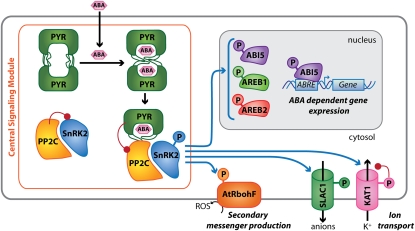
Figure 1.
Figure 1.
The core ABA signaling pathway. Recent progress in understanding early ABA signal transduction has led to the construction of a PYR/RCAR–PP2C–SnRK2 signal transduction model. In the absence of ABA, PP2Cs inhibit protein kinase (SnRK2) activity through removal of activating phosphates. ABA is bound by intracellular PYR/PYL dimers, which dissociate to form ABA receptor–PP2C complexes. Complex formation therefore inhibits the activity of the PP2C in an ABA-dependent manner, allowing activation of SnRK2s. Several SnRK2 targets have been identified both at the plasma membrane and in the nucleus, resulting in control of ion channels, secondary messenger production, and gene expression. Red connections on left indicate an inhibitory interaction.
Figure 2.
Figure 2.
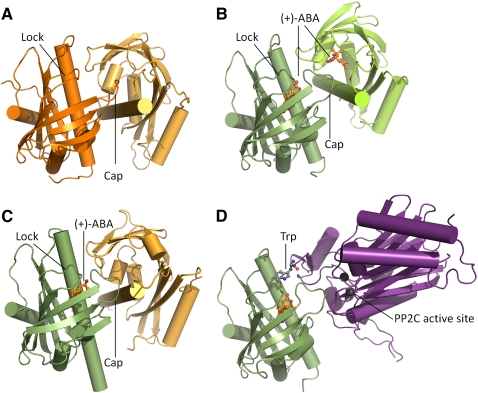
Structural mechanism of ABA–PYR/RCAR–PP2C interactions. The structures of PYR/RCAR proteins in both ABA-unbound conformations (gold) and ABA-bound conformations (green), and in complex with PP2C. The following structures are shown: a PYL2 homodimer in the absence of ABA (A), and a symmetrical PYL2 dimer with both ABA molecules shown in orange (B). Note that the cap and lock have changed position to come in closer contact with the ABA molecule, while reducing dimer interaction. (C) An asymmetrical PYR1 dimer exhibiting “closed” hormone-bound (green) and “open” hormone-free (gold) subunit conformations. (D) A PYL2–HAB1 (PP2C) complex: A tryptophan residue from the PP2C (purple) inserts into the gap between the cap and lock to interact with the ABA molecule. The cap makes contact with the Mg2+-containing active site of the PP2C, therefore preventing phosphatase activity in the presence of ABA. The structures of PYR1 (Nishimura et al. 2009), PYL2, and the HAB1–PYL2 complex (Melcher et al. 2009) are oriented to align PYR/RCAR (shown at left).
Figure 3.
Figure 3.
Possible mechanisms of Ca2+ sensitivity priming by ABA. Exposure to ABA enhances the Ca2+ sensitivity of the signaling pathway through several potential mechanisms; a calcium sensor is shown as the point of priming for clarity, but the priming mechanism may potentially involve downstream components. (i) ABA allows the appropriate subcellular localization of the sensor protein. (ii) ABA treatment causes the appropriate post-translational protein modifications for activity; removal of a negatively regulating modification is shown, but addition of a positively regulating modification is equally possible. (iii) ABA treatment provides the appropriate additional components of a protein complex to associate with the sensor; removal of a negative regulator is indicated, but ABA may also recruit positive interactors. (iv) ABA-stimulated transcriptional changes include expression of the sensor protein.

References

    1. Albrecht V, Ritz O, Linder S, Harter K, Kudla J 2001. The NAF domain defines a novel protein–protein interaction module conserved in Ca2+-regulated kinases. EMBO J 20: 1051–1063 - PMC - PubMed
    1. Albrecht V, Weinl S, Blazevic D, D'Angelo C, Batistic O, Kolukisaoglu Ü, Bock R, Schulz B, Harter K, Kudla J 2003. The calcium sensor CBL1 integrates plant responses to abiotic stresses. Plant J 36: 457–470 - PubMed
    1. Allan AC, Fricker MD, Ward JL, Beale MH, Trewavas AJ 1994. Two transduction pathways mediate rapid effects of abscisic acid in commelina guard cells. Plant Cell 6: 1319–1328 - PMC - PubMed
    1. Allen GJ, Kuchitsu K, Chu SP, Murata Y, Schroeder JI 1999. Arabidopsis abi1-1 and abi2-1 phosphatase mutations reduce abscisic acid-induced cytoplasmic calcium rises in guard cells. Plant Cell 11: 1785–1798 - PMC - PubMed
    1. Allen GJ, Murata Y, Chu SP, Nafisi M, Schroeder JI 2002. Hypersensitivity of abscisic acid-induced cytosolic calcium increases in the Arabidopsis farnesyltransferase mutant era1-2. Plant Cell 14: 1649–1662 - PMC - PubMed

Publication types

MeSH terms