


C-reactive protein levels and body mass index: elucidating direction of causation through reciprocal Mendelian randomization
- PMID: 20714329
- PMCID: PMC4783860
- DOI: 10.1038/ijo.2010.137
C-reactive protein levels and body mass index: elucidating direction of causation through reciprocal Mendelian randomization
Abstract
Context: The assignment of direction and causality within networks of observational associations is problematic outside randomized control trials, and the presence of a causal relationship between body mass index (BMI) and C-reactive protein (CRP) is disputed.
Objective: Using reciprocal Mendelian randomization, we aim to assess the direction of causality in relationships between BMI and CRP and to demonstrate this as a promising analytical technique.
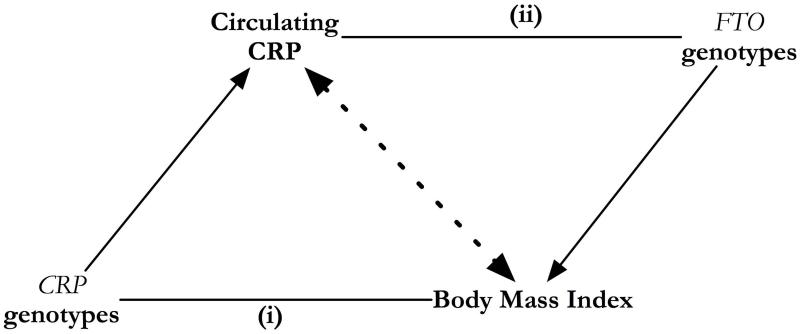
Participants and methods: The study was based on a large, cross-sectional European study from Copenhagen, Denmark. Genetic associates of BMI (FTO(rs9939609)) and circulating CRP (CRP(rs3091244)) have been used to reexamine observational associations between them.
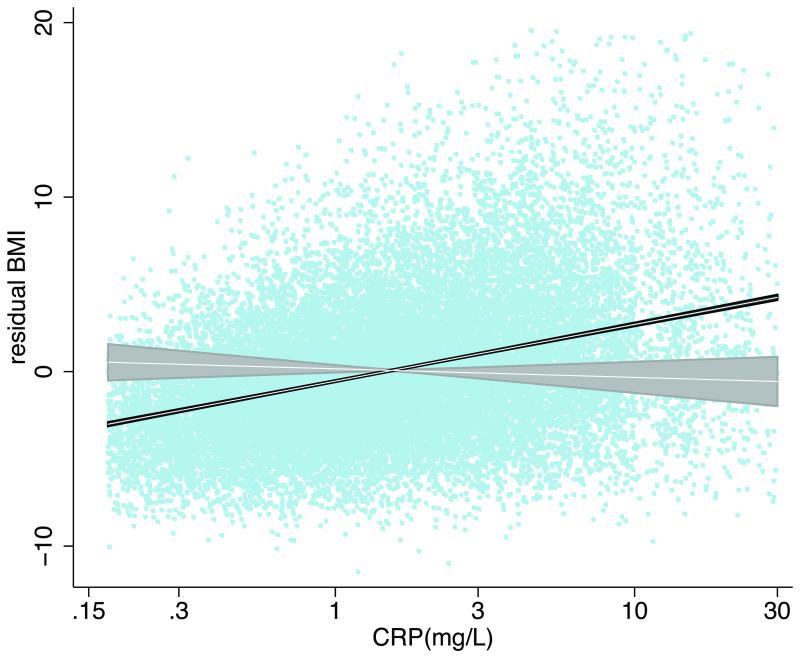
Results: Observational analyses showed a strong, positive association between circulating CRP and BMI (change in BMI for a doubling in log CRP of 1.03 kg m(-2) (95% confidence interval (95% CI): 1.00, 1.07), P<0.0001). Analysis using CRP(rs3091244) to re-estimate the causal effect of circulating CRP on BMI yielded null effects (change in BMI for a doubling in log CRP of -0.24 kg m(-2) (95% CI: -0.58, 0.11), P=0.2). In contrast, analysis using FTO(rs9939609) to assess the causal effect of BMI on circulating CRP confirmed observational associations (ratio of geometric means of CRP per s.d. increase in BMI 1.41 (95% CI: 1.10, 1.80), P=0.006).
Conclusions: Taken together, these data suggest that the observed association between circulating CRP and measured BMI is likely to be driven by BMI, with CRP being a marker of elevated adiposity. More generally, the method of reciprocal randomization has general applicability in determining the direction of causation within inter-correlated networks of metabolic components.
Figures

References
-
- Yudkin JS, Stehouwer CD, Emeis JJ, Coppack SW. C-reactive protein in healthy subjects: associations with obesity, insulin resistance, and endothelial dysfunction: a potential role for cytokines originating from adipose tissue? Arteriosclerosis, Thrombosis & Vascular Biology. 1999;19:972–978. - PubMed
-
- Dandona P, Aljada A, Bandyopadhyay A. Inflammation: the link between insulin resistance, obesity and diabetes. Trends in Immunology. 2004;25:4–7. - PubMed
-
- Dandona P, Weinstock R, Thusu K, Abdel-Rahman E, Aljada A, Wadden T. Tumor necrosis factor-alpha in sera of obese patients: fall with weight loss. Journal of Clinical Endocrinology & Metabolism. 1998;83:2907–2910. - PubMed
-
- Bochud M, Fabienne M, Marques-Vidal P, Vollenweider P, Beckmann JS, Mooser V, et al. Association between C-reactive protein and adiposity in women. Journal of Endocrinology and Metabolism. 2009 - PubMed
Publication types
MeSH terms
Substances
Grants and funding
LinkOut - more resources
Full Text Sources
Medical
Research Materials
Miscellaneous
