


Biodegradation of pyrene in sand, silt and clay fractions of sediment
- PMID: 20714921
- PMCID: PMC3046355
- DOI: 10.1007/s10532-010-9399-z
Biodegradation of pyrene in sand, silt and clay fractions of sediment
Abstract
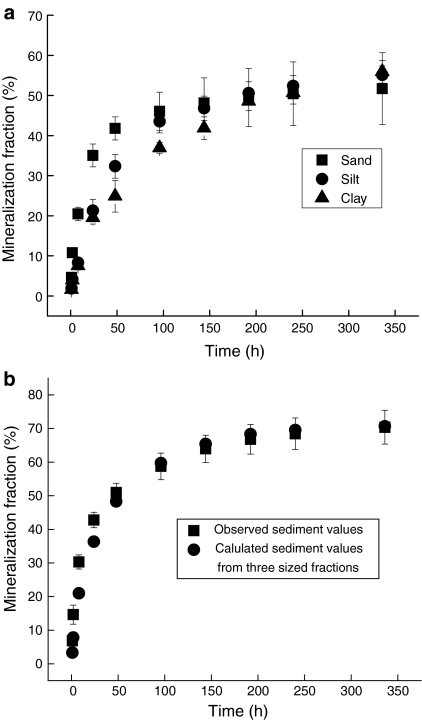
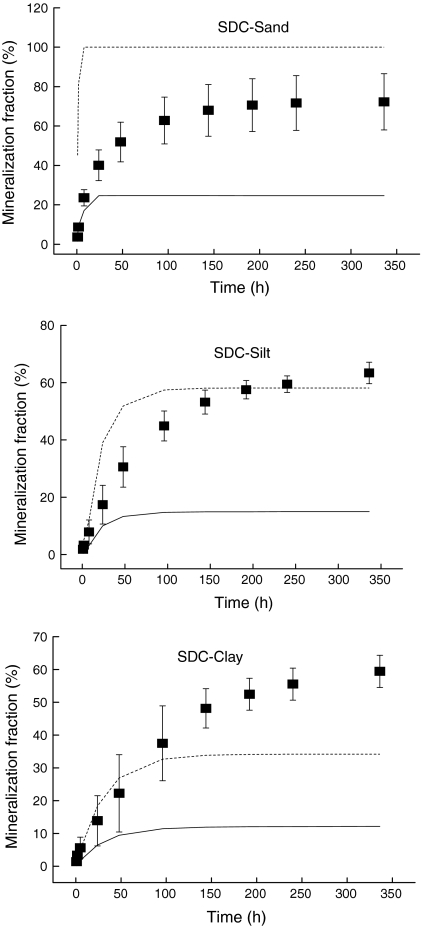
Microbial degradation is the dominant pathway for natural attenuation of PAHs in environmental compartments such as sediments, which in turn depends on the bioavailability of PAHs. The bioavailability of PAHs has seldom been studied at the sediment particle size scale. We evaluated biodegradation of pyrene by Mycobacterium vanbaalenii PYR-1 as a function of sediment particle sizes, and investigated the relationship between the rate of degradation on sand, silt and clay particles with their individual desorption kinetics measured with the Tenax extraction method. Regression analysis showed that the total organic carbon (TOC), black carbon (BC), and specific surface area (SSA) of the specific particle size fractions, instead of the particle size scale itself, were closely related (P<0.01) with the mineralization rate. While the fraction in the rapid desorption pool (F (rapid)) ranged from 0.11 to 0.38 for the whole sediments and different size groups, the fractions mineralized after 336-h incubation (0.52 to 0.72) greatly surpassed the F (rapid) values, suggesting utilization of pyrene in the slow desorption pool (F (slow)). A biodegradation model was modified by imbedding a two-phase desorption relationship describing sequential Tenax extractions. Model analysis showed that pyrene sorbed on silt and clay aggregates was directly utilized by the degrading bacteria. The enhanced bioavailability may be attributed to the higher chemical concentration, higher TOC or larger SSA in the silt and clay fractions, which appeared to overcome the reduced bioavailability of pyrene due to sorption, making pyrene on the silt and clay particles readily available to degrading microbes. This conjecture merits further investigation.
Figures



References
-
- Amellal N, Portal JM, Vogel T, Berthelin J. Distribution and location of polycyclic aromatic hydrocarbons (PAHs) and PAH-degrading bacteria within polluted soil aggregates. Biodegradation. 2001;12:49–57. - PubMed
-
- Beckles DM, Chen W, Hughes JB. Bioavailability of polycylic aromatic hydrocarbons sequestered in sediment: microbial study and model prediction. Environ Toxicol Chem. 2007;26:878–883. - PubMed
-
- Bogan BW, Sullican WR. Physicochemical soil parameters affecting sequestration and mycobacterial biodegradation of polycyclic aromatic hydrocarbons in soil. Chemosphere. 2003;52:1717–1726. - PubMed
-
- Bouchez M, Blanchet D, Vandecasteele JP. Substrate availability in phenanthrene biodegradation: transfer mechanism and influence on metabolism. Appl Microbiol Biotechnol. 1995;43:952–960. - PubMed
-
- Cornelissen G, van Noort PCM, Govers HAJ. Desorption kinetics of chlorobenzenes, polycyclic aromatic hydrocarbons, and polychlorinated biphenyls: sediment extraction with Tenax and effects of contact time and solute hydrophobicity. Environ Toxicol Chem. 1997;16:1351–1357.
MeSH terms
Substances
LinkOut - more resources
Full Text Sources
Molecular Biology Databases
Research Materials
