


Decision trees for identifying predictors of treatment effectiveness in clinical trials and its application to ovulation in a study of women with polycystic ovary syndrome
- PMID: 20716558
- PMCID: PMC2939757
- DOI: 10.1093/humrep/deq210
Decision trees for identifying predictors of treatment effectiveness in clinical trials and its application to ovulation in a study of women with polycystic ovary syndrome
Abstract
Background: Double-blind, randomized clinical trials are the preferred approach to demonstrating the effectiveness of one treatment against another. The comparison is, however, made on the average group effects. While patients and clinicians have always struggled to understand why patients respond differently to the same treatment, and while much hope has been held for the nascent field of predictive biomarkers (e.g. genetic markers), there is still much utility in exploring whether it is possible to estimate treatment efficacy based on demographic and baseline variables.
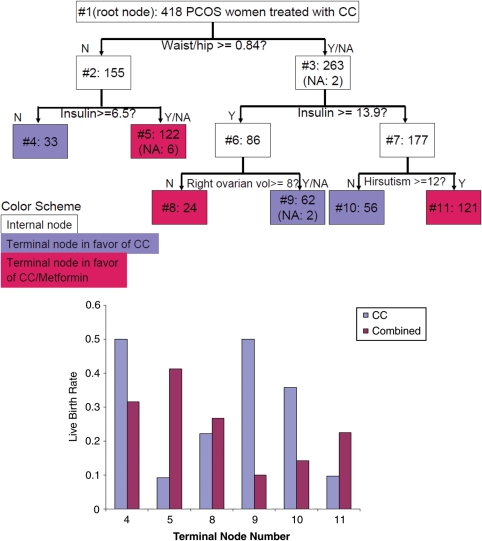
Methods: The pregnancy in polycystic ovary syndrome (PPCOS) study was a prospective, multi-center, randomized clinical trial comparing three ovulation induction regimens: clomiphene citrate (CC), metformin and the combination of the two. There were 446 women who ovulated in response to the treatments among the entire 626 participants. In this report, we focus on the 418 women who received CC (alone or combined with metformin) to determine if readily available baseline physical characteristics and/or easily obtainable baseline measures could be used to distinguish treatment effectiveness in stimulating ovulation. We used a recursive partitioning technique and developed a node-splitting rule to build decision tree models that reflected within-node and within-treatment responses.
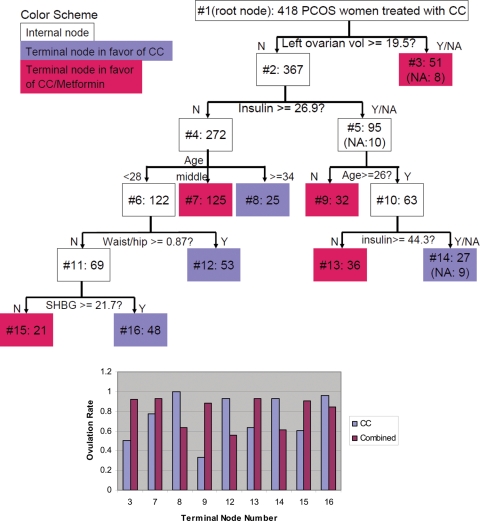
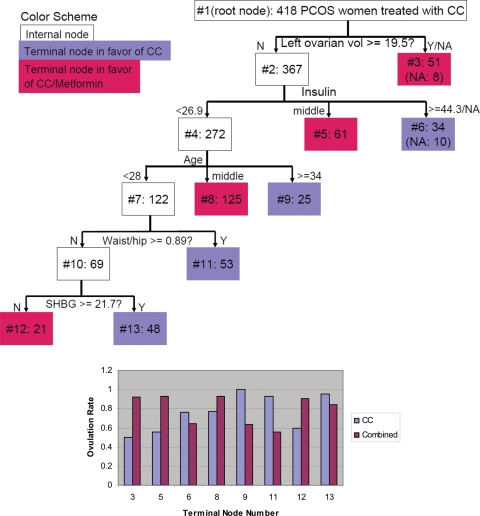
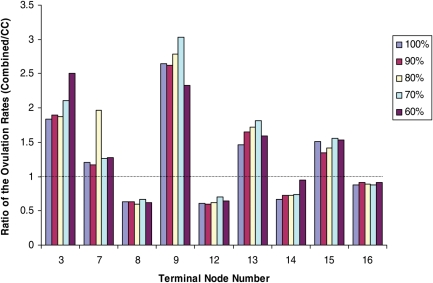
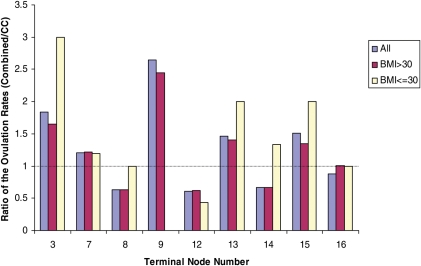
Results: Overall, the combination of CC plus metformin resulted in an increased incidence of ovulation compared with CC alone. This is particularly so in women with relatively larger left ovarian volumes (≥ 19.5 cubic cm), and a left ovarian volume <19.5 cubic cm was related to treatment outcomes for all subsequent nodes. Women who were older, who had higher baseline insulin, higher waist-to-hip circumference ratio or higher sex hormone-binding globulin levels had better ovulatory rates with CC alone than with the combination of CC plus metformin.
Conclusions: Polycystic ovary syndrome (PCOS) is a phenotypically diverse condition. Both baseline laboratory and clinical parameters can predict the ovulatory response in women with PCOS undergoing ovulation induction. Without a priori hypotheses with regard to any predictors, the observation regarding left ovary volume is novel and worthy of further investigation and validation.
Figures
References
-
- Atiomo WU, Pearson S, Shaw S, Prentice A, Dubbins P. Ultrasound criteria in the diagnosis of polycystic ovary syndrome (PCOS) Ultrasound Med Biol. 2000;26:977–980. doi:10.1016/S0301-5629(00)00219-2. - DOI - PubMed
-
- Azziz R, Woods KS, Reyna R, Key TJ, Knochenhauer ES, Yildiz BO. The prevalence and features of the polycystic ovary syndrome in an unselected population. J Clin Endocrinol Metab. 2004;89:2745–2749. doi:10.1210/jc.2003-032046. - DOI - PubMed
-
- Balen AH, Platteau P, Andersen AN, Devroey P, Sorensen P, Helmgaard L, Arce JC. The influence of body weight on response to ovulation induction with gonadotrophins in 335 women with World Health Organization group II anovulatory infertility. BJOG. 2006;113:1195–1202. - PubMed
-
- Boomsma CM, Eijkemans MJ, Hughes EG, Visser GH, Fauser BC, Macklon NS. A meta-analysis of pregnancy outcomes in women with polycystic ovary syndrome. Hum Reprod Update. 2006;12:673–683. doi:10.1093/humupd/dml036. - DOI - PubMed
-
- Boomsma CM, Fauser BC, Macklon NS. Pregnancy complications in women with polycystic ovary syndrome. Semin Reprod Med. 2008;26:72–84. doi:10.1055/s-2007-992927. - DOI - PubMed
Publication types
MeSH terms
Substances
Grants and funding
LinkOut - more resources
Full Text Sources
Medical
