


Two-Part Factor Mixture Modeling: Application to an Aggressive Behavior Measurement Instrument
- PMID: 20717486
- PMCID: PMC2921717
- DOI: 10.1080/10705510903203516
Two-Part Factor Mixture Modeling: Application to an Aggressive Behavior Measurement Instrument
Abstract
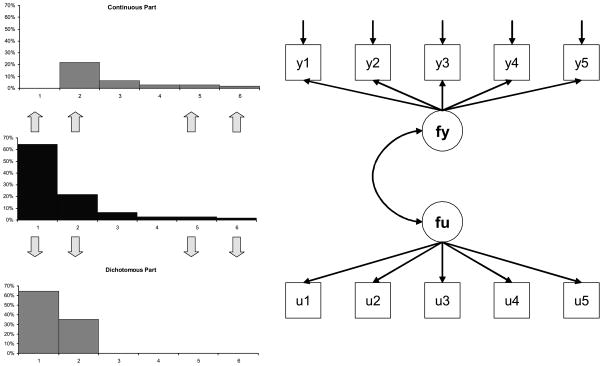
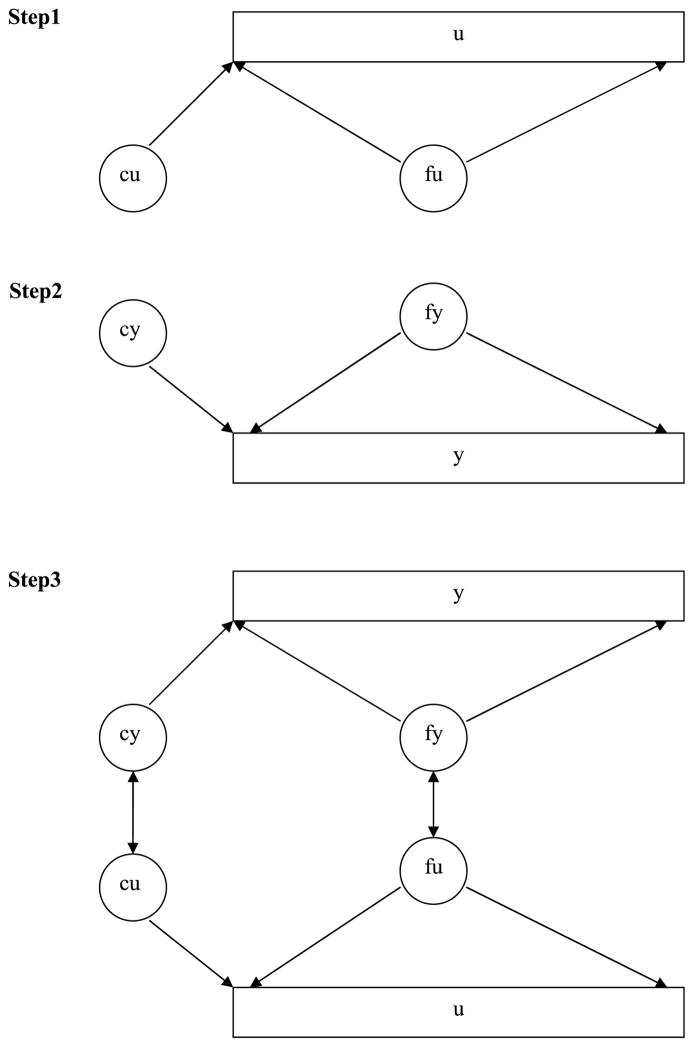
This study introduces a two-part factor mixture model as an alternative analysis approach to modeling data where strong floor effects and unobserved population heterogeneity exist in the measured items. As the names suggests, a two-part factor mixture model combines a two-part model, which addresses the problem of strong floor effects by decomposing the data into dichotomous and continuous response components, with a factor mixture model, which explores unobserved heterogeneity in a population by establishing latent classes. Two-part factor mixture modeling can be an important tool for situations in which ordinary factor analysis produces distorted results and can allow researchers to better understand population heterogeneity within groups. Building a two-part factor mixture model involves a consecutive model building strategy that explores latent classes in the data for each part as well as a combination of the two-part. This model building strategy was applied to data from a randomized preventive intervention trial in Baltimore public schools administered by the Johns Hopkins Center for Early Intervention. The proposed model revealed otherwise unobserved subpopulations among the children in the study in terms of both their tendency toward and their level of aggression. Furthermore, the modeling approach was examined using a Monte Carlo simulation.
Figures
References
-
- Boomsma A, Hoogland JJ. The robustness of LISREL modeling revisited. In: Cudeck R, du Toit S, Sörbom D, editors. Structural equation modeling: Present and future. Lincolnwood, IL: Scientific Software International; 2001. pp. 139–168.
-
- Brown EC, Catalano CB, Fleming CB, Haggerty KP, Abbot RD. Adolescent substance use outcomes in the Raising Healthy Children Project: A two-part latent growth curve analysis. Journal of Consulting and Clinical Psychology. 2005;73:699–710. - PubMed
-
- Duan N, Manning WG, Morris CN, Newhouse JP. A comparison of alternative models for the demand for medical care. Journal of Business and Economic Statistics. 1983;1:115–126.
-
- Jedidi K, Jagpal HS, DeSarbo WS. STEMM: A general finite mixture structural equation model. Journal of Classification. 1997;14:23–50.
-
- McLachlan GJ, Do KA, Ambroise C. Analyzing microarray gene expression data. New York: Wiley; 2004.
Grants and funding
LinkOut - more resources
Full Text Sources
Research Materials