Ras-induced senescence and its physiological relevance in cancer
- PMID: 20718709
- PMCID: PMC4023163
- DOI: 10.2174/156800910793357998
Ras-induced senescence and its physiological relevance in cancer
Abstract
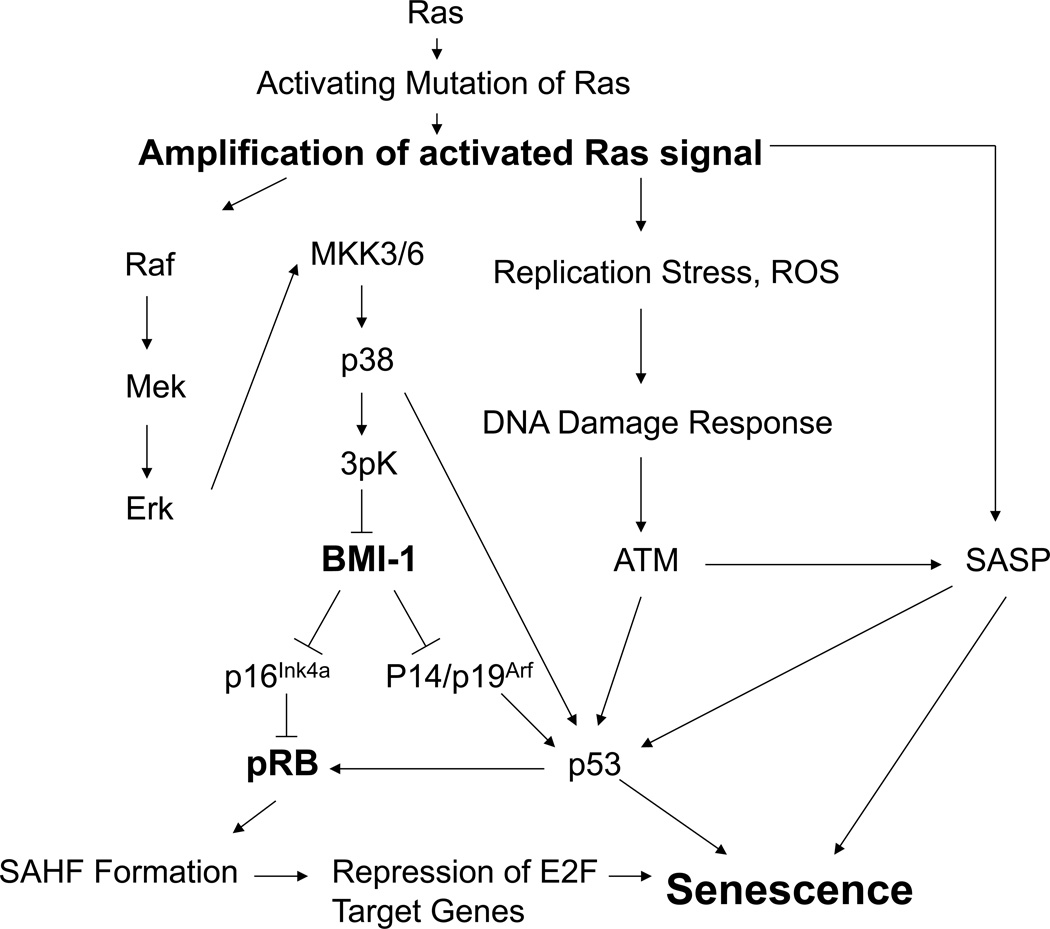
Activated oncogenes like Ras have traditionally been thought as promoting unrestrained proliferation; therefore, the concept of oncogene-induced senescence has been, and still is, controversial. The counter-intuitive notion that activation of oncogenes leads to the prevention of cellular proliferation has initially been fueled by in vitro studies using ectopic expression of activated Ras in primary fibroblasts. While these initial studies demonstrated unambiguously the existence of a new type of cellular senescence, induced by oncogenes in an ex-vivo system, questions were raised about the physiological relevance of this process. Indeed, recent technical advances in mouse modeling for cancer have suggested that the occurrence of Ras-induced senescence is highly dependent on the cellular context, as well as the level of expression of activated Ras, and may not be pertinent to the study of human cancer initiation and/or progression. However, our increased knowledge of the molecular basis for cellular senescence has led to a better understanding of the molecular events modulating cancer progression in vivo. Recent studies have not only clearly established the incidence of cellular senescence in pre-neoplasic lesions, but also its role as a potential tumor-suppressor mechanism in vivo. Here, we review the recent and exciting new findings regarding the physiological relevance of Ras-induced senescence, and discuss their implications in terms of cancer therapy.
Figures
References
-
- Hayflick L, Moorhead PS. The serial cultivation of human diploid cell strains. Exp Cell Res. 1961;25:585–621. - PubMed
-
- Campisi J. Replicative senescence: an old lives' tale? Cell. 1996;84:497–500. - PubMed
-
- Blagosklonny MV. Cell senescence: hypertrophic arrest beyond the restriction point. J Cell Physiol. 2006;209:592–597. - PubMed
-
- Itahana K, Campisi J, Dimri GP. Methods to detect biomarkers of cellular senescence: the senescence-associated beta-galactosidase assay. Methods Mol Biol. 2007;371:21–31. - PubMed
Publication types
MeSH terms
Substances
Grants and funding
LinkOut - more resources
Full Text Sources