


Association of an intronic, but not any exonic, FRMD4B sequence variant and heart failure
- PMID: 20718813
- PMCID: PMC2925316
- DOI: 10.1111/j.1752-8062.2010.00220.x
Association of an intronic, but not any exonic, FRMD4B sequence variant and heart failure
Abstract
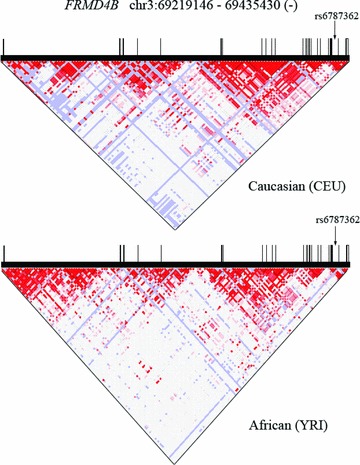
Common forms of heart failure (HF) exhibit familial clustering, but specific genetic risk factors have been challenging to identify. A recent single-nucleotide polymorphism (SNP) microarray study implicated a locus within an intron of FRMD4B in Caucasian HF. Here, we used next-generation resequencing of pooled DNA and individual Sequenom genotyping to test for associations between FRMD4B SNPs and ischemic and/or nonischemic cardiomyopathy in two independent populations. Exonic resequencing of Caucasians and African-Americans identified 32 FRMD4B SNPs, 13 of which had allele frequencies greater than 1%. None of these common FRMD4B SNPs were significantly associated with ischemic, nonischemic, or all-cause HF in either of the study populations. We individually genotyped the seminal intronic rs6787362 FRMD4B SNP in the primary study population and compared genotypes between HF cases and controls. The rs6787362 variant allele was more frequent in Caucasians with ischemic cardiomyopathy, and carriers (heterozygous or homozygous) of the variant allele had increased risk of HF (OR 1.437, CI 1.085-1.904; p= 0.0118). No such association was seen for African-American HF. These results confirm an association between the intronic rs6787362 FRMD4B SNP and ischemic cardiomyopathy in a European-derived population, but do not support the proposition that coding FRMD4B variants are susceptibility factors in common HF.
Figures
References
-
- Richard P, Villard E, Charron P, Isnard R. The genetic bases of cardiomyopathies. J Am Coll Cardiol. 2006; 48: A79–A89.
-
- Larson MG, Atwood LD, Benjamin EJ, Cupples LA, D’Agostino RB Sr, Fox CS, Govindaraju DR, Guo CY, Heard‐Costa NL, Hwang SJ, Murabito JM, Newton‐Cheh C, O’Donnell CJ, Seshadri S, Vasan RS, Wang TJ, Wolf PA, Levy D. Framingham Heart Study 100K project: genome‐wide associations for cardiovascular disease outcomes. BMC Med Genet. 2007; 8(Suppl 1): S5. - PMC - PubMed
-
- Vasan RS, Glazer NL, Felix JF, Lieb W, Wild PS, Felix SB, Watzinger N, Larson MG, Smith NL, Dehghan A, Grosshennig A, Schillert A, Teumer A, Schmidt R, Kathiresan S, Lumley T, Aulchenko YS, Konig IR, Zeller T, Homuth G, Struchalin M, Aragam J, Bis JC, Rivadeneira F, Erdmann J, Schnabel RB, Dorr M, Zweiker R, Lind L, Rodeheffer RJ, Greiser KH, Levy D, Haritunians T, Deckers JW, Stritzke J, Lackner KJ, Volker U, Ingelsson E, Kullo I, Haerting J, O’Donnell CJ, Heckbert SR, Stricker BH, Ziegler A, Reffelmann T, Redfield MM, Werdan K, Mitchell GF, Rice K, Arnett DK, Hofman A, Gottdiener JS, Uitterlinden AG, Meitinger T, Blettner M, Friedrich N, Wang TJ, Psaty BM, Van Duijn CM, Wichmann HE, Munzel TF, Kroemer HK, Benjamin EJ, Rotter JI, Witteman JC, Schunkert H, Schmidt H, Volzke H, Blankenberg S. Genetic variants associated with cardiac structure and function: a meta‐analysis and replication of genome‐wide association data. JAMA. 2009; 302: 168–178. - PMC - PubMed
-
- Small KM, Wagoner LE, Levin AM, Kardia SL, Liggett SB. Synergistic polymorphisms of beta1‐ and alpha2C‐adrenergic receptors and the risk of congestive heart failure. N Engl J Med. 2002; 347: 1135–1142. - PubMed
-
- Canham RM, Das SR, Leonard D, Abdullah SM, Mehta SK, Chung AK, Li JL, Victor RG, Auchus RJ, Drazner MH. Alpha2cDel322‐325 and beta1Arg389 adrenergic polymorphisms are not associated with reduced left ventricular ejection fraction or increased left ventricular volume. J Am Coll Cardiol. 2007; 49: 274–276. - PubMed
Publication types
MeSH terms
Substances
Grants and funding
LinkOut - more resources
Full Text Sources
Medical
Molecular Biology Databases
Research Materials
Miscellaneous
