Renal mass biopsy to guide treatment decisions for small incidental renal tumors: a cost-effectiveness analysis
- PMID: 20720070
- PMCID: PMC2923731
- DOI: 10.1148/radiol.10092013
Renal mass biopsy to guide treatment decisions for small incidental renal tumors: a cost-effectiveness analysis
Abstract
Purpose: To evaluate the effectiveness, cost, and cost-effectiveness of using renal mass biopsy to guide treatment decisions for small incidentally detected renal tumors.
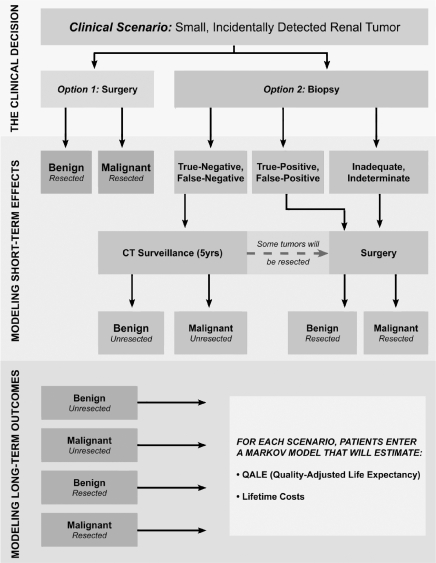
Materials and methods: A decision-analytic Markov model was developed to estimate life expectancy and lifetime costs for patients with small (< or = 4-cm) renal tumors. Two strategies were compared: renal mass biopsy to triage patients to surgery or imaging surveillance and empiric nephron-sparing surgery. The model incorporated biopsy performance, the probability of track seeding with malignant cells, the prevalence and growth of benign and malignant tumors, treatment effectiveness and costs, and patient outcomes. An incremental cost-effectiveness analysis was performed to identify strategy preference under a willingness-to-pay threshold of $75,000 per quality-adjusted life-year (QALY). Effects of changes in key parameters on strategy preference were evaluated in sensitivity analysis.
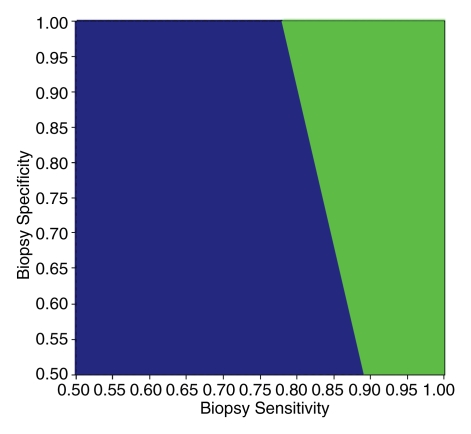
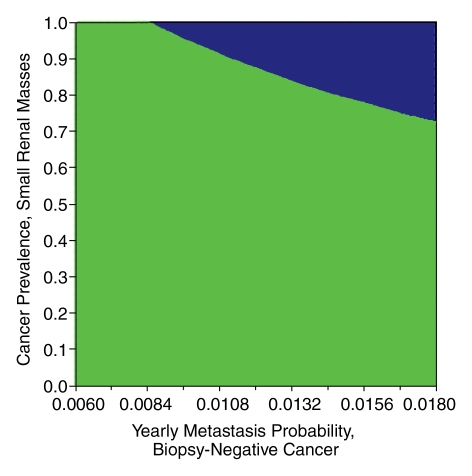
Results: Under base-case assumptions, the biopsy strategy yielded a minimally greater quality-adjusted life expectancy (4 days) than did empiric surgery at a lower lifetime cost ($3466), dominating surgery from a cost-effectiveness perspective. Over the majority of parameter ranges tested in one-way sensitivity analysis, the biopsy strategy dominated surgery or was cost-effective relative to surgery based on a $75,000-per-QALY willingness-to-pay threshold. In two-way sensitivity analysis, surgery yielded greater life expectancy when the prevalence of malignancy and propensity for biopsy-negative cancers to metastasize were both higher than expected or when the sensitivity and specificity of biopsy were both lower than expected.
Conclusion: The use of biopsy to guide treatment decisions for small incidentally detected renal tumors is cost-effective and can prevent unnecessary surgery in many cases.
(c) RSNA 2010.
Conflict of interest statement
See Materials and Methods for pertinent disclosures.
Figures
References
-
- American Cancer Society Cancer facts and figures 2009 Atlanta, Ga: American Cancer Society, 2009
-
- Chow WH, Devesa SS, Warren JL, Fraumeni JF., Jr Rising incidence of renal cell cancer in the United States. JAMA 1999;281(17):1628–1631 - PubMed
-
- Devesa SS, Silverman DT, McLaughlin JK, Brown CC, Connelly RR, Fraumeni JF., Jr Comparison of the descriptive epidemiology of urinary tract cancers. Cancer Causes Control 1990;1(2):133–141 - PubMed
-
- Jayson M, Sanders H. Increased incidence of serendipitously discovered renal cell carcinoma. Urology 1998;51(2):203–205 - PubMed
-
- Hollingsworth JM, Miller DC, Daignault S, Hollenbeck BK. Rising incidence of small renal masses: a need to reassess treatment effect. J Natl Cancer Inst 2006;98(18):1331–1334 - PubMed
MeSH terms
Grants and funding
LinkOut - more resources
Full Text Sources
Medical