


Repeated stress impairs endocannabinoid signaling in the paraventricular nucleus of the hypothalamus
- PMID: 20720126
- PMCID: PMC6633493
- DOI: 10.1523/JNEUROSCI.1046-10.2010
Repeated stress impairs endocannabinoid signaling in the paraventricular nucleus of the hypothalamus
Abstract
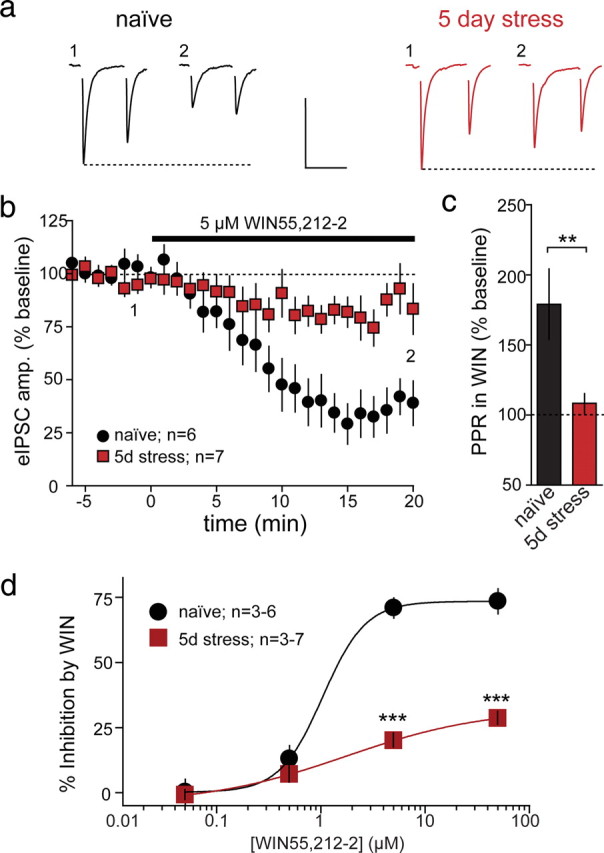
Endocannabinoids (eCBs) are ubiquitous retrograde signaling molecules in the nervous system that are recruited in response to robust neuronal activity or the activation of postsynaptic G-protein-coupled receptors. Physiologically, eCBs have been implicated as important mediators of the stress axis and they may contribute to the rapid feedback inhibition of the hypothalamic-pituitary-adrenal axis (HPA) by circulating corticosteroids (CORTs). Understanding the relationship between stress and eCBs, however, is complicated by observations that eCB signaling is itself sensitive to stress. The mechanisms that link stress to changes in synaptic eCB signaling and the impact of these changes on CORT-mediated negative feedback have not been resolved. Here, we show that repetitive immobilization stress, in juvenile male rats, causes a functional downregulation of CB(1) receptors in the paraventricular nucleus of the hypothalamus (PVN). This loss of CB(1) receptor signaling, which requires the activation of genomic glucocorticoid receptors, impairs both activity and receptor-dependent eCB signaling at GABA and glutamate synapses on parvocellular neuroendocrine cells in PVN. Our results provide a plausible mechanism for how stress can lead to alterations in CORT-mediated negative feedback and may contribute to the development of plasticity of HPA responses.
Figures




References
-
- Avital A, Richter-Levin G. Exposure to juvenile stress exacerbates the behavioural consequences of exposure to stress in the adult rat. Int J Neuropsychopharmacol. 2005;8:163–173. - PubMed
-
- Breivogel CS, Childers SR, Deadwyler SA, Hampson RE, Vogt LJ, Sim-Selley LJ. Chronic delta9-tetrahydrocannabinol treatment produces a time-dependent loss of cannabinoid receptors and cannabinoid receptor-activated G proteins in rat brain. J Neurochem. 1999;73:2447–2459. - PubMed
-
- Cole MA, Kalman BA, Pace TW, Topczewski F, Lowrey MJ, Spencer RL. Selective blockade of the mineralocorticoid receptor impairs hypothalamic-pituitary-adrenal axis expression of habituation. J Neuroendocrinol. 2000;12:1034–1042. - PubMed
-
- Dallman MF. Fast glucocorticoid actions on brain: back to the future. Front Neuroendocrinol. 2005;26:103–108. - PubMed
-
- David DJ, Samuels BA, Rainer Q, Wang JW, Marsteller D, Mendez I, Drew M, Craig DA, Guiard BP, Guilloux JP, Artymyshyn RP, Gardier AM, Gerald C, Antonijevic IA, Leonardo ED, Hen R. Neurogenesis-dependent and -independent effects of fluoxetine in an animal model of anxiety/depression. Neuron. 2009;62:479–493. - PMC - PubMed
Publication types
MeSH terms
Substances
Grants and funding
LinkOut - more resources
Full Text Sources
Medical
