


Two forms of implicit learning in childhood ADHD
- PMID: 20721771
- PMCID: PMC2925298
- DOI: 10.1080/87565641.2010.494750
Two forms of implicit learning in childhood ADHD
Abstract
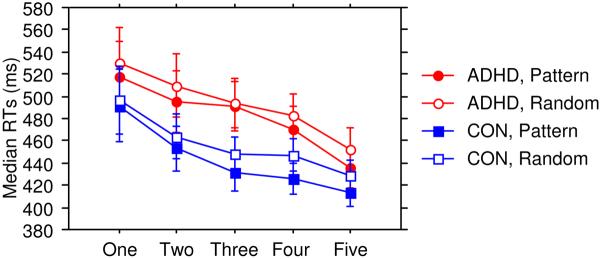
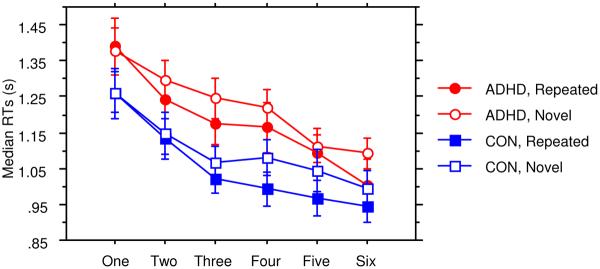
Attention deficit hyperactivity disorder (ADHD) is characterized by inattention, impulsivity, and hyperactivity mediated by frontal-striatal-cerebellar dysfunction. These circuits support implicit learning of perceptual-motor sequences but not visual-spatial context. ADHD and control children performed the Alternating Serial Reaction Time (ASRT) task, a measure of sequence learning, and the Contextual Cueing (CC) task, a measure of spatial contextual learning. Relative to controls, children with ADHD showed inconsistent ASRT learning but did not differ on CC learning. Thus, implicit sequence learning, a cognitive process mediated by frontal-striatal-cerebellar circuitry that is not under executive control, was atypical in ADHD.
Figures
References
-
- Achenbach TM. Manual for the Child Behavior Checklist/4–18 and 1991 Profile. University of Vermont; Burlington: 1991.
-
- Aron AR, Poldrack RA. The cognitive neuroscience of response inhibition: relevance for genetic research in attention-deficit/hyperactivity disorder. Biological Psychiatry. 2005;57:1285–1292. - PubMed
-
- Barkley RA. Attention-Deficit Hyperactivity Disorder: A Handbook for Diagnosis and Treatment. Third ed. The Guilford Press; New York: 2005.
-
- Barkley RA. The Inattentive Type of ADHD As a Distinct Disorder: What Remains To Be Done. Clinical Psychology. 2001;8:489–493.
-
- Barkley RA, Murphy KR, Bush T. Time perception and reproduction in young adults with attention deficit hyperactivity disorder. Neuropsychology. 2001;15:351–360. - PubMed
MeSH terms
Grants and funding
LinkOut - more resources
Full Text Sources
Medical
