


Association between chronic periodontal disease and obesity: a systematic review and meta-analysis
- PMID: 20722533
- PMCID: PMC3187554
- DOI: 10.1902/jop.2010.100321
Association between chronic periodontal disease and obesity: a systematic review and meta-analysis
Abstract
Background: Obesity is increasing in prevalence and is a major contributor to worldwide morbidity. One consequence of obesity might be an increased risk for periodontal disease, although periodontal inflammation might, in turn, exacerbate the metabolic syndrome, of which obesity is one component. This review aims to systematically compile the evidence of an obesity-periodontal disease relationship from epidemiologic studies and to derive a quantitative summary of the association between these disease states.
Methods: Systematic searches of the MEDLINE, SCOPUS, BIOSIS, LILACS, Cochrane Library, and Brazilian Bibliography of Dentistry databases were conducted with the results and characteristics of relevant studies abstracted to standardized forms. A meta-analysis was performed to obtain a summary measure of association.
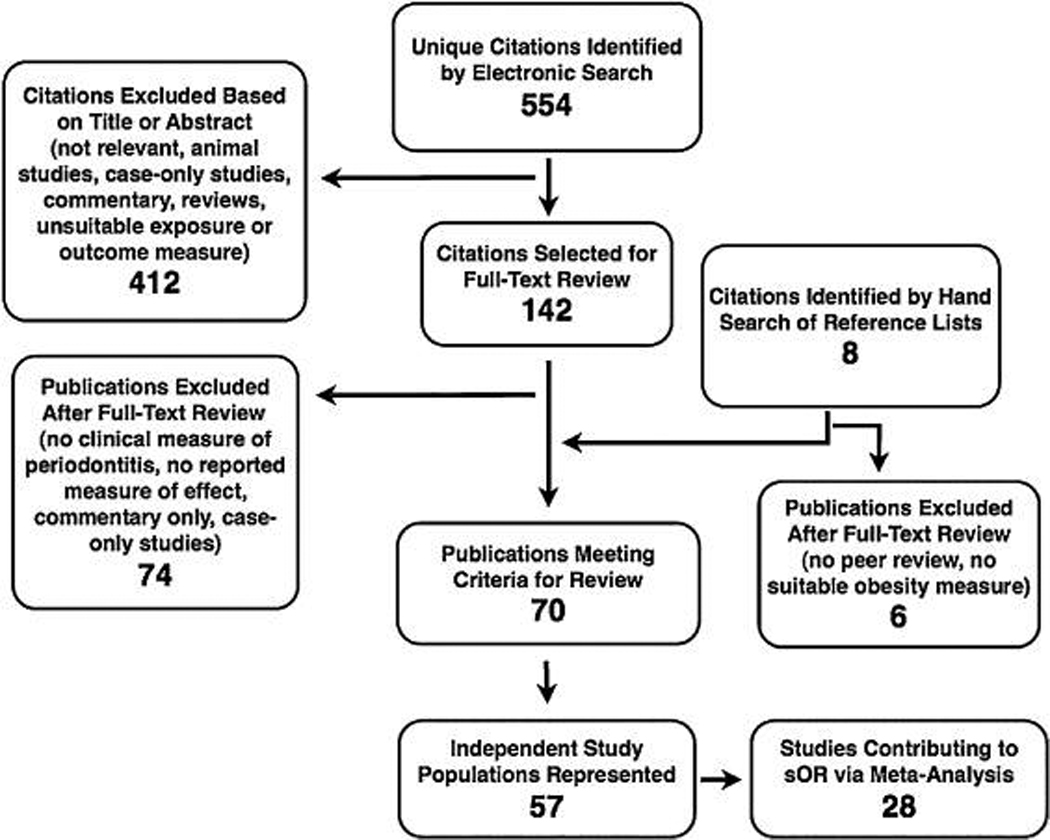
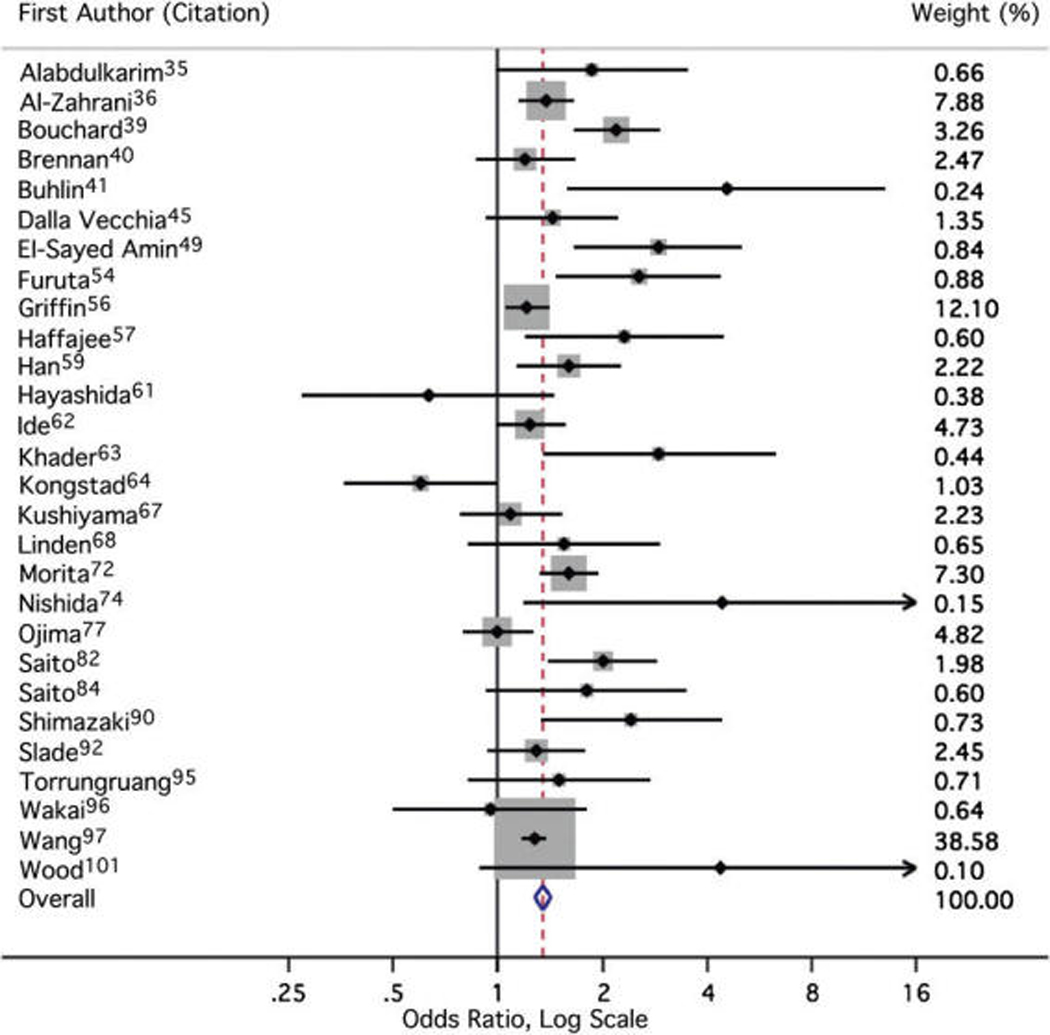
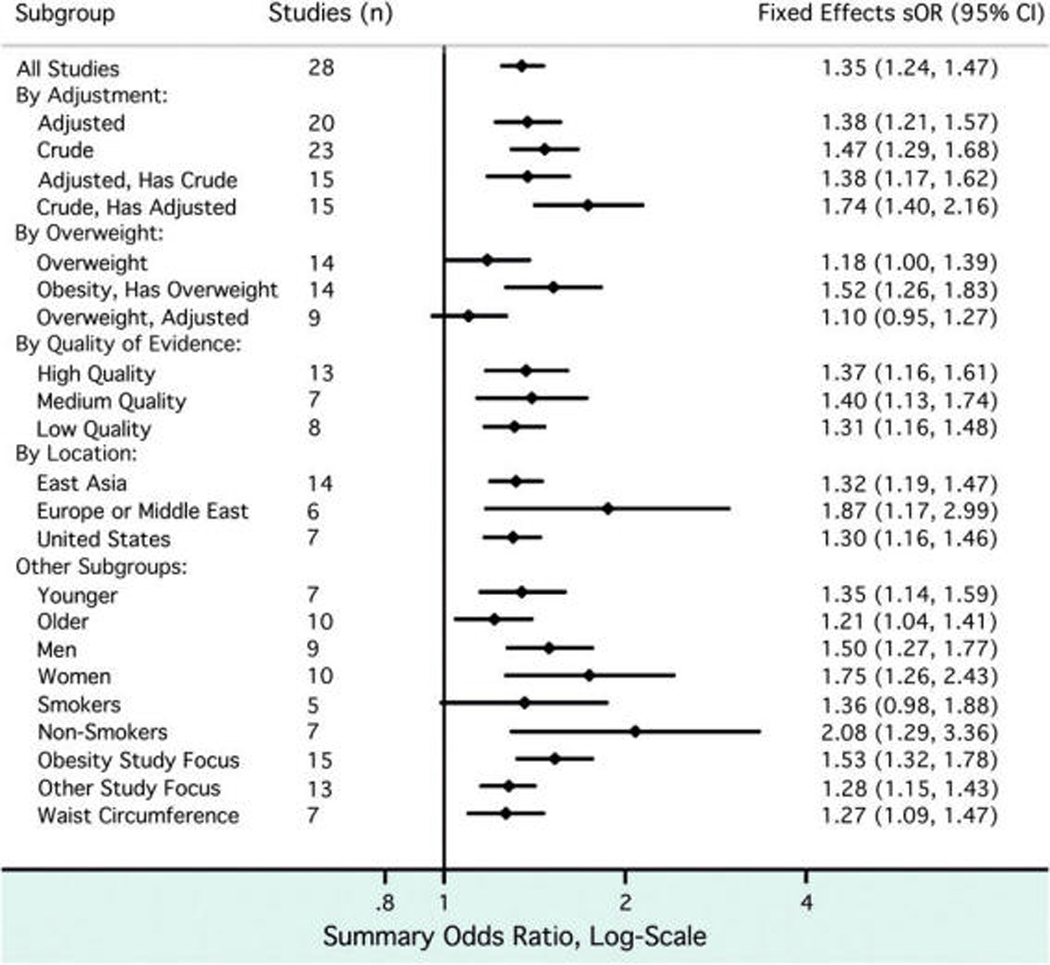
Results: The electronic search identified 554 unique citations, and 70 studies met a priori inclusion criteria, representing 57 independent populations. Nearly all studies matching inclusion criteria were cross-sectional in design with the results of 41 studies suggesting a positive association. The fixed-effects summary odds ratio was 1.35 (Shore-corrected 95% confidence interval: 1.23 to 1.47), with some evidence of a stronger association found among younger adults, women, and non-smokers. Additional summary estimates suggested a greater mean clinical attachment loss among obese individuals, a higher mean body mass index (BMI) among periodontal patients, and a trend of increasing odds of prevalent periodontal disease with increasing BMI. Although these results are highly unlikely to be chance findings, unmeasured confounding had a credible but unknown influence on these estimates.
Conclusions: This positive association was consistent and coherent with a biologically plausible role for obesity in the development of periodontal disease. However, with few quality longitudinal studies, there is an inability to distinguish the temporal ordering of events, thus limiting the evidence that obesity is a risk factor for periodontal disease or that periodontitis might increase the risk of weight gain. In clinical practice, a higher prevalence of periodontal disease should be expected among obese adults.
Conflict of interest statement
The authors report no conflicts of interest related to this review.
Figures
References
-
- World Health Organization. Obesity: Preventing and managing the global epidemic. Report of a WHO consultation. World Health Organ Tech Rep Ser. 2000;894(i–xii):1–253. - PubMed
-
- World Health Organization. Diet, nutrition and the prevention of chronic diseases. World Health Organ Tech Rep Ser. 2003;916(i–viii):1–149. backcover. - PubMed
-
- Socransky SS, Haffajee AD. The bacterial etiology of destructive periodontal disease: Current concepts. J Periodontol. 1992;63 Suppl. 4:322–331. - PubMed
-
- Marsh PD. Microbial ecology of dental plaque and its significance in health and disease. Adv Dent Res. 1994;8:263–271. - PubMed
-
- Pihlstrom BL, Michalowicz BS, Johnson NW. Periodontal diseases. Lancet. 2005;366:1809–1820. - PubMed
Publication types
MeSH terms
Grants and funding
LinkOut - more resources
Full Text Sources
Medical
Miscellaneous
