


Light touch induces ERK activation in superficial dorsal horn neurons after inflammation: involvement of spinal astrocytes and JNK signaling in touch-evoked central sensitization and mechanical allodynia
- PMID: 20722971
- PMCID: PMC2970698
- DOI: 10.1111/j.1471-4159.2010.06946.x
Light touch induces ERK activation in superficial dorsal horn neurons after inflammation: involvement of spinal astrocytes and JNK signaling in touch-evoked central sensitization and mechanical allodynia
Abstract
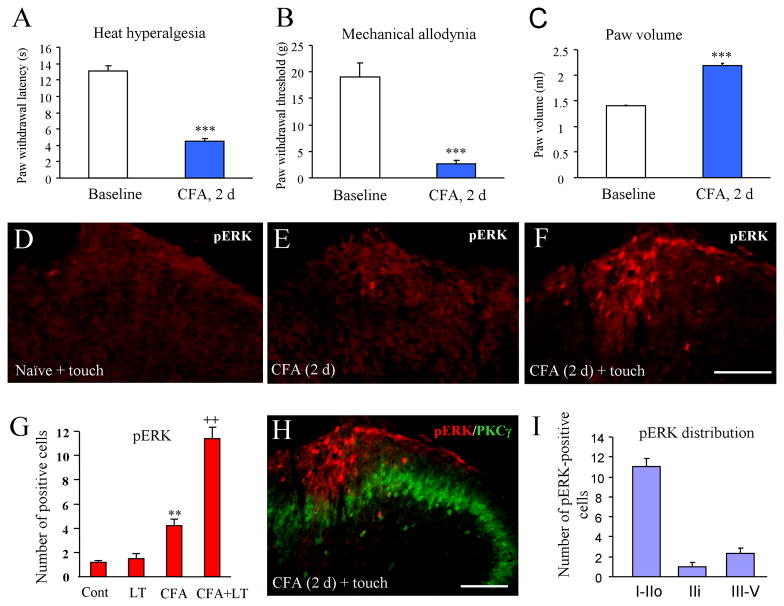
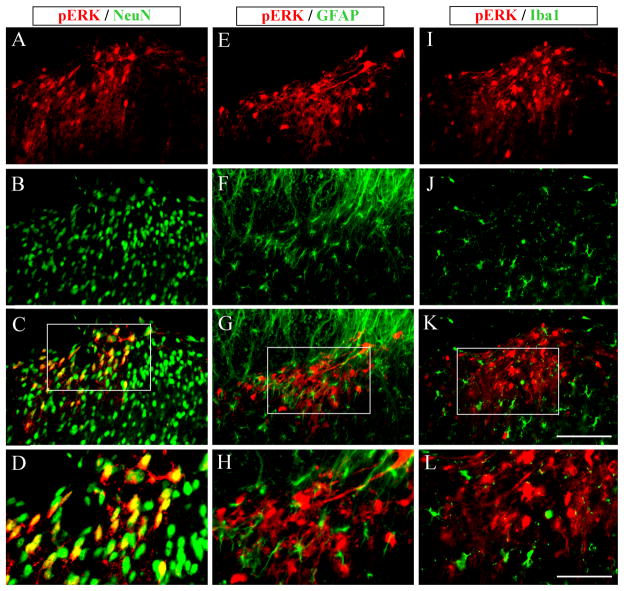
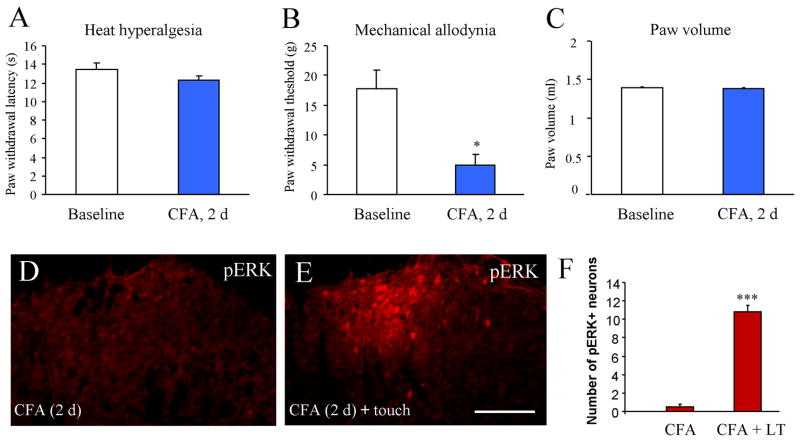
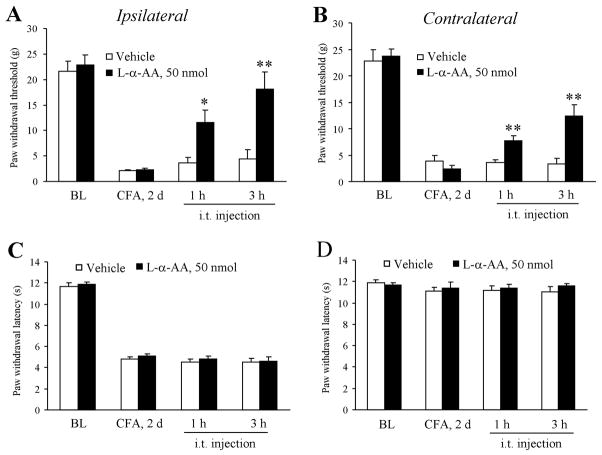
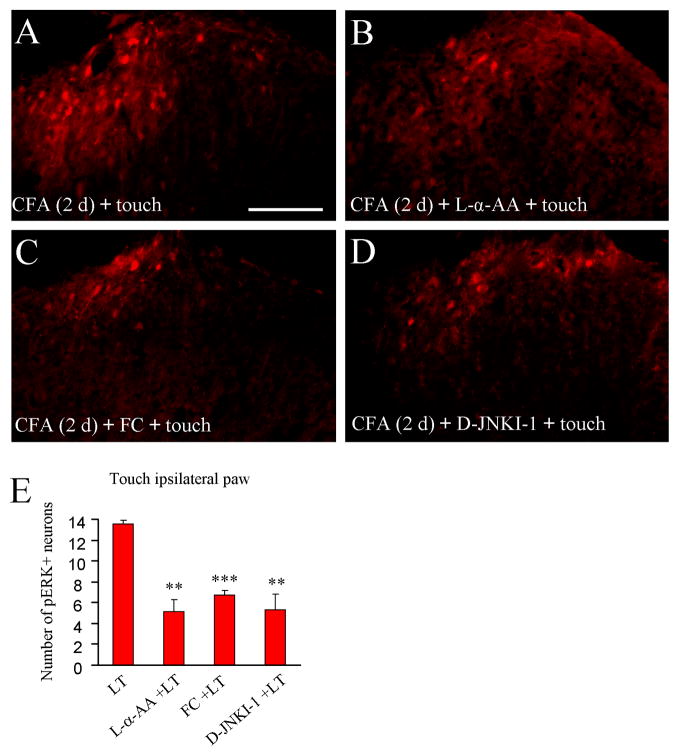
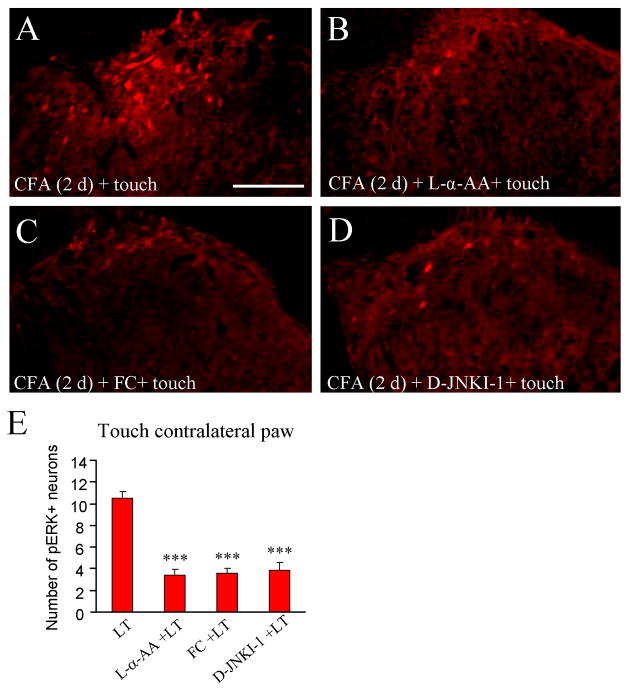
Activation of extracellular signal-regulated kinase (ERK) in spinal cord neurons could serve as a marker for sensitization of dorsal horn neurons in persistent pain. ERK is normally activated by high-threshold noxious stimuli. We investigated how low-threshold mechanical stimuli could activate ERK after complete Freund's adjuvant (CFA)-induced inflammation. Unilateral injection of CFA induced ipsilateral heat hyperalgesia and bilateral mechanical allodynia. CFA-induced ERK activation in ipsilateral dorsal horn neurons declined after 2 days. Interestingly, low-threshold mechanical stimulation given by light touch either on the inflamed paw or the contralateral non-inflamed paw dramatically increased ERK phosphorylation in the dorsal horn ipsilateral to touch stimulation. Notably, light touch induced ERK phosphorylation mainly in superficial neurons in laminae I-IIo. Intrathecal administration of the astroglial toxin L-α-aminoadipate on post-CFA day 2 reversed CFA-induced bilateral mechanical allodynia but not heat hyperalgesia. Furthermore, L-α-aminoadipate, the glial inhibitor fluorocitrate, and a peptide inhibitor of c-Jun N-terminal Kinase all reduced light touch-evoked ERK activation ipsilateral to touch. Collectively, these data suggest that (i) ERK can be activated in superficial dorsal horn neurons by low-threshold mechanical stimulation under pathological condition and (ii) ERK activation by light touch is associated with mechanical allodynia and requires an astrocyte network.
© 2010 The Authors. Journal Compilation © 2010 International Society for Neurochemistry.
Figures
References
-
- Adwanikar H, Karim F, Gereau RWt. Inflammation persistently enhances nocifensive behaviors mediated by spinal group I mGluRs through sustained ERK activation. Pain. 2004;111:125–135. - PubMed
-
- Ambalavanar R, Dessem D, Moutanni A, Yallampalli C, Yallampalli U, Gangula P, Bai G. Muscle inflammation induces a rapid increase in calcitonin gene-related peptide (CGRP) mRNA that temporally relates to CGRP immunoreactivity and nociceptive behavior. Neuroscience. 2006;143:875–884. - PubMed
-
- Baron R. Neuropathic pain: a clinical perspective. Handbook of experimental pharmacology. 2009:3–30. - PubMed
-
- Bertorelli R, Corradini L, Rafiq K, Tupper J, Calo G, Ongini E. Nociceptin and the ORL-1 ligand [Phe1psi (CH2-NH)Gly2]nociceptin(1-13)NH2 exert anti-opioid effects in the Freund’s adjuvant-induced arthritic rat model of chronic pain. British journal of pharmacology. 1999;128:1252–1258. - PMC - PubMed
Publication types
MeSH terms
Substances
Grants and funding
LinkOut - more resources
Full Text Sources
Research Materials
Miscellaneous
