


Association of hypoglycemic symptoms with patients' rating of their health-related quality of life state: a cross sectional study
- PMID: 20723229
- PMCID: PMC2936440
- DOI: 10.1186/1477-7525-8-86
Association of hypoglycemic symptoms with patients' rating of their health-related quality of life state: a cross sectional study
Abstract
Background: To evaluate the association between patient-reported hypoglycemic symptoms with ratings of their health-related quality of life state and patient-reported adverse events in patients with type 2 diabetes mellitus (T2DM).
Methods: This observational, multicenter, cross sectional study was based on a sample of patients with T2DM from seven European countries who added sulfonylurea or thiazolidinedione to metformin monotherapy between January 2001 and January 2006. Included patients were required to have at least one hemoglobin A1c (HbA1c) measurement in the 12 months before enrollment and to not be receiving insulin. Demographic and clinical data from medical records were collected using case report forms. Questionnaires measured patient-reported hypoglycemic symptoms, health-related quality of life (EuroQol visual analogue scale, EQ-5D VAS), and treatment-related adverse events.
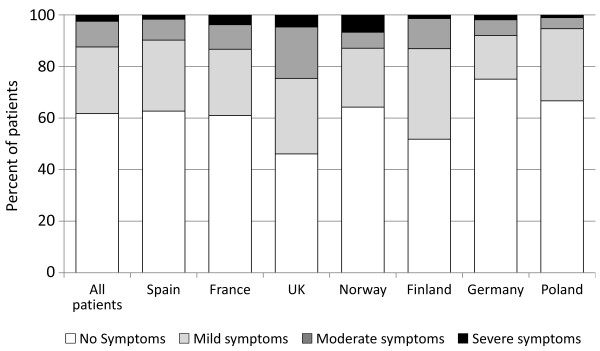
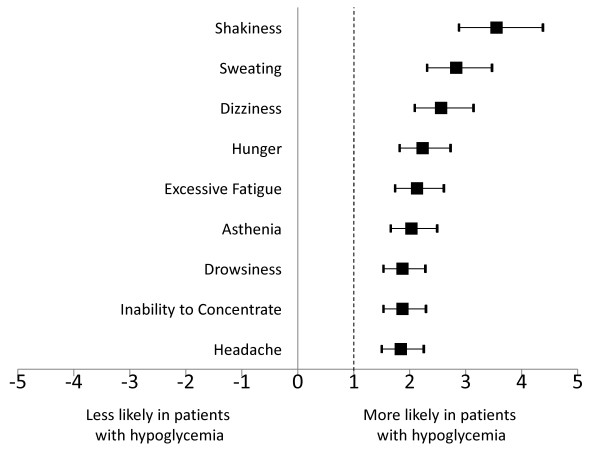
Results: A total of 1,709 patients were included in the study. Mean patient age was 63 years, 45% were female, mean HbA1c was 7.06%, and 28% were at HbA1c goal (HbA1c < 6.5%). Hypoglycemic symptoms during the 12 months before enrollment were reported by 38% of patients; among whom 68% reported their most severe symptoms were mild, 27% moderate, and 5% severe. Adjusted linear regression analyses revealed that patients reporting hypoglycemic symptoms had significantly lower EQ-5D VAS scores indicating worse patient-reported quality of life (mean difference -4.33, p < 0.0001). Relative to those not reporting symptoms, the adjusted decrement to quality of life increased with greater hypoglycemic symptom severity (mild: -2.68, p = 0.0039; moderate: -6.42, p < 0.0001; severe: -16.09, p < 0.0001). Patients with hypoglycemia reported significantly higher rates of shakiness, sweating, excessive fatigue, drowsiness, inability to concentrate, dizziness, hunger, asthenia, and headache (p < 0.0001 for each comparison).
Conclusions: Hypoglycemic symptoms and symptom severity have an adverse effect on patients' rating of their health related quality of life state. Hypoglycemic symptoms are correlated with treatment-related adverse effects. Minimizing the risk and severity of hypoglycemia may improve patients' quality of life and clinical outcomes. Results are subject to limitations associated with observational studies including the potential biases due to unobserved patient heterogeneity and the use of a convenience sample of patients.
Figures
Similar articles
-
Impact of Hypoglycemia on Health-Related Quality of Life among Type 2 Diabetes: A Cross-Sectional Study in Thailand.J Diabetes Res. 2019 Oct 23;2019:5903820. doi: 10.1155/2019/5903820. eCollection 2019. J Diabetes Res. 2019. PMID: 31772942 Free PMC article.
-
Hypoglycaemic symptoms, treatment satisfaction, adherence and their associations with glycaemic goal in patients with type 2 diabetes mellitus: findings from the Real-Life Effectiveness and Care Patterns of Diabetes Management (RECAP-DM) Study.Diabetes Obes Metab. 2008 Jun;10 Suppl 1:25-32. doi: 10.1111/j.1463-1326.2008.00882.x. Diabetes Obes Metab. 2008. PMID: 18435671
-
Outcomes of adding second hypoglycemic drug after metformin monotherapy failure among type 2 diabetes in Hungary.Health Qual Life Outcomes. 2008 Oct 31;6:88. doi: 10.1186/1477-7525-6-88. Health Qual Life Outcomes. 2008. PMID: 18976457 Free PMC article.
-
Glycaemic control among patients with type 2 diabetes mellitus in seven European countries: findings from the Real-Life Effectiveness and Care Patterns of Diabetes Management (RECAP-DM) study.Diabetes Obes Metab. 2008 Jun;10 Suppl 1:8-15. doi: 10.1111/j.1463-1326.2008.00881.x. Diabetes Obes Metab. 2008. PMID: 18435669
-
Repaglinide : a pharmacoeconomic review of its use in type 2 diabetes mellitus.Pharmacoeconomics. 2004;22(6):389-411. doi: 10.2165/00019053-200422060-00005. Pharmacoeconomics. 2004. PMID: 15099124 Review.
Cited by
-
Impact of Hypoglycemia on Health-Related Quality of Life among Type 2 Diabetes: A Cross-Sectional Study in Thailand.J Diabetes Res. 2019 Oct 23;2019:5903820. doi: 10.1155/2019/5903820. eCollection 2019. J Diabetes Res. 2019. PMID: 31772942 Free PMC article.
-
Comorbidity, health-related quality of life and self-care in type 2 diabetes: a cross-sectional study in an outpatient population.Ir J Med Sci. 2015 Sep;184(3):623-30. doi: 10.1007/s11845-014-1190-4. Epub 2014 Aug 29. Ir J Med Sci. 2015. PMID: 25168194
-
Flash Glucose-Sensing Technology as a Replacement for Blood Glucose Monitoring for the Management of Insulin-Treated Type 2 Diabetes: a Multicenter, Open-Label Randomized Controlled Trial.Diabetes Ther. 2017 Feb;8(1):55-73. doi: 10.1007/s13300-016-0223-6. Epub 2016 Dec 20. Diabetes Ther. 2017. PMID: 28000140 Free PMC article.
-
Risk of non-hypoglycemic agents for hypoglycemia-related hospitalization in patients with type 2 diabetes: a large-scale medical receipt database analysis.BMJ Open Diabetes Res Care. 2023 Apr;11(2):e003177. doi: 10.1136/bmjdrc-2022-003177. BMJ Open Diabetes Res Care. 2023. PMID: 37085279 Free PMC article.
-
Health-related quality of life in paediatric patients with Type 1 diabetes mellitus using insulin infusion systems. A systematic review and meta-analysis.PLoS One. 2019 Jun 25;14(6):e0217655. doi: 10.1371/journal.pone.0217655. eCollection 2019. PLoS One. 2019. PMID: 31237873 Free PMC article.
References
Publication types
MeSH terms
LinkOut - more resources
Full Text Sources
Medical
