


Evolutionary lineages of nickel hyperaccumulation and systematics in European Alysseae (Brassicaceae): evidence from nrDNA sequence data
- PMID: 20724306
- PMCID: PMC2958781
- DOI: 10.1093/aob/mcq162
Evolutionary lineages of nickel hyperaccumulation and systematics in European Alysseae (Brassicaceae): evidence from nrDNA sequence data
Abstract
Background and aims: Nickel (Ni) hyperaccumulation is a rare form of physiological specialization shared by a small number of angiosperms growing on ultramafic soils. The evolutionary patterns of this feature among European members of tribe Alysseae (Brassicaceae) are investigated using a phylogenetic approach to assess relationships among Ni hyperaccumulators at the genus, species and below-species level.
Methods: Internal transcribed spacer (ITS) sequences were generated for multiple accessions of Alysseae. Phylogenetic trees were obtained for the genera of the tribe and Alyssum sect. Odontarrhena. All accessions and additional herbarium material were tested for Ni hyperaccumulation with the dimethylglyoxime colorimetric method.
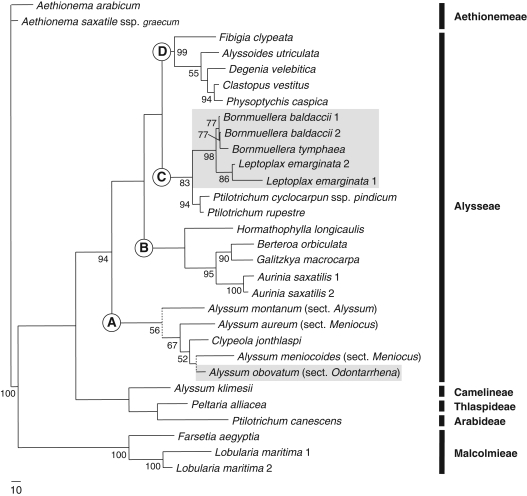
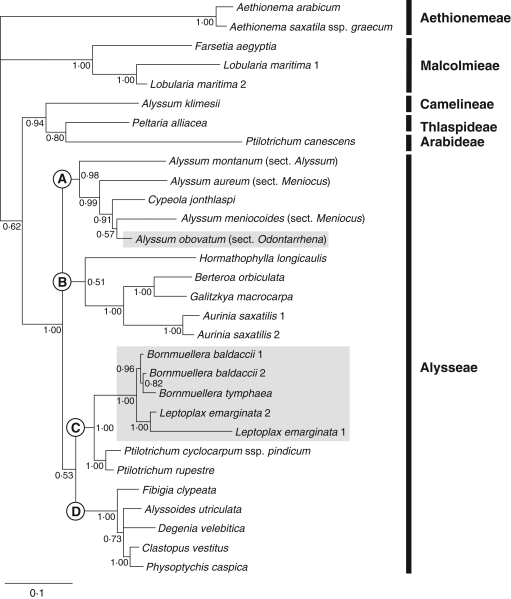
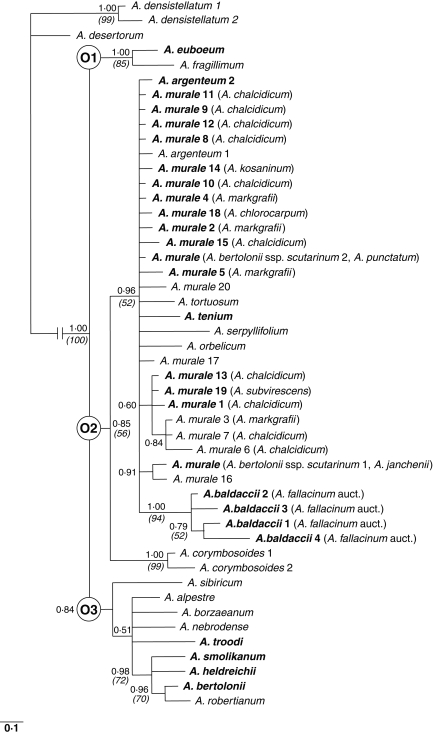
Key results: Molecular data strongly support the poorly known hyperaccumulator endemic Leptoplax (Peltaria) emarginata as sister to hyperaccumulator species of Bornmuellera within Alysseae. This is contrary to current assumptions of affinity between L. emarginata and the non-hyperaccumulator Peltaria in Thlaspideae. The lineage Bornmuellera-Leptoplax is, in turn, sister to the two non-hyperaccumulator Mediterranean endemics Ptilotrichum rupestre and P. cyclocarpum. Low ITS sequence variation was found within the monophyletic Alyssum sect. Odontarrhena and especially in A. murale sensu lato. Nickel hyperaccumulation was not monophyletic in any of three main clades retrieved, each consisting of hyperaccumulators and non-hyperaccumulators of different geographical origin.
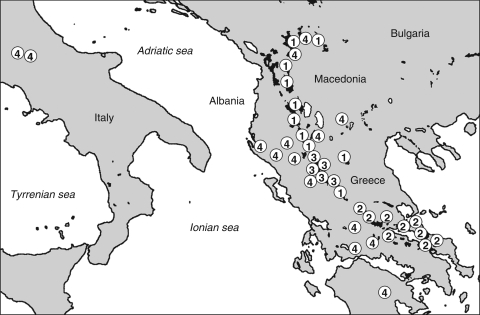
Conclusions: Nickel hyperaccumulation in Alysseae has a double origin, but it did not evolve in Thlaspideae. In Bornmuellera-Leptoplax it represents an early synapomorphy inherited from an ancestor shared with the calcicolous, sister clade of Mediterranean Ptilotrichum. In Alyssum sect. Odontarrhena it has multiple origins even within the three European clades recognized. Lack of geographical cohesion suggests that accumulation ability has been lost or gained over the different serpentine areas of south Europe through independent events of microevolutionary adaptation and selection. Genetic continuity and strong phenotypic plasticity in the A. murale complex call for a reduction of the number of Ni hyperaccumulator taxa formally recognized.
Figures
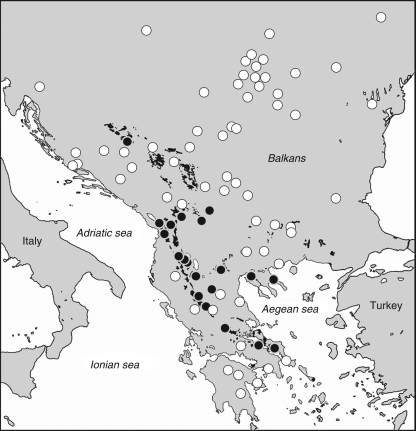
References
-
- Adigüzel N, Reeves RD. A new nickel-accumulating species of Alyssum (Cruciferae) from western Turkey. Edinburgh Journal of Botany. 2002;59:215–219.
-
- Al-Shehbaz IA, Beilstein MA, Kellogg EA. Systematics and phylogeny of the Brassicaceae (Cruciferae): an overview. Plant Systematics and Evolution. 2006;259:89–120.
-
- Appel O, Al-Shehbaz IA. Cruciferae. In: Kubitzki K, Bayer C, editors. The families and genera of vascular plants: V. Flowering plants, dicotyledons: Malvales, Capparales, and non-betalain Caryophyllales. Berlin: Springer; 2003. pp. 75–174.
-
- APG III (Angiosperm Phylogeny Group III) An update of the Angiosperm Phylogeny Group classification for the orders and families of flowering plants: APG III. Botanical Journal of the Linnean Society. 2009;161:105–121.
-
- Assunção AGL, Schat H, Aarts MGM. Thlaspi caerulescens, an attractive model species to study heavy metal hyperaccumulation in plants. New Phytologist. 2003;159:351–360. - PubMed
Publication types
MeSH terms
Substances
LinkOut - more resources
Full Text Sources
Miscellaneous
