


Bioactives in blueberries improve insulin sensitivity in obese, insulin-resistant men and women
- PMID: 20724487
- PMCID: PMC3139238
- DOI: 10.3945/jn.110.125336
Bioactives in blueberries improve insulin sensitivity in obese, insulin-resistant men and women
Abstract
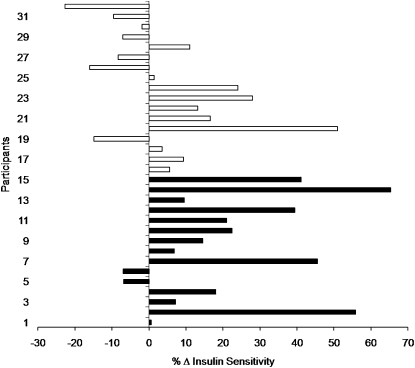
Dietary supplementation with whole blueberries in a preclinical study resulted in a reduction in glucose concentrations over time. We sought to evaluate the effect of daily dietary supplementation with bioactives from blueberries on whole-body insulin sensitivity in men and women. A double-blinded, randomized, and placebo-controlled clinical study design was used. After screening to resolve study eligibility, baseline (wk 0) insulin sensitivity was measured on 32 obese, nondiabetic, and insulin-resistant subjects using a high-dose hyperinsulinemic-euglycemic clamp (insulin infusion of 120 mU(861 pmol)⋅m(-2)⋅min(-1)). Serum inflammatory biomarkers and adiposity were measured at baseline. At the end of the study, insulin sensitivity, inflammatory biomarkers, and adiposity were reassessed. Participants were randomized to consume either a smoothie containing 22.5 g blueberry bioactives (blueberry group, n = 15) or a smoothie of equal nutritional value without added blueberry bioactives (placebo group, n = 17) twice daily for 6 wk. Both groups were instructed to maintain their body weight by reducing ad libitum intake by an amount equal to the energy intake of the smoothies. Participants' body weights were evaluated weekly and 3-d food records were collected at baseline, the middle, and end of the study. The mean change in insulin sensitivity improved more in the blueberry group (1.7 ± 0.5 mg⋅kg FFM(-1)⋅min(-1)) than in the placebo group (0.4 ± 0.4 mg⋅kg FFM(-1)⋅min(-1)) (P = 0.04). Insulin sensitivity was enhanced in the blueberry group at the end of the study without significant changes in adiposity, energy intake, and inflammatory biomarkers. In conclusion, daily dietary supplementation with bioactives from whole blueberries improved insulin sensitivity in obese, nondiabetic, and insulin-resistant participants.
Trial registration: ClinicalTrials.gov NCT01005420.
Conflict of interest statement
Author disclosures: A. J. Stull, K. C. Cash, W. D. Johnson, and C. M. Champagne, no conflicts of interest. W. T. Cefalu received research funds from the United States Highbush Blueberry Council.
Figures

References
-
- Bagchi D, Sen CK, Bagchi M, Atalay M. Anti-angiogenic, antioxidant, and anti-carcinogenic properties of a novel anthocyanin-rich berry extract formula. Biochemistry (Mosc). 2004;69:75–80, 1 p preceding 75 - PubMed
-
- Papandreou MA, Dimakopoulou A, Linardaki ZI, Cordopatis P, Klimis-Zacas D, Margarity M, Lamari FN. Effect of a polyphenol-rich wild blueberry extract on cognitive performance of mice, brain antioxidant markers and acetylcholinesterase activity. Behav Brain Res. 2009;198:352–8 - PubMed
-
- Martineau LC, Couture A, Spoor D, Benhaddou-Andaloussi A, Harris C, Meddah B, Leduc C, Burt A, Vuong T, et al. Anti-diabetic properties of the Canadian lowbush blueberry Vaccinium angustifolium Ait. Phytomedicine. 2006;13:612–23 - PubMed
-
- Vuong T, Martineau LC, Ramassamy C, Matar C, Haddad PS. Fermented Canadian lowbush blueberry juice stimulates glucose uptake and AMP-activated protein kinase in insulin-sensitive cultured muscle cells and adipocytes. Can J Physiol Pharmacol. 2007;85:956–65 - PubMed
Publication types
MeSH terms
Substances
Associated data
Grants and funding
LinkOut - more resources
Full Text Sources
Other Literature Sources
Medical
Research Materials
