


The abundance and activation of mTORC1 regulators in skeletal muscle of neonatal pigs are modulated by insulin, amino acids, and age
- PMID: 20724570
- PMCID: PMC2980373
- DOI: 10.1152/japplphysiol.00428.2010
The abundance and activation of mTORC1 regulators in skeletal muscle of neonatal pigs are modulated by insulin, amino acids, and age
Abstract
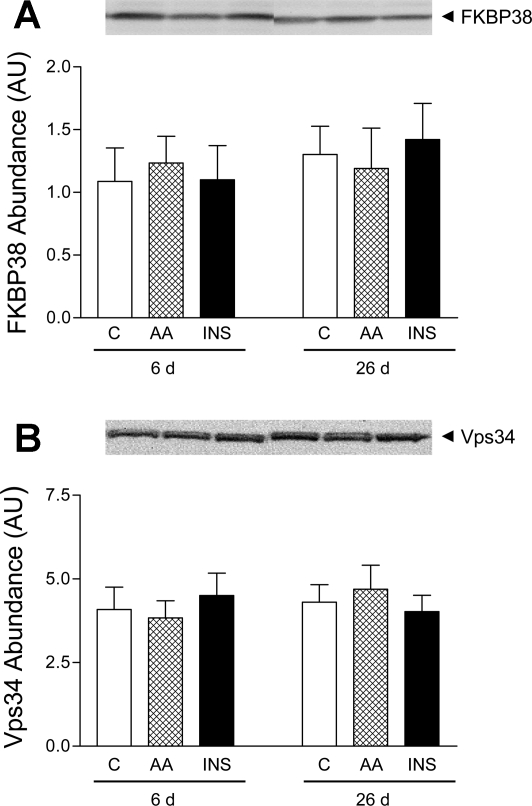
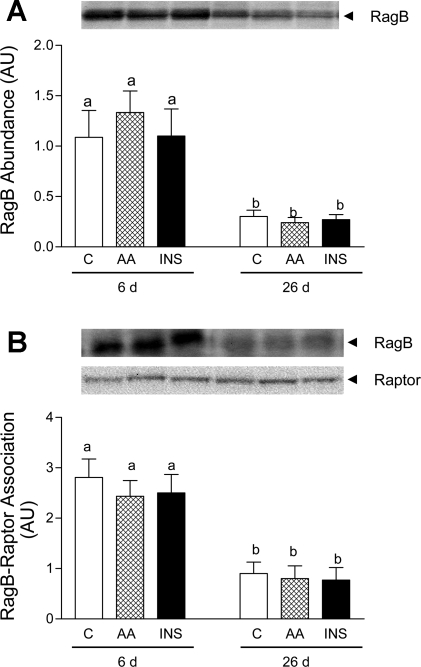
Mammalian target of rapamycin complex 1 (mTORC1) signaling is crucial for the regulation of protein synthesis. Most of known mTORC1 regulators have been isolated and characterized using cell culture systems, and the physiological roles of these regulators have not been fully tested in vivo. Previously we demonstrated that the insulin (INS) and amino acid (AA)-induced activation of mTORC1 is developmentally regulated in skeletal muscle (Suryawan A et al. Am J Physiol Endocrinol Metab 293: E1597-E1605, 2007). The present study aimed to characterize in more detail the effects of the postprandial rise in INS and AA on the activation and abundance of mTORC1 regulators in muscle and how this is modified by development. Overnight fasted 6- and 26-day-old pigs were studied during 1) euinsulinemic-euglycemic-euaminoacidemic conditions (control), 2) euinsulinemic-euglycemic-hyperaminoacidemic clamps (AA), and 3) hyperinsulinemic-euglycemic-euaminoacidemic clamps (INS). INS, but not AA, enhanced the PRAS40 phosphorylation, and this effect was greater in 6- than in 26-day old pigs. Phospholipase D1 (PLD1) abundance and phosphorylation, and the association of PLD1 with Ras homolog enriched in brain (Rheb), were greater in the younger pigs. Neither INS, AA, nor age altered the abundance of Rheb, vacuolar protein sorting 34 (Vps34), or FK506-binding protein 38 (FKBP38). Although INS and AA had no effect, the abundance of ras-related GTP binding B (RagB) and the association of RagB with Raptor were greater in 6- than in 26-day-old pigs. Neither INS, AA, nor age altered AMPK-induced phosphorylation of Raptor. Our results suggest that the enhanced activation of mTORC1 in muscle of neonatal pigs is in part due to regulation by PRAS40, PLD1, and the Rag GTPases.
Figures


References
-
- Arsham AM, Howell JJ, Simon MC. A novel hypoxia-inducible factor-independent hypoxic response regulating mammalian target of rapamycin and its targets. J Biol Chem 278: 29655–29660, 2003 - PubMed
-
- Avruch J, Lin Y, Long X, Murthy S, Ortiz-Vega S. Recent advances in the regulation of the TOR pathway by insulin and nutrients. Curr Opin Clin Nutr Metab Care 8: 67–72, 2005 - PubMed
-
- Backer JM. The regulation and function of Class III PI3Ks: novel roles for Vps34. Biochem J 410: 1–17, 2008 - PubMed
-
- Bai X, Ma D, Liu A, Shen X, Wang QJ, Liu Y, Jiang Y. Rheb activates mTOR by antagonizing its endogenous inhibitor, FKBP38. Science 318: 977–980, 2007 - PubMed
-
- Bradford MM. A rapid and sensitive method for the quantitation of microgram quantities of protein utilizing the principle of protein-dye binding. Anal Biochem 72: 248–254, 1976 - PubMed
Publication types
MeSH terms
Substances
Grants and funding
LinkOut - more resources
Full Text Sources
Medical
Miscellaneous
