. 2010 Nov;25(6):609-16.
doi: 10.1093/mutage/geq048. Epub 2010 Aug 19.

Characterisation of Muta™Mouse λgt10-lacZ transgene: evidence for in vivo rearrangements

Affiliations

Characterisation of Muta™Mouse λgt10-lacZ transgene: evidence for in vivo rearrangements

Philip S Shwed et al. Mutagenesis. 2010 Nov.

Abstract

The multicopy λgt10-lacZ transgene shuttle vector of Muta™Mouse serves as an important tool for genotoxicity studies. Here, we describe a model for λgt10-lacZ transgene molecular structure, based on characterisation of transgenes recovered from animals of our intramural breeding colony. Unique nucleotide sequences of the 47 513 bp monomer are reported with GenBank® assigned accession numbers. Besides defining ancestral mutations of the λgt10 used to construct the transgene and the Muta™Mouse precursor (strain 40.6), we validated the sequence integrity of key λ genes needed for the Escherichia coli host-based mutation reporting assay. Using three polymerase chain reaction (PCR)-based chromosome scanning and cloning strategies, we found five distinct in vivo transgene rearrangements, which were common to both sexes, and involved copy fusions generating ∼10 defective copies per haplotype. The transgene haplotype was estimated by Southern hybridisation and real-time-polymerase chain reaction, which yielded 29.0 ± 4.0 copies based on spleen DNA of Muta™Mouse, and a reconstructed CD2F(1) genome with variable λgt10-lacZ copies. Similar analysis of commercially prepared spleen DNA from Big Blue® mouse yielded a haplotype of 23.5 ± 3.1 copies. The latter DNA is used in calibrating a commercial in vitro packaging kit for E.coli host-based mutation assays of both transgenic systems. The model for λgt10-lacZ transgene organisation, and the PCR-based methods for assessing copy number, integrity and rearrangements, potentially extends the use of Muta™Mouse construct for direct, genomic-type assays that detect the effects of clastogens and aneugens, without depending on an E.coli host, for reporting effects.


Figures
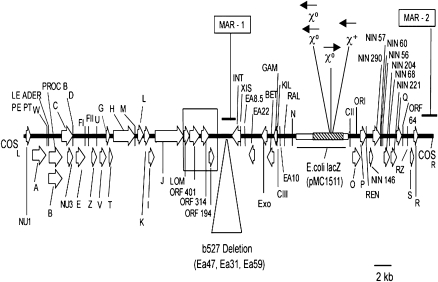
Fig. 1
Fig. 1
Model of the Muta™Mouse λgt10-lacZ transgene derived by sequence analysis. The transgene monomer has 47 513 bp and 57 ORFs and is based on nucleotide sequencing of PCR amplicons derived from systematic scanning of functional regions of λgt10-lacZ using Muta™Mouse genomic DNA from tissues of both gender and λgt10-lacZ in vivo copies rescued by in vitro phage packaging and commercial stocks of λCI857 and λgt10. Data include the b527 deletion and unfinished parts of bacteriophage imm434 (accession numbers M60848, Y00118) and the 5.2 kb EcoR1-DraI fragment of pMC1511, which contains the E.coli lacZ mutation reporter (GenBank® L08935) (hatched-box). The GenBank® accession numbers for sequences other than those reported already for λ (NC_001416; 48.5 kb) are given in Table II. Functional regions included left (COSL) and right (COSR) cohesive ends and ORFs required for virion assembly and DNA packaging and origin of λ DNA replication (ORI). Arrows show orientation of ORFs common to the 48.5 kb λ bacteriophage as identified by λ gene nomenclature (see NC_001416). Novel in vivo copy rearrangements are described in Figure 2 and Table II. The large open box spans a novel finding of a region of substitution by lambdoid Rac prophage tail fiber assembly gene (lom and ORFs 401, 314 and 194) found also in λgt10 and λCI857 commercial stocks. Also identified are crossover hot spot instigator motifs (Chi sites) conveying potential for lacZ recombination with the E.coli genome. The symbol χ+ signifies a fully functional Chi motif (starts at nucleotide position 3508 on the reverse or antistrand with respect to E.coli lacZ (accession J01636). χ0 signifies a one base difference version of the Chi motif that requires a single mutation for full function. These χ0sites start at nucleotide positions 3149 and 3152 for the two on the anti-strand and position 3248 for the one on the sense strand. MAR-1 and MAR-2 show location of sequences identified as matrix-associated regions using a computational approach (15). MAR-1 is located 5′ to the lambda INT gene and MAR-2 is located in the 3′ non-coding λgt-10 region and they represent regions that may contribute to higher order mammalian chromosome loop structures. In a head-to-tail arrangement of transgenes, MAR-2 would be located within 1.4 kb of the COSL site and in the vicinity of rearrangements featured in Figure 2.
Fig. 2
Fig. 2
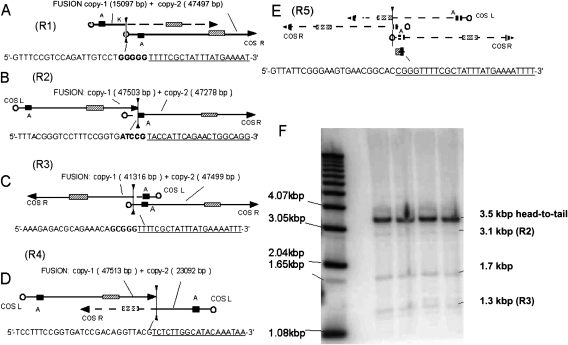
Schematic diagrams illustrating in vivo rearrangements of λgt10-lacZ transgene. Panels (A) through (E) show examples of rearranged λgt10-lacZ copies (R1–R5) that correspond to the rearrangement fragments of <1 kb, initially recovered from genomic DNA of three male and two female Muta™Mouse animals by genome scanning methods (see Materials and methods). Donor sequences (underlined) at the fusion site between copies are shown, along with selected features of the transgene: left (COSL) and right (COSR) cohesive ends, genes A, K and lacZ, shown as a hatched box. Additional sequence data can be accessed through GenBank® (see Table II). PCR primers in each case were selected to amplify the fusion fragment and validate these rearrangements in DNA samples from eight males and eight females (see text). Examples R1–R4 were likely formed by head-to-tail (R1 and R2) and head-to-head (R3 and R4) fusions between adjacent transgene copies and stabilisation by sequence loss (dashed lines). Panel E shows example R5 that is composed of 546 bp of lacZ (nucleotides 3371–3916 accession J01636) fused to 113 bp of the bacteriophage lambda A gene (nucleotides 2328–2441 accession J02459) fused to a partial COSL sequence (nucleotides 15–138 accession J02459) and appears to have originated from a fusion and extensive deletion of as many as three transgene copies. Putative crossover sites, shown as bolded sequences in R1–R3, involve similar sequences (e.g. the R1 dimer fusion occurs between sequence GGGGG (nucleotides 15094–15098) and sequence CGGG (nucleotides 15–18), and the latter sequence is also involved in R3 and R5 fusions). (F) A phospho-image of a Southern blot hybridisation derived from agarose gel fractionated EcoRV digested genomic DNA of four animals probed with a 563 bp amplicon spanning the COSL-Nu1 region. DNA ladder fragment sizes are shown on the left of the panel and estimated EcoRV fragment sizes are shown on the right side. In a head-to-tail arrangement of transgenes, the predicted EcoRV fragment would be sized 3.5 kb. The EcoRV fragment sizes that appear to correspond to particular rearranged transgene copies are shown in brackets.
Fig. 3
Fig. 3
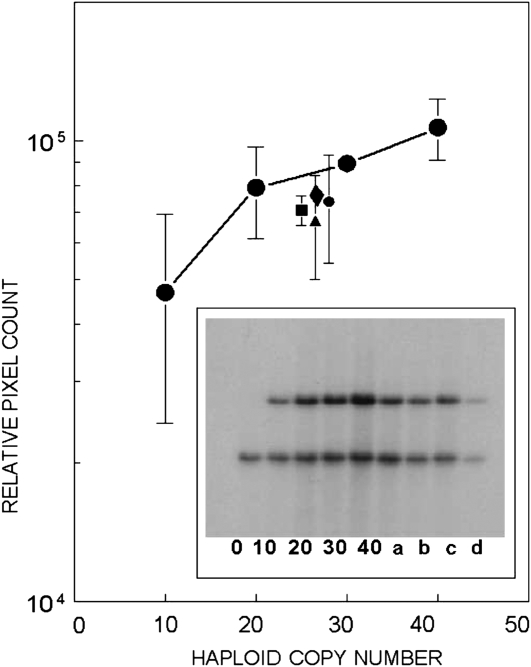
Determination of copy number by Southern blot hybridisation. Copy number was determined by quantifying scanned images (pixel counts) of three Southern hybridisation replicates. An example of the primary results is shown in inset figure, which includes standards made up by using a constant amount of CD2F1 non-transgenic mouse DNA alone (0) or mixed with λgt10-lacZ monomer copies ranging from 10 to 40 per haplotype. Male transgenic DNA samples included: bone marrow (a, closed square); heart (b, closed diamond); lung (c, closed circles) and testis (d, closed triangle). Each DNA sample was BamHI digested, electrophoretically fractionated in 0.8% agarose and transferred to nylon membranes before hybridisation in two steps, first to a 32P-labelled λgt10 ori 501 bp probe (upper band) and then to a 32P-labelled 812 bp mouse 18S probe (lower band).
Fig. 4
Fig. 4
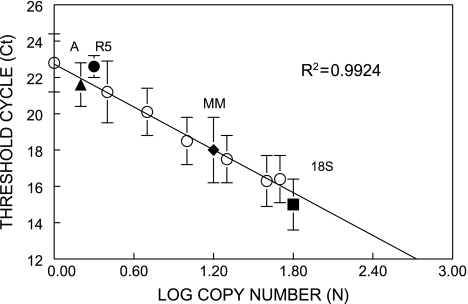
Summary of RT–PCR analysis of in vivo transgene copy number. Standard curves were based on quantifications of the ori amplicons, using replicated sets of template composed of CD2F1 non-transgenic mouse DNA mixed with λgt10-lacZ (see Figure 3 Materials and methods) to generate haploid standards of 1, 2.5, 5, 10, 20, 40 and 50 copies. Cycle thresholds (Ct) and efficiency parameters were obtained by iCycler software and show a linear correlation with log copy number values (R2 = 0.9924). Shown are average Ct values for: ori standards (open circles), single-copy annexin V exon 4 (closed triangle, A); R5 rearrangement (closed circle, R5); interpolated copies of Muta™mouse ori (closed diamond, MM) and 18S (closed box, 18S).

References

    1. Gossen JA, de Leeuw WJ, Tan CH, Zwarthoff EC, Berends F, Lohman PH, Knook DL, Vijg J. Efficient rescue of integrated shuttle vectors from transgenic mice: a model for studying mutations in vivo. Proc. Natl Acad. Sci. USA. 1989;86:7971–7975. - PMC - PubMed
    1. Gossen JA, Vijg J. A selective system for lacZ- phage using a galactose-sensitive E. coli host. Biotechniques. 1993;14:330. - PubMed
    1. Kohler SW, Provost GS, Fieck A, Kretz PL, Bullock WO, Sorge JA, Putman DL, Short JM. Spectra of spontaneous and mutagen-induced mutations in the lacI gene in transgenic mice. Proc. Natl Acad. Sci. USA. 1991;88:7958–7962. - PMC - PubMed
    1. Dycaico MJ, Provost GS, Kretz PL, Ransom SL, Moores JC, Short JM. The use of shuttle vectors for mutation analysis in transgenic mice and rats. Mutat. Res. 1994;307:461–478. - PubMed
    1. Wyborski DL, Malkhosyan S, Moores J, Perucho M, Short JM. Development of a rat cell line containing stably integrated copies of a lambda lacI shuttle vector. Mutat. Res. 1995;334:161–165. - PubMed

Publication types