. 2010 Sep 7;107(36):15933-8.
doi: 10.1073/pnas.1011221107. Epub 2010 Aug 19.

Mas-related G-protein-coupled receptors inhibit pathological pain in mice

Affiliations

Mas-related G-protein-coupled receptors inhibit pathological pain in mice

Yun Guan et al. Proc Natl Acad Sci U S A. .

Abstract

An important objective of pain research is to identify novel drug targets for the treatment of pathological persistent pain states, such as inflammatory and neuropathic pain. Mas-related G-protein-coupled receptors (Mrgprs) represent a large family of orphan receptors specifically expressed in small-diameter nociceptive primary sensory neurons. To determine the roles of Mrgprs in persistent pathological pain states, we exploited a mouse line in which a chromosomal locus spanning 12 Mrgpr genes was deleted (KO). Initial studies indicated that these KO mice show prolonged mechanical- and thermal-pain hypersensitivity after hind-paw inflammation compared with wild-type littermates. Here, we show that this mutation also enhances the windup response of dorsal-horn wide dynamic-range neurons, an electrophysiological model for the triggering of central pain sensitization. Deletion of the Mrgpr cluster also blocked the analgesic effect of intrathecally applied bovine adrenal medulla peptide 8-22 (BAM 8-22), an MrgprC11 agonist, on both inflammatory heat hyperalgesia and neuropathic mechanical allodynia. Spinal application of bovine adrenal medulla peptide 8-22 also significantly attenuated windup in wild-type mice, an effect eliminated in KO mice. These data suggest that members of the Mrgpr family, in particular MrgprC11, may constitute an endogenous inhibitory mechanism for regulating persistent pain in mice. Agonists for these receptors may, therefore, represent a class of antihyperalgesics for treating persistent pain with minimal side effects because of the highly specific expression of their targets.


Conflict of interest statement

The authors declare no conflict of interest.

Figures
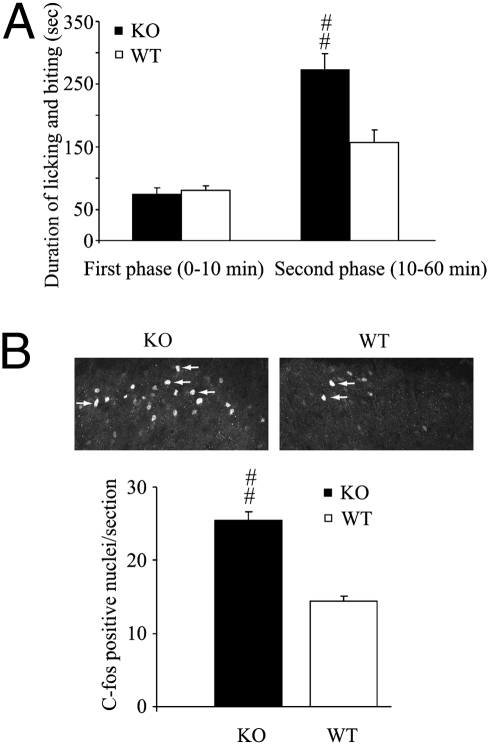
Fig. 1.
Fig. 1.
KO mice display stronger dorsal-horn neuronal activation and enhanced pain responses after intraplantar formalin injection. (A) KO mice expressed enhanced spontaneous pain responses in the second phase of formalin-induced pain but responded normally in the first (acute) phase. (B) Transverse sections of L4–L5 spinal cord from WT and KO mice were stained with anti–c-fos antibody 3 h after intraplantar formalin injection (2%, 5 μL). Ten sections were chosen randomly from each mouse (three mice per genotype). c-fos–positive nuclei are indicated by arrows. KO mice had significantly more c-fos–positive cells than did WT mice, indicating that the KO mice had greater neuronal activation. Data are expressed as mean ± SEM.
Fig. 2.
Fig. 2.
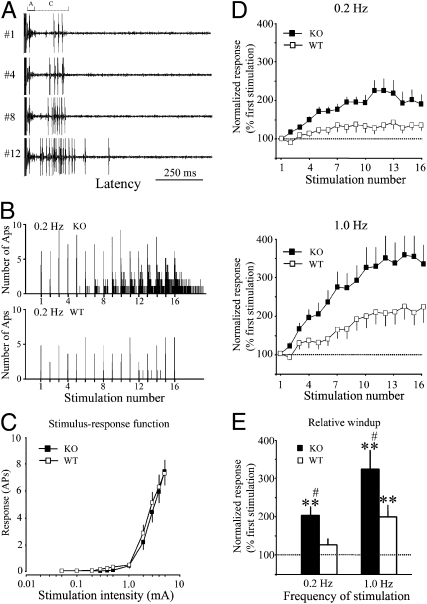
WDR neurons in KO mice display enhanced windup to repetitive C fiber input. (A) A WDR neuron displayed typical A component (0–40 ms) and C component (40–250 ms) responses in response to suprathreshold intracutaneous electrical stimulation. This unit from a KO mouse showed progressive increases in C component (windup) in response to repetitive electrical stimulation of 0.2 Hz (16 pulses, 3.0 mA, 0.5 ms). (B) Histograms show responses of WDR neurons from KO and WT mice to 0.2-Hz stimulation. The KO neuron displayed windup, but the WT neuron did not. Bin size is 50 ms. APs, action potentials. (C) Stimulus-response functions of C components to graded electrical stimuli (0.1–5.0 mA, 2.0 ms) did not differ between WT (n = 23) and KO mice (n = 30). (D) C components of the responses to repetitive windup-inducing electrical stimulation applied at 0.2 Hz and 1.0 Hz in WT and KO mice were plotted against the stimulation number of each trial. (E) The averaged C components of the responses to the last 10 stimuli (7–16) of 0.2- and 1.0-Hz stimulation were significantly higher in KO than WT mice. Windup data are normalized to the response evoked by the first stimulation of each trial. Data are presented as mean ± SEM. **P < 0.01 vs. the input value; #P < 0.05 vs. WT group.
Fig. 3.
Fig. 3.
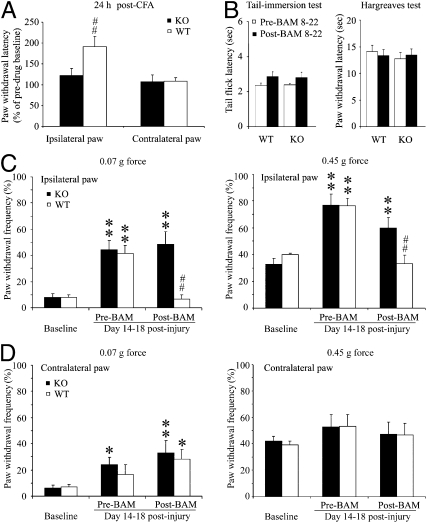
Intrathecal injection of BAM 8–22 inhibits persistent inflammatory pain and neuropathic pain in WT but not KO mice. (A) Intrathecal (i.th.) injection of BAM 8–22 (1 mM, 5 μL) significantly alleviated thermal hyperalgesia in the ipsilateral hind paw 24 h after intraplantar injection of CFA (6 μL, 50%) in WT (n = 12) but not KO mice (n = 10). BAM 8–22 did not affect PWL of the contralateral hind paw in either group. (B) The same dose of BAM 8–22 did not significantly change the tail-flick latency in the tail-immersion test (50 °C) in WT (n = 10) or KO mice (n = 10). In addition, the tail-flick latencies were not significantly different between the two groups at pre- and postdrug conditions. PWL of the contralateral hind paw to radiant heat (Hargreaves test) in the CFA experiment was similar before and after intrathecal BAM 8–22 injection in both groups. (C) BAM 8–22 (0.5 mM, 5 μL, i.th.) also attenuated mechanical-pain hypersensitivity induced by CCI of the sciatic nerve in WT mice but not KO mice. The PWF of the ipsilateral hind paw to low-force (0.07 g) and high-force (0.45 g) punctuate stimulation was significantly increased from the preinjury levels in both KO and WT mice 14–18 d postinjury. BAM 8–22 significantly reduced the PWF of the ipsilateral hind paw in response to low- and high-force stimuli in WT mice (n = 7) but not KO mice (n = 8) after 30 min. (D) BAM 8–22 did not significantly reduce the PWF of the contralateral hind paw in either group. Data are expressed as mean ± SEM. *P < 0.05 and **P < 0.01 vs. preinjury value; ##P < 0.01 vs. predrug value.
Fig. 4.
Fig. 4.
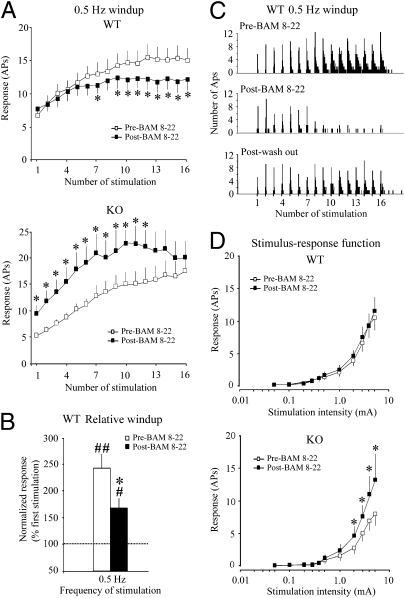
BAM 8–22 inhibits windup in WT mice. (A) The C components of WDR neuronal response to 0.5-Hz stimulation were plotted as a function of stimulus number before and after BAM 8–22 administration. (B) The averaged C component responses for the last 10 stimuli during 0.5-Hz stimulation in WT mice were normalized by the respective response evoked by the first stimulation of each trial (input value). The relative windup in WT mice was significantly decreased by BAM 8–22 compared with the predrug level. Because of a significant increase of input in KO mice after BAM 8–22 treatment, windup data were not normalized. (C) The histograms show an example of the inhibitory effect of BAM 8–22 on the windup of a WDR neuron in WT mice at 0.5-Hz stimulation. The windup response was substantially attenuated 10–30 min after BAM 8–22 application and was partially recovered 10–30 min after saline washout. Bin size is 50 ms. (D) BAM 8–22 (0.1 mM, 30 μL) significantly increased the C component response to graded electrical stimulation at intensities of 2.0–5.0 mA in KO (n = 17) but not WT mice (n = 25) at 10–30 min after spinal topical application. Data are expressed as mean ± SEM. *P < 0.05 and **P < 0.01 vs. the predrug condition; #P < 0.05 vs. the input value.

References

    1. Julius D, Basbaum AI. Molecular mechanisms of nociception. Nature. 2001;413:203–210. - PubMed
    1. Woolf CJ, Salter MW. Neuronal plasticity: Increasing the gain in pain. Science. 2000;288:1765–1769. - PubMed
    1. Costigan M, Scholz J, Woolf CJ. Neuropathic pain: A maladaptive response of the nervous system to damage. Annu Rev Neurosci. 2009;32:1–32. - PMC - PubMed
    1. Baron R. Mechanisms of disease: Neuropathic pain—a clinical perspective. Nat Clin Pract Neurol. 2006;2:95–106. - PubMed
    1. MacPherson RD. New directions in pain management. Drugs Today (Barc) 2002;38:135–145. - PubMed

Publication types

Substances