


Association of metabolic syndrome with development of new-onset diabetes after transplantation
- PMID: 20724958
- PMCID: PMC2959139
- DOI: 10.1097/TP.0b013e3181f1543c
Association of metabolic syndrome with development of new-onset diabetes after transplantation
Abstract
Background: New-onset diabetes after transplantation (NODAT) is a major posttransplant complication associated with lower allograft and recipient survival. Our objective was to determine whether metabolic syndrome pretransplant is independently associated with NODAT development.
Methods: We recruited 640 consecutive incident nondiabetic renal transplant recipients from three academic centers between 1999 and 2004. NODAT was defined as the use of hypoglycemic medication, a random plasma glucose level more than 200 mg/dL, or two fasting glucose levels more than or equal to 126 mg/dL beyond 30 days posttransplant.
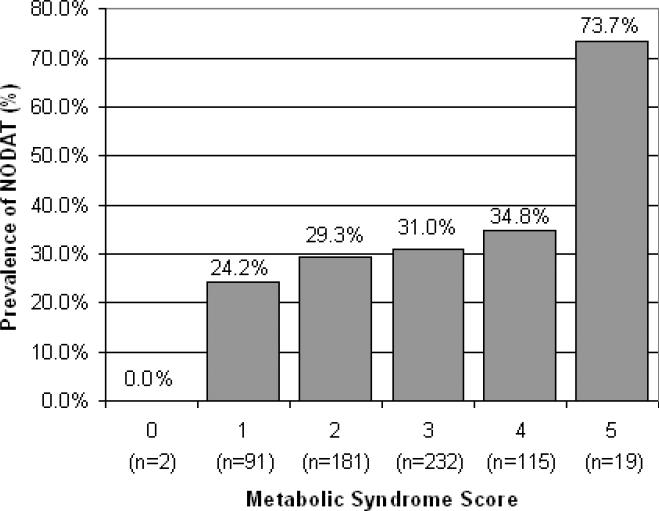
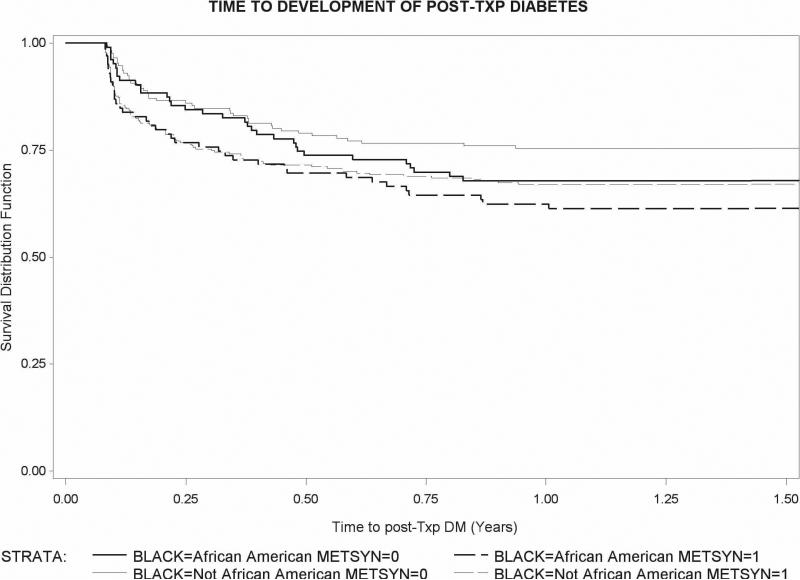
Results: Metabolic syndrome was common pretransplant (57.2%). NODAT developed in 31.4% of recipients 1 year posttransplant. Participants with metabolic syndrome were more likely to develop NODAT compared with recipients without metabolic syndrome (34.4% vs. 27.4%, P=0.057). Recipients with increasing number of positive metabolic syndrome components were more likely to develop NODAT (metabolic syndrome score prevalence at 1 year: 0 components-0.0%, 1-24.2%, 2-29.3%, 3-31.0%, 4-34.8%, and 5-73.7%, P=0.001). After adjustment for demographics, age by decade (hazard ratio [HR] 1.34 [1.20-1.50], P<0.0001), African American race (HR 1.35 [1.01-1.82], P=0.043), cumulative prednisone dosage (HR 1.18 [1.07-1.30], P=0.001), and metabolic syndrome (HR 1.34 [1.00-1.79], P=0.047) were independent predictors of development of NODAT at 1 year posttransplant. In a multivariable analysis incorporating the individual metabolic syndrome components themselves as covariates, the only pretransplant metabolic syndrome component to remain an independent predictor of NODAT was low high-density lipoprotein (hazard ratio [HR] 1.37 [1.01-1.85], P=0.042).
Conclusions: Metabolic syndrome is an independent predictor for NODAT and is a possible target for intervention to prevent NODAT. Future studies to evaluate whether modification of metabolic syndrome factors pretransplant reduces NODAT development are needed.
Figures
Comment in
-
The metabolic syndrome and new-onset diabetes after transplantation: presumed guilty?Transplantation. 2010 Oct 27;90(8):821-2. doi: 10.1097/TP.0b013e3181f1546e. Transplantation. 2010. PMID: 20686442 No abstract available.
-
Metabolic syndrome as a predictor for new-onset diabetes after transplantation--to use or abuse?Transplantation. 2011 Mar 15;91(5):591-2. doi: 10.1097/TP.0b013e31820813ac. Transplantation. 2011. PMID: 21336088 No abstract available.
References
-
- Montori VM, Basu A, Erwin PJ, Velosa JA, Gabriel SE, Kudva YC. Posttransplantation diabetes: a systematic review of the literature. Diabetes Care. 2002;25(3):583. - PubMed
-
- Miles AM, Sumrani N, Horowitz R, et al. Diabetes mellitus after renal transplantation: as deleterious as non-transplant-associated diabetes? Transplantation. 1998;65(3):380. - PubMed
-
- Cosio FG, Pesavento TE, Kim S, Osei K, Henry M, Ferguson RM. Patient survival after renal transplantation: IV. Impact of post-transplant diabetes. Kidney Int. 2002;62(4):1440. - PubMed
-
- Kasiske BL, Snyder JJ, Gilbertson D, Matas AJ. Diabetes mellitus after kidney transplantation in the United States. Am J Transplant. 2003;3(2):178. - PubMed
-
- Fernandez-Fresnedo G, Escallada R, de Francisco AL, et al. Posttransplant diabetes is a cardiovascular risk factor in renal transplant patients. Transplant Proc. 2003;35(2):700. - PubMed
Publication types
MeSH terms
Substances
Grants and funding
LinkOut - more resources
Full Text Sources
Medical
